Portuguese
  Spanish


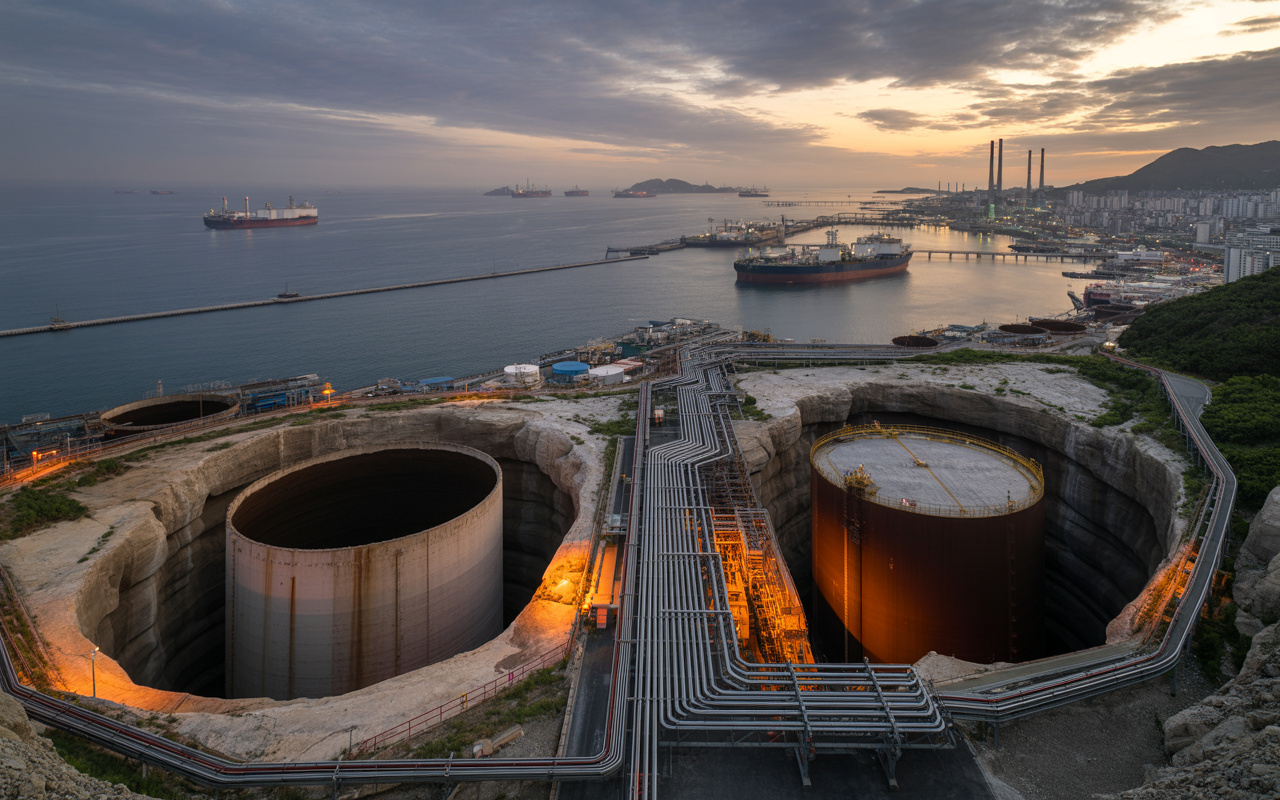


South Korea Uses Industrial Underground Caverns to Store 146 Million Barrels of Oil and Hazardous Cargoes Linked to Ports and Refineries in Ulsan.
According to documents from the Korea National Oil Corporation (KNOC), responsible for the country’s energy strategy, the system of underground industrial caverns for the storage of oil and hazardous cargoes began construction in the early 1980s, during South Korea’s logistical restructuring. The goal was threefold: to increase national strategic reserves, protect flammable substances, and free up limited urban and port space for industry and housing.
The first phase began operating in 1986, and since then new caverns and corridors have been excavated, increasing the total capacity to approximately 146 million barrels of crude oil, derivatives, and liquefied petroleum gas (LPG). For comparison, this volume would be equivalent to more than 7 months of domestic consumption in Korea in the 1980s or more than two fully loaded VLCC supertankers.
Why Store Oil Inside a Mountain?
Unlike other countries such as the United States and China, which store oil in deep saline caverns or aboveground tanks, South Korea has favorable geology for caverns excavated in crystalline rock, especially in the Ulsan region.
-
Oil production grows in Rio, but reserve replacement raises a warning sign

-
Petrobras is expected to complete the drilling of the Morpho well in the Foz do Amazonas in August 2026, the first well in the Equatorial Margin, an oil frontier that the ANP estimates at more than 30 billion barrels and could redraw the map of Brazil.

-
Oil returns to the center of concerns with tension between the US and Iran

-
IEA reduces forecast for global oil demand in 2026 after impacts of the Middle East crisis


This allowed Korean engineers to convert rocky masses near the coast into true underground terminals, directly connected to the sea and the region’s refineries. Storing oil within the rock offers clear advantages:
- Explosion Safety
In case of an accident, the mountain serves as a physical barrier. - Protection Against Military Attacks
Underground tanks withstand bombings much better than exposed tanks. - Urban and Port Relief
Ulsan is one of Asia’s largest petrochemical hubs and already suffers from a lack of space. - Absence of Visual Impact
Energy infrastructure disappears from the surface, freeing the landscape for clean cities and industries.
Caverns Excavated with Mining Engineering and Port Infrastructure
The heart of the system is the set of caverns housing oil in giant underground chambers, some over 100 meters long and dozens of meters wide, all connected by access tunnels, technical corridors, and industrial pipelines. These caverns are not makeshift deposits but planned structures following mining engineering standards:
- Internal Lining to prevent infiltrations
- Pressure and Ventilation Control
- Segregated Piping System
- Gas, Temperature, and Humidity Sensors
- Valve and Pump Rooms
The proximity to the sea allows tankers to load and unload directly using submarine pipelines that reach the underground terminal. On the other side, the land connection takes oil to the refineries in Ulsan, Onsan, and Yeosu, consolidating a petrochemical corridor integrated on a continental scale.
One of the Largest Underground Strategic Reserves on the Planet
The number of 146 million barrels is not arbitrary. It is part of a national strategy that has caught the attention of allied and rival countries. Of the total:
- one part is national stock, for supply emergencies
- another part is commercial stock, leased to buyers such as Japan, the U.S., and IEA members
- and the remainder serves for petrochemical transit, supplying refineries and exports
This hybrid arrangement has transformed Ulsan into an energy hub: oil arrives, is stored, refined, and re-exported. All of this beneath a solid layer of rock, invisible to those passing through the city.
Hazardous Cargoes and the Urban Density Issue
With the growth of Korean cities and the advancement of industrialization from the 1970s onwards, a dilemma emerged: where to place highly hazardous facilities when the country is small, densely populated, and has limited coastal area? Under the cities, Korea found the answer. In addition to Ulsan, the country has built:
- Underground LPG Stations
- Pressurized Depots
- Shielded Chemical Warehouses
All to reduce urban risks and industrial accidents in densely populated areas. According to KNOC itself, this type of underground infrastructure drastically reduces the risk of urban fires and eliminates the need for exclusion zones above ground.
Geopolitics and Energy: A Country Without Oil Became a Petrochemical Power
South Korea has no oil and depends almost 100% on imports. Nevertheless, it has become one of the world’s largest producers of:
- Petrochemical Resins
- Marine Fuels
- Industrial Fertilizers
- Technical Polymers
How? With integrated logistics, giant refineries, and underground terminals like those in Ulsan. Today, the country is home to giants such as:
- SK Energy
- Hyundai Oilbank
- S-OIL
- LG Chem
The result is a fascinating paradox: a country without oil supplying the world with petrochemicals. The underground terminals are a key piece of this puzzle.
Why Almost No One Knows About This Type of Infrastructure?
There are three main reasons:
- It’s Underground There are no “pretty pictures” like offshore platforms or illuminated refineries.
- It Was Not Designed to Be Touristic Its function is technical, defensive, and industrial.
- The World Focuses on Oil in the Middle East, Not Korea
While the global focus is on Saudi Arabia, Iraq, and Iran, few realize that Korea has built a quiet model of energy security.
From Underground to the Future of Energy
With the energy transition underway, structures like the caverns in Ulsan may gain new uses. South Korean experts are already studying the possibility of converting hydrocarbon caverns into:
- Hydrogen Depositories
- Compressed Air Reservoirs
- Strategic CO₂ Storage
In other words, what began for oil can turn into infrastructure for decarbonization. This places the country at the table for the next decade: the underground as a logistical asset.