Portuguese
  Spanish


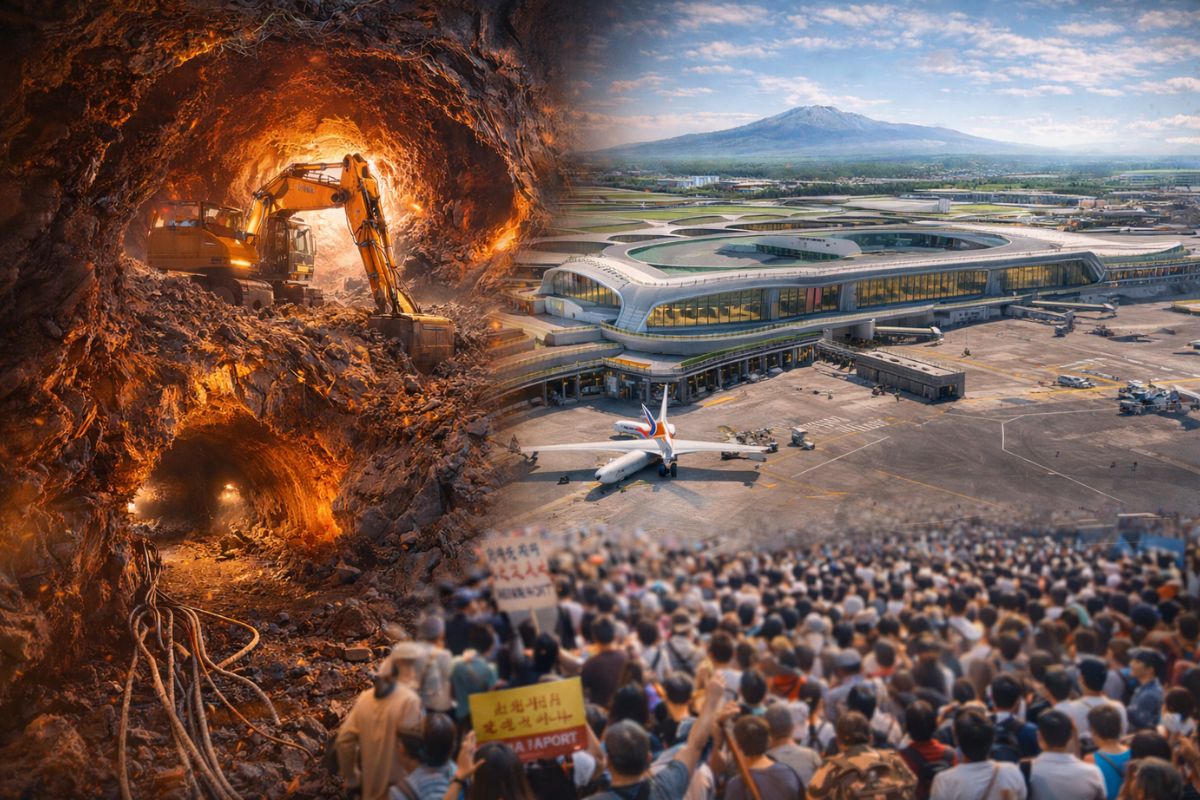

Pressured by the Growth of Tourism in Jeju, South Korea Plans a New Jeju Airport for US$ 4.4 Billion on UNESCO-Recognized Volcanic Island.
In just a few years, Jeju ceased to be a poor and remote island to become the main showcase of South Korean tourism, receiving up to 40 million visitors a year in a territory of just over 1,800 km². Almost all of this flow enters and leaves through a single airport, built in 1968 and currently operating beyond capacity, which led the government to propose a second terminal in another region of the island, with an investment of about 4.4 billion dollars.
However, behind the official narrative of development and strengthening of tourism, the project has raised deep alarms. In Jeju, residents took to the streets, opinion polls showed a divided society, and experts pointed out real geological risks, from lava tunnels beneath the runway to the possibility of losing UNESCO World Natural Heritage status. At the same time, critics fear that the new airport will join the list of ghost airports in South Korea, resulting from demand forecasts that have never materialized.
Jeju: From Poor Island to Symbol of South Korean Tourism

Jeju is the largest island in South Korea, but the smallest province by administrative area, at around 1,846 km². In this relatively small piece of land, the country has concentrated its biggest bet on national tourism.
-
While NATO secured more than $10 billion in missiles and space surveillance at a single forum, Brazil still spends 1.1% of its GDP on defense and is stalling its own anti-aircraft system.

-
Corn ethanol attracts R$ 23 billion in 21 new plants and prepares for a nearly 50% jump in Brazilian production by 2027, even with high interest rates.
-
A newly opened terminal in the middle of the Amazon has begun transporting soy and corn through Amapá, eyeing the queue of ships that is congesting the ports in the South.
-
Tesla injected an additional $250 million into the German factory, doubled the battery cell target, and opened its own production line for startups.


The island is about 130 kilometers from the mainland, far enough to offer a break from industrial routines, but close enough for a flight of less than an hour from Seoul.
The mild climate enhances its vocation for tourism year-round. In summer, temperatures rarely exceed 33 degrees, and in winter, they almost never drop below 10 degrees.
With no extreme cold, almost no heavy snow, no severe heat waves. In addition, the volcanic scenery creates a unique landscape.
The porous, lightweight black basalt appears on roads, stone walls, and tangerine orchards. Residents use these rocks to build walls, gates, and to delineate villages.
You can watch the sunrise at Seongsan Ilchulbong, walk through the ancient forests of Mount Hallasan at noon, spend the afternoon on Jungmun beaches, and end the day with seafood next to the black rocks.
Before the global wave of Korean dramas, Jeju was a poor region used even as an exile place. With productions like Winter Sonata, the island gained visibility, became the backdrop for television romances, and was repositioned as a dream destination for domestic tourism.
When Mass Tourism Drains the Jeju Airport
The effect was swift. In a few years, the number of visitors reached 40 million, more than 20 times the local population.
It’s as if a city the size of Nice or Edinburgh had to accommodate tourism volumes comparable to entire Paris. Most are South Korean tourists on weekend trips, public holidays, and honeymoons.
As Jeju is an island, almost everything enters and exits through a single point: the international airport. Opened in 1968, it was expanded in the 2000s and designed for about 26 million passengers a year.
At the time, it seemed sufficient for a regional airport. But tourism grew faster than any planning.
In 2019, just before the pandemic, Jeju reached a record of 31.3 million passengers, around 5 million above the projected capacity. The airport operated for long periods at approximately 120 percent of capacity.
Although it has two runways, the layout, sea winds, and conflicts on the taxiways rarely allow them to work as an efficient dual system.
In practice, during peak hours, airplanes line up side by side, the taxiways are crowded, and the turnaround time for aircraft is maximized.
Any delays due to bad weather or technical issues trigger a domino effect. At the same time, there is no physical space to expand. On one side, the runway is right up against the sea.
On the other side, the city has grown, surrounding the airport with neighborhoods, hotels, and avenues. There is no free area to extend runways, enlarge taxiways, or build new terminals without encroaching on residential areas.
Second Airport: Relief for Tourism or Risky Bet of 4.4 Billion Dollars

When it became clear that the current airport could not be expanded, South Korea began working on a new airport plan.
The official logic was simple: tourism keeps growing, the airport is at its limit, so it’s necessary to create a second gateway to Jeju.
In 2015, the government announced the selection of a site of approximately 5.5 million square meters in the eastern part of the island, about 40 to 45 kilometers from the existing airport.
The distance was intended to allow both to operate independently, with divided airspace and separate procedures.
On paper, the project is described as compact and functional. A single terminal, with an area between 118,000 and nearly 167,000 square meters, a runway about 3,200 meters long and 45 meters wide, sufficient for the domestic commercial fleet.
The initial capacity would be approximately 17 million passengers per year, with the potential to expand to around 20 million.
The idea is not to turn Jeju into a mega international hub like Incheon, but to create a support airport to split domestic tourism and reduce pressure on the old terminal.
Two separate airports, more space for operations, and breathing room to keep tourism flowing for decades. At least, that is the promise.
Lava Tunnels, UNESCO, and the Invisible Side of Tourism in Jeju

When the government revealed the chosen area, the island became divided. Opinion polls showed that nearly half the population opposed the project.
In some surveys, over 50 percent of respondents rejected the new airport, while just over 40 percent supported it.
But in the eastern part of the island, where the airport would be built, the scenario was reversed, with about two-thirds of residents in favor, looking at jobs, infrastructure, and property value increases.
Beyond the direct impacts of tourism, the most sensitive point was the geological risk. Jeju is a young volcanic island. Mount Hallasan has been quiet for thousands of years but is not classified as extinct.
And the island has more than one volcano. There are over 360 secondary cones, called oreum, scattered throughout the territory, indicating that lava has emerged from many different points.
Even more critical is the underground. Jeju has an extremely dense network of lava tunnels. These tunnels formed when rivers of lava flowed, cooling on the outside and leaving hollow galleries inside.
In many sections, they are just a few meters from the surface. For ordinary houses, this is already a problem. For an airport, it could be potentially disastrous.
A runway requires a continuous and uniform base. Irregular subsidence of a few centimeters could force immediate closure.
Even worse is slow, progressive settlement after years of operation when hundreds of daily flights are already established. And in Jeju’s case, the combination of volcanic island and lava tunnels is not just a natural phenomenon.
Since 2007, the Jeju Volcanic Island and Lava Tubes set has been a UNESCO World Natural Heritage site. The element attracting part of the tourism, paradoxically, is the same element that the new airport could jeopardize.
The area chosen for the terminal is near a volcanic cave system classified as highly sensitive, and for UNESCO, direct destruction is not necessary for there to be a problem. The mere risk already triggers alerts.
In 2023, due to local pressure and scientific concerns, the project was frozen. Not canceled, but suspended until detailed geological studies are completed, focusing on the relationship between the airport, lava tunnels, and heritage status.
Ghost Airports: When Expected Tourism Never Arrives
Even if the new Jeju airport passes all geological and environmental filters, there is another fear surrounding the project: the risk of becoming a ghost airport, like others in South Korea.
The most well-known example is Yangyang International Airport on the east coast. Designed for 3 million passengers per year, it received nearly 400 million dollars in investments and modern infrastructure.
In practice, it faced periods with as few as 26 passengers per day, while around 146 employees continued working. An entire airport almost empty, with silent conveyor belts, stationary panels, and few flights.
A similar case occurred with Muan International Airport in the southwest. Inaugurated with high expectations, it operated in the first years with actual traffic around 3 percent of projected capacity.
When looking at the system as a whole, the picture is even more concerning. South Korea has 14 airports, of which 11 operate at a loss.
A fifteenth project on the east coast had construction suspended even after about 80 percent of the works were completed, precisely due to doubts about the actual need.
For critics in Jeju, this experience should serve as a warning. Building infrastructure for tourism does not guarantee that the flow of tourists will grow on the imagined scale.
There is a risk that the island will gain a second costly, complex airport that, over time, will be underutilized, while problems of overtourism and environmental pressure remain.
A Country Used to Challenging Limits in the Name of Tourism and Infrastructure
South Korea’s willingness to insist on the project is not the result of an isolated impulse. It fits into a historical pattern.
The country has little flat land, steep coasts, and challenging weather. Still, it has built a dense system of roads, railways, and airports.
The most emblematic case is Incheon International Airport. Instead of locating the main air hub on solid ground, the government decided to build it on reclaimed land.
At the time, many feared that the combination of strong waves, typhoons, erosion risks, and immense costs would turn the project into a failure.
The opposite happened. Incheon became one of Asia’s main hubs, serving tens of millions of passengers a year and winning awards for efficiency and quality.
More recently, Korea approved another risky project, the Gadeok Offshore Airport near Busan, designed to serve the industrial region in the southeast, with projections of millions of passengers and hundreds of thousands of tons of cargo for the coming decades.
Like in Jeju, the project faces environmental criticisms, economic doubts, and political disputes, but it continues to be pushed by the state.
For South Korean planners, the message is clear. When the traditional method runs out, the solution is often to change the rules of the game, even if it involves taking high risks in the name of tourism and competitiveness.
Overtourism in Jeju: More Airport or New Tourism Model
Today, Jeju no longer suffers from a lack of tourists. The problem is exactly the opposite. Congested roads, rising property prices, pressure on the environment, and profound changes in residents’ routines are signs of overtourism.
Part of the population believes that the island should not indefinitely expand its tourism capacity but should change strategy.
Instead of always seeking more flights and more visitors, they advocate measures such as redistributing flights throughout the day, creating seasonal entry limits, improving air traffic management, and especially,migrating from massive, low-cost tourism to smaller, but more qualified and sustainable tourism.
In this view, the 4.4 billion dollars for the new airport could be better invested in destination management, environmental protection, internal transport, and policies that raise the average spending per visitor, without inflating the volume of people on the island even further.
The final question, therefore, goes beyond engineering and geology. Does Jeju really need a new airport to sustain its tourism, or does it need a new way to view its own tourist growth?
What do you think, should the island of Jeju invest billions in more tourism infrastructure or should it limit the flow of visitors and focus on a more qualified and sustainable model?