






 Portuguese
  Spanish


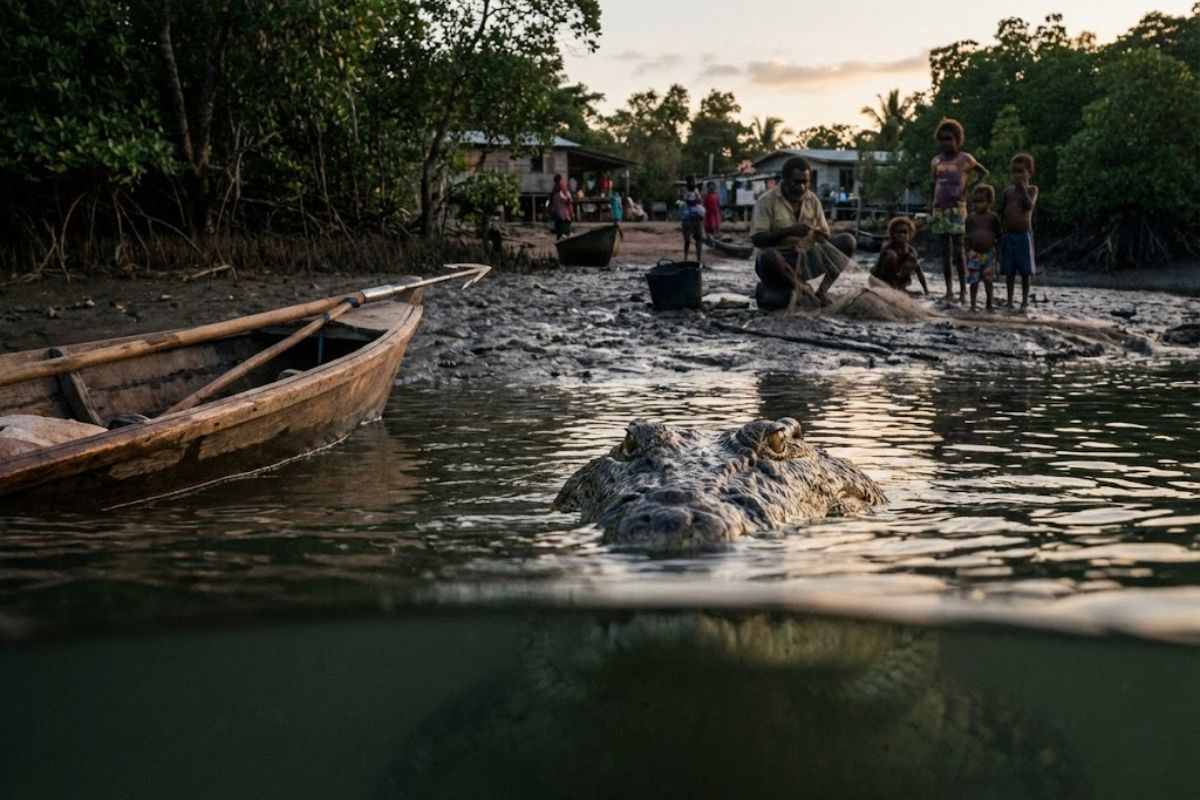


The Saltwater Crocodile Dominates Rivers, Estuaries, and Beaches by Pretending Passivity While Analyzing Human Patterns, Memorizing Schedules, and Choosing the Exact Moment of Attack, Revealing Rare Strategic Intelligence Among Reptiles and Explaining Why Aquatic Areas Turn into Deadly Territories
The saltwater crocodile is not an impulsive predator. In environments where humans routinely circulate, this animal silently observes, studies repeated behaviors, and transforms predictability into a lethal advantage, using memory, patience, and calculation before attacking.
This behavior has been observed in coastal regions, rivers, and areas of both fresh and salt water where the saltwater crocodile coexists with human activities, especially in northern Australia and tropical areas of the Southeast Asia and the Western Pacific.
The Apparent Silence That Hides Constant Vigilance

The immobility of the saltwater crocodile is often interpreted as apathy. In practice, it is active vigilance. With its eyes, nostrils, and ears positioned on top of its head, the animal remains almost fully submerged while monitoring any movement along the shore.
-
Brazilian Innovator Converts Old Car into Electric Vehicle Using Laptop Batteries and Forklift Motor, Achieves Nearly 90 km/h in Urban Settings

-
Samsung Unveils Smart Oven with Built-In Camera, AI Food Recognition, and Real-Time Monitoring via Smartphone.
-
Ocean Transformed into Sci-Fi Lab: 87-Meter Structure with Submarines, Deep-Sea Robots, Helicopter, Genetic Labs, and 8K Cameras Unveils Rare Creatures
-
11-Year-Old Develops Solar Water Purifier to Aid Communities in Kenya and Gambia





This state of prolonged observation allows the saltwater crocodile to identify patterns. Bathing times, fishing routines, washing utensils on the riverbank, and repeated pathways are recorded over days. The absence of an immediate attack does not imply disinterest, but information gathering.
Spatial Memory and Learning Human Routines

Reports of attacks show a recurring pattern. On the first day, the crocodile observes. On the second, it confirms the behavior. On the third or fourth, it positions itself in advance at the ideal point. The attack occurs when the victim believes it is safe precisely because nothing has happened before.
This ability to memorize specific locations, distances, water depths, and human flows transforms the saltwater crocodile into a predator that anticipates movements. The strategy does not rely on prolonged pursuit, but on calculated ambush.
Active Planning and Choosing the Exact Moment

The saltwater crocodile does not react to any stimulus. It chooses the moment when the victim is most vulnerable. Shallow water, distraction, repeated behavior, and proximity to the shore are factors combined before the strike.
The attack is quick and silent. The victim rarely perceives the initial movement. Efficiency comes from planning, not from isolated strength, even though the strength is extreme.
Physical Strength Allied to Strategic Intelligence

In addition to intelligence, the saltwater crocodile possesses extreme physical characteristics. Adult individuals can exceed six meters in length and weigh over 450 kilograms. The largest officially measured specimen reached over six meters in length and more than one ton.
The bite is the strongest ever recorded in a living animal, exceeding 3,700 pounds per square inch. When strategy meets this strength, the chance of escape becomes minimal.
Mobility Between Fresh Water, Salt Water, and Open Ocean
Unlike other reptiles, the saltwater crocodile moves between rivers, mangroves, estuaries, and the open ocean. It can swim hundreds of kilometers out to sea and return to its original territory, drastically expanding its operating area.
This mobility explains why beaches, interior rivers, and coastal areas fall into the risk zone. There is no clear boundary between safe habitat and predator territory.
Body Sensors That Detect Prey Without Vision
Even in murky or dark waters, the saltwater crocodile hunts with precision. This occurs thanks to a network of sensors distributed throughout its skin, capable of detecting minimal vibrations caused by movement in the water.
Ripples imperceptible to humans are sufficient to guide the attack. The animal senses the prey even before seeing it, eliminating the reliance on vision in low-visibility environments.
Extreme Territoriality and Return to Original Location
When removed from a location for posing a risk, the saltwater crocodile often returns to the original territory, even after being transported dozens or hundreds of kilometers. This ability reveals advanced spatial orientation and territorial attachment.
This behavior reinforces the difficulty of managing risk in inhabited areas. Removing the animal does not guarantee that the territory will stop being occupied.
Complex Communication and Little-Known Social Life
Despite the image of a solitary predator, the saltwater crocodile exhibits sophisticated social behaviors. Vocalizations, visual signals, jaw claps, and low-frequency vibrations are part of a communication repertoire used since birth.
Hatchlings vocalize while still in the egg, alerting the mother before hatching. After birth, they remain under protection for months. This parental care is uncommon among reptiles and indicates high behavioral complexity.
Why Rivers and Beaches Turned into Deadly Territories
The combination of strategic intelligence, long-term memory, extreme physical strength, broad mobility, and body sensors makes the saltwater crocodile one of the most dangerous predators to humans.
The risk does not lie only in the presence of the animal, but in human predictability. Fixed routines turn people into calculable targets, while the crocodile adapts its strategy to the observed behavior.
The Human Error That Costs the Most Lives
The most recurrent factor in attacks is repetition. Returning to the same spot, at the same time, for the same activity creates a pattern that is easily exploited. The saltwater crocodile learns quickly and waits patiently.
Breaking routines, avoiding banks, not underestimating periods of apparent calm, and respecting marked areas are attitudes directly linked to survival in regions where this predator operates.
Would you change your daily habits if you knew a saltwater crocodile might be watching, learning, and waiting for the right moment to attack?






It’s true that saltwater/estuarine crocodiles have good memories, because they remember the locations of the same or different hunting areas, even campsites and hiking trails. Not to mention that they know when schools of fish will migrate.
Also, it has been nearly twenty years since Steve Irwin died. So, without Steve, there is no hope for the salties and for the people as well. And with that, people still go into their territory, even if their territory is close to people’s property, which is an outrage – considering that people still come along swimming in their homes, and people shooting them the next. Crocodilians dominate the waters since the age of the dinosaurs (over 200 hundred million years ago) – they arrived here first before we arrived.
Eu nem penso nisto pq quero distância de QQ predador
Eu não ia nem entra nessas águas 😄