






 Portuguese
  Spanish


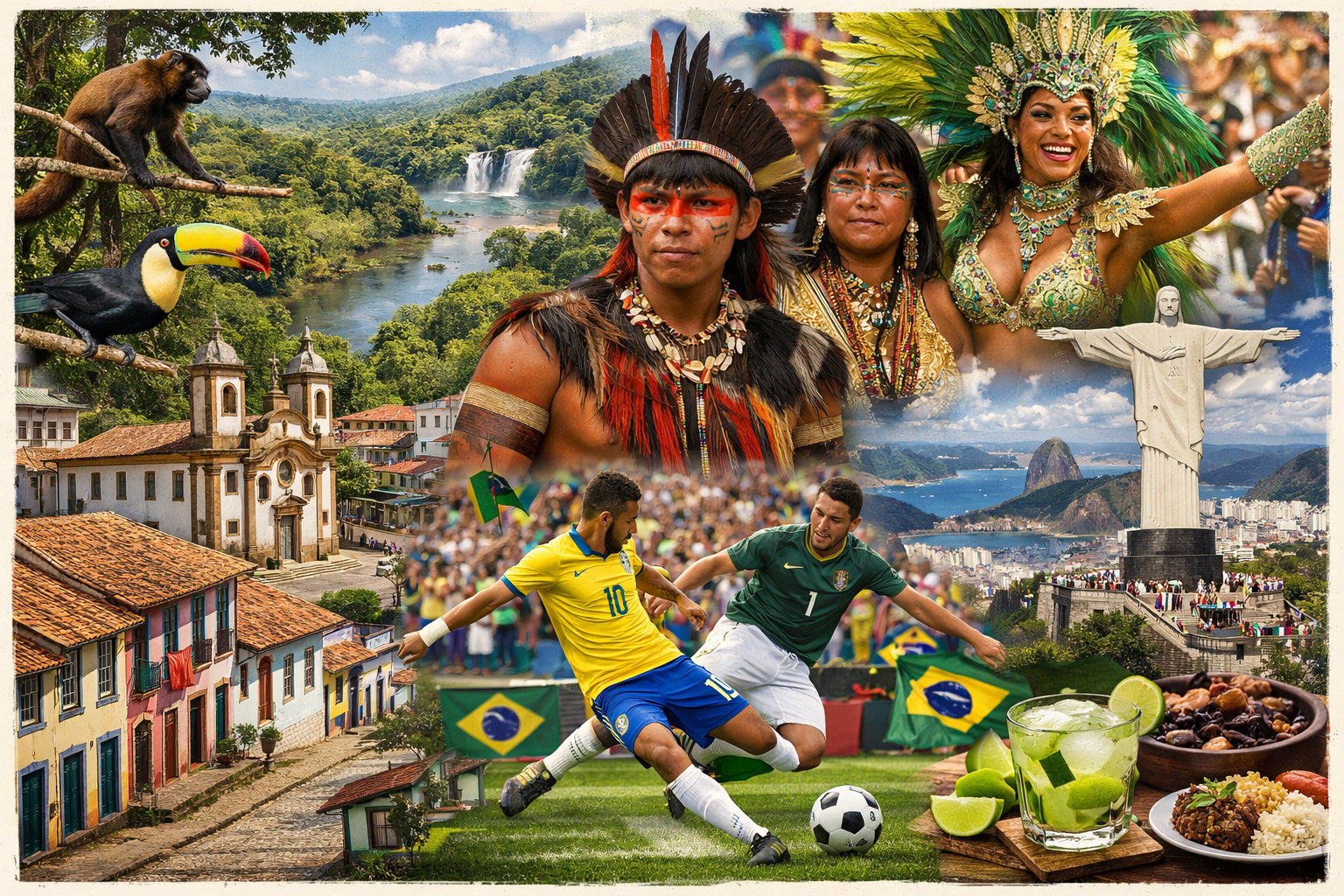


Beyond The Obvious: Numbers, Territory And Diversity Explain Why Brazil Occupies A Unique Position In The Global Scenario, Gathering Geographical Extremes, Incomparable Natural Wealth And A Cultural Formation Without Parallel On The Planet Explain Why The Country Is Unique In The World
Brazil is often remembered for its territorial dimension, football, and Carnival. However, when we analyze the country more closely, we realize that it brings together rare geographical, historical, and cultural characteristics in the world. It is not just about size or population, but a complexity that combines nature, human diversity, and little-known singularities, even to Brazilians themselves.
This information was disclosed by educational portals specialized in geography and history, based on official data from the IBGE, CNPq, IBAMA, and international organizations. These surveys help explain why Brazilian territory occupies a strategic position in the global scenario.
Moreover, understanding these curiosities allows us to see Brazil beyond stereotypes. At the same time, it reveals how natural and historical factors have shaped the current country.
-
Raised in a Family of 16, Mechanic’s Daughter Overcomes Challenges to Become a Leading Female Figure in Brazil’s Automotive Industry

-
Brazilian Sisters, Aged 103, 104, and 109, Set Guinness World Record as Oldest Sibling Trio, Totaling 316 Years; Attract Scientific Interest for Longevity DNA Study
-
14-Year-Old Australian Entrepreneur Goes Viral After Y Combinator Rejection, Runs Two Startups Including an AI Company After Sock Business Failure

-
100-Year-Old Brazilian Sets World Record by Swimming 50 Meters in 1 Minute and 9 Seconds, Inspired by Tarzan Films


Brazilian Geography Brings Together Rare Extremes On The Planet
First of all, Brazil stands out as the largest country in South America. The territory covers 8,510,417 km², which represents about 47.7% of the subcontinent’s surface. This dimension explains the existence of four different time zones, with GMT-3 as the Official Brasília Time.
About 93% of the Brazilian territory is in the Southern Hemisphere. Only 7% is in the Northern Hemisphere. In this context, Macapá stands out for being exactly on the Equator Line, making it the only Brazilian capital located in both hemispheres at the same time.
The country also has four well-defined extreme points. To the north is the source of the Ailã River, in Roraima. To the south, the Arroio Chuí, in Rio Grande do Sul. The easternmost point is at Ponta do Seixas, in Paraíba. The westernmost point is at the source of the Moa River, in Acre.
The maximum distance within Brazil reaches 4,378.41 km from north to south and 4,326.63 km from east to west. Furthermore, the country has the 15th longest coastline in the world, with 7,491 kilometers bathed by the Atlantic Ocean.
Despite the large territorial extension, the Brazilian relief is considered modest in altitude. Most of the territory is between 200 and 600 meters above sea level. Although there are elevated peaks, such as Pico da Neblina, at 2,995.3 meters, Brazil does not have young mountain ranges.
Brazilian Biodiversity Places The Country At The Global Top

Next, the Brazilian natural wealth stands out clearly. The country is home to six major biomes: Amazon, Cerrado, Caatinga, Atlantic Forest, Pantanal, and Pampa. This environmental diversity sustains the title of the most megadiverse country on the planet.
About 20% of all global biodiversity is found in Brazilian territory. The fauna comprises approximately 100,000 species of animals. The cataloged flora totals 46,975 species of plants, algae, and fungi.
The Amazon Rainforest occupies 61.8% of its area within Brazil. It is the largest equatorial forest in the world and houses a significant portion of global biodiversity. Furthermore, the country concentrates most of the Amazon River, considered the longest and most voluminous river on the planet, with a length of 6,992 km.
These factors place Brazil at the center of global debates on climate, environmental preservation, and sustainability.
History, Population, And Culture Reinforce Brazilian Diversity
From a human perspective, Brazil has 203,080,756 inhabitants, according to the 2022 Census by IBGE. This number represents about 2.5% of the global population. Ethnic diversity also stands out: 45.3% of the population identifies as brown, 43.5% white, and 10.2% black.
The country is home to 267 different indigenous peoples, totaling over 1.2 million people. Administratively, the territory is divided into 5,586 municipalities. São Paulo is the most populous city, with 11,451,999 inhabitants, while Serra da Saudade, in Minas Gerais, has only 833 residents.
São Vicente, on the São Paulo coast, is recognized as the oldest city in Brazil. It was founded in 1531. Tocantins is the youngest state, officially created in 1989. Salvador was the country’s first capital, followed by Rio de Janeiro, until Brasília was inaugurated in 1960.
Culturally, Brazil stands out for its own musical genres, such as samba, bossa nova, and MPB. Carnival is the biggest popular festival in the country and significantly boosts the economy. In sports, football has solidified Brazil’s international image as the only country to win five World Cup titles.
Which of these curiosities about Brazil surprised you the most — and do you think Brazilians themselves know their country as well as they should?


