Portuguese
  Spanish


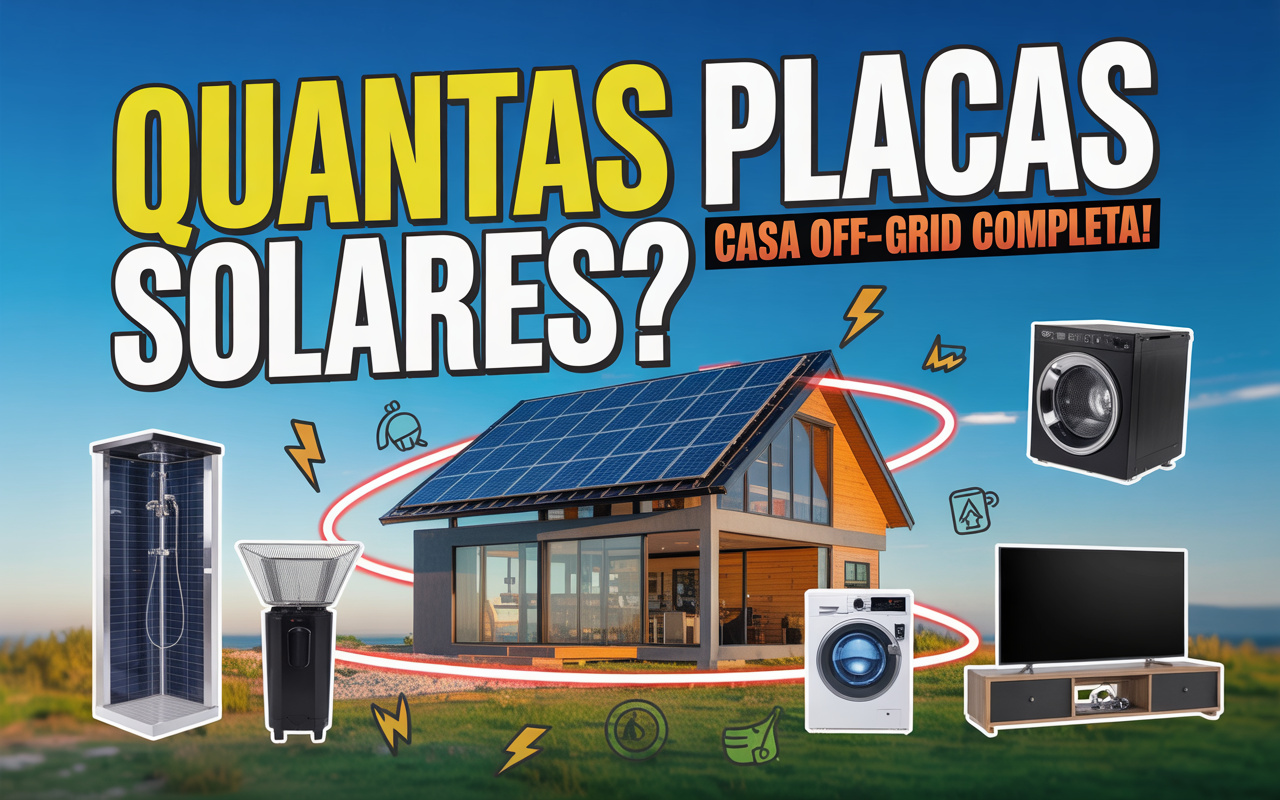


Is It Possible to Live Off-Grid with Electric Shower, Air Fryer, and Washing Machine? Real Calculations Show How Many Solar Panels and Batteries Would Be Needed.
Setting up a truly off-grid house without a utility company, without power lines, and without a battery “hack” is a challenge that is decided by math, not marketing. And the question that always comes up is the same: can you use an electric shower, air fryer, washing machine, and TV just with solar panels? The answer is: it is possible, but the number of panels and batteries in the real world tends to surprise those who imagine total autonomy with a simple kit.
To calculate the minimum size of a system, we use real power ratings from the Brazilian market and an average irradiation of 5.5 kWh/m²/day, typical of the Southeast/Central-West region. We consider 550 Wp modules, common in current retail.
How Much Energy Does Each Appliance Require from Solar?

First Step: Understand the daily consumption of these four appliances in realistic home use.
-
Solar energy reaches 55 GW, becoming the second largest power source in Brazil’s energy mix

-
Solar energy can increase property value by up to 10% and become a selling point.
-
Solar and wind energy surpass natural gas for the first time in the world and accelerate energy revolution

-
Africa has about 500,000 cell towers and most still burn diesel to operate, while companies rush to cover antennas with solar energy and avoid signal blackouts.


Usual Values:
| Equipment | Power | Typical Daily Use | Daily Consumption |
|---|---|---|---|
| Electric Shower 5,500 W | 5,500 W | 20 min/day (0.33 h) | 1.81 kWh |
| Air Fryer 1,500 W | 1,500 W | 30 min/day (0.5 h) | 0.75 kWh |
| Washing Machine 800 W | 800 W | 1 cycle/day (1 h) | 0.80 kWh |
| LED TV 42″ 120 W | 120 W | 4 h/day | 0.48 kWh |
Adding just these four:
Daily Consumption = 1.81 + 0.75 + 0.80 + 0.48 ≈ 3.84 kWh/day
This number does not yet include refrigerator, lighting, router, laptop, fan, or air conditioning, which in off-grid homes tend to weigh more than the TV.
How Many Solar Panels Would Be Needed Just for Them?
One 550 Wp panel generates, on average:
550 Wp × 5.5 h = ~3.025 kWh/day per panel
Now we divide:
3.84 kWh/day ÷ 3.025 kWh/day ≈ 1.27 panels
Rounding up:
➡ 2 panels of 550 Wp
cover only these 4 appliances (without batteries and without losses)
But that’s just half the story, because:
Off-Grid ≠ Just Generate Energy, It’s Store Energy
If the house is truly off-grid, it needs to operate at night, and the problem arises in two fronts:
1) power peak
The electric shower pulls 5,500 W instantaneously.
The air fryer pulls 1,500 W.
If someone turns on the shower + air fryer together, that’s 7,000 W.
This requires:
✔ large inverter, usually 8,000 W to 10,000 W, to avoid shutting down.
2) storage
To store 3.84 kWh/day + losses, approximately:
5 kWh usable of LFP battery
But here comes another trap: the shower drains the battery very quickly. A 20-minute shower consumes 1.81 kWh, which is more than 36% of a 5 kWh battery.
That’s why, in 99% of off-grid projects in Brazil, the electric shower is replaced by:
✔ gas heating, or
✔ solar thermal (panels that heat water, not energy)
When the user insists on keeping the electric shower off-grid, the system scales up:
How Would an Off-Grid System Look with These 4 Appliances Operating 365 Days a Year
Conservative scenario for daily use:
✔ 2 panels of 550 Wp are not enough ⇒ we use 3 panels to compensate for clouds, losses, and seasonality.
Minimum system:
- 3 panels of 550 Wp (1.65 kWp)
- 8 kW inverter (for shower)
- LFP battery 10 kWh (to sustain shower + air fryer)
Even so, it is not comfortable. And here’s the reason:
A single 20-minute shower consumes ≈ 18% of the 10 kWh battery.
Two showers already use almost 36%.
The air fryer + washing machine + TV consume more 2 kWh throughout the day.
In the end, the battery can drop to 30%, which reduces lifespan.
And When We Add the Rest of the House?
A real off-grid house still needs:
- refrigerator (1.2 to 1.8 kWh/day)
- lighting (0.3 kWh/day)
- internet/router (0.2 kWh/day)
- laptop (0.2 to 0.4 kWh/day)
- fan (0.5 kWh/day)
Summing up the basic package:
Minimum home package ≈ 2.5 to 3 kWh/day
Now we add everything:
3.84 kWh (4 appliances) + 2.8 kWh (home) ≈ 6.6 kWh/day
Needed panels:
6.6 ÷ 3.025 ≈ 2.18 panels → 3 panels (without losses) → 4 panels (with losses)
In other words:
➡ Off-grid house with electric shower = 4 panels + 10 kWh battery + 8 kW inverter
➡ Off-grid house without electric shower = 2 to 3 panels + 5 kWh battery + 3 kW inverter
Yes, it is possible to live off-grid with electric shower, air fryer, washing machine, and TV, but that requires:
✔ enough panels to generate,
✔ enough batteries to store,
✔ robust inverter for peaks,
✔ and a project based on real consumption, not assumption.
The bottleneck is not the TV; it is the shower, which turns the system from “compact and cheap” to “large, expensive, and heavy”.
That’s why, in the field, installers recommend:
- electric shower → gas or solar thermal
- air fryer → ok
- washing machine → ok with planning
- TV → irrelevant in the balance
When the shower is removed from the equation, the off-grid system becomes something much more reasonable.