Portuguese
  Spanish


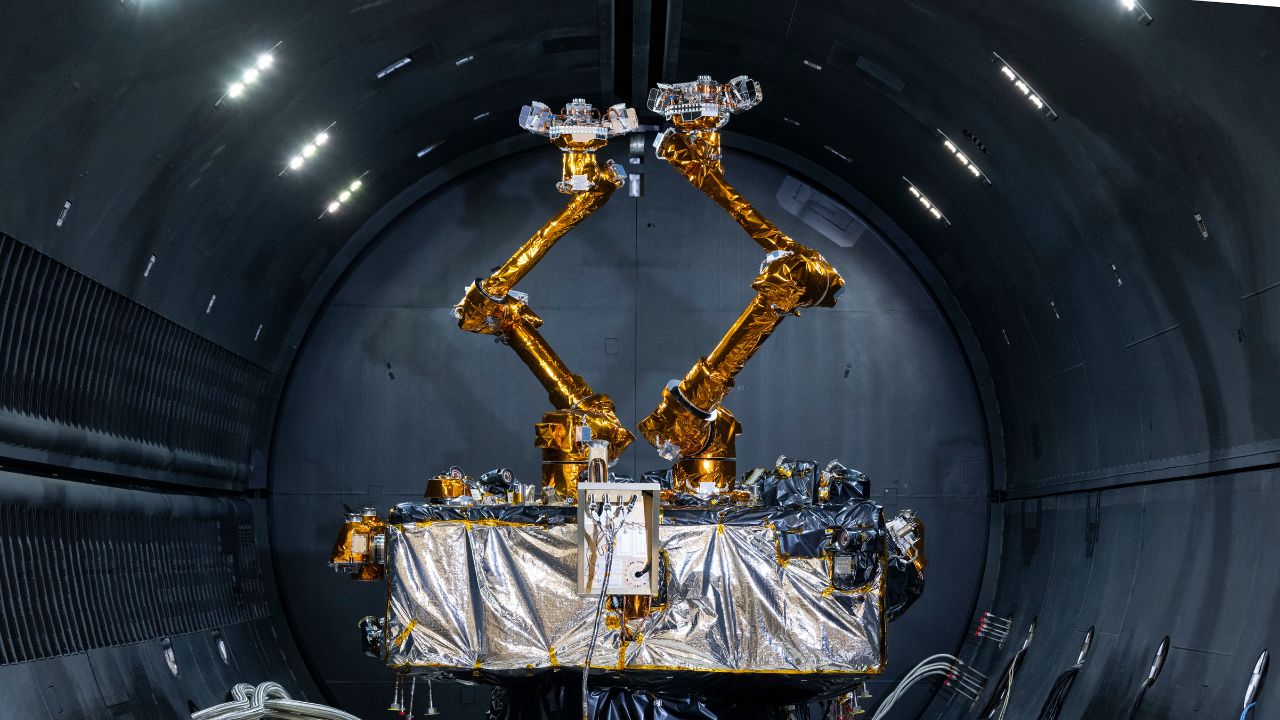


DARPA robot will be launched to perform satellite maintenance in orbit and extend the durability of space equipment.
The DARPA (U.S. Defense Advanced Research Projects Agency) is preparing for a 2026 mission launch that aims to transform how satellites operate in space. The project, called RSGS, will use a space robot to perform maintenance, inspections, and even refueling of equipment positioned in geostationary orbit, a region located nearly 36,000 kilometers from Earth.
The initiative seeks to increase the lifespan of satellites and reduce the disposal of these structures after the fuel ends. Developed by DARPA in partnership with private companies and institutions linked to the American space sector, the system will be able to operate for several years in space. The expectation is that the robotic vehicle will service dozens of satellites throughout the mission.
Space robot will be sent to distant orbit
The program was named Robotic Servicing of Geosynchronous Satellites, known by the acronym RSGS. The main structure of the mission combines DARPA technologies with a chassis from SpaceLogistics, a company linked to Northrop Grumman.
-
Canada Makes Historic Decision to Purchase New German Submarines in $70 Billion Defense Program, Replacing Aging Victoria-Class Fleet by 2033

-
4,000-Year-Old Stone Circle Discovered Near Belfast, Unveiling Prehistoric Ritual Complex in Irish Countryside

-
Brazilian Innovator Transforms 1962 Mercury Comet with Nissan Leaf Electric Motor, Achieving 125 km Range for Under $6,000
-
China Tests Giant 582-Ton Magnets to Contain Plasma Hotter Than the Sun’s Core, Aiming to Cut Superconductor Costs and Generate First Electricity from “Artificial Sun” by 2030


Named Mission Robotic Vehicle (MRV), the equipment was created to operate directly in orbit performing different types of technical support.
Among the functions planned for the robot are:
- Satellite refueling;
- Correction of technical failures;
- Remote inspections;
- Equipment upgrades;
- Orbital repositioning.
According to DARPA, the main goal is to prove that this maintenance model can work commercially in the future.
Satellite in geostationary orbit requires complex operation
The mission will take place in the so-called geostationary orbit, also known as GEO. This region is approximately 35,786 kilometers in altitude and is mainly used by satellites related to telecommunications, climate monitoring, and defense.
The equipment positioned in this band follows the Earth’s rotation, remaining apparently fixed in relation to the planet.

For comparison, the International Space Station operates much closer to the Earth’s surface. The agency highlights that the GEO is about 90 times farther from Earth than the ISS orbit.
Robot can prevent premature satellite disposal
Today, many satellites end up being discarded when the fuel runs out. The problem is that these pieces of equipment have an extremely high cost and can remain active for approximately 15 years.
According to Olhar Digital, some satellites in GEO can be worth hundreds of millions of dollars.
With the new proposal, the space robot could extend the operational time of these structures, reducing financial losses and helping to decrease risks related to space debris. Furthermore, maintenance in orbit can prevent collisions involving abandoned equipment.
Although the launch is scheduled for 2026, the program started several years ago. The RSGS was originally announced in 2017, but faced different technical and operational challenges.
Maxar Technologies, the first company involved in the project, left the initiative in 2019. Subsequently, the pandemic also affected the schedule due to impacts on the global supply chain.
The integration of DARPA’s systems into the spacecraft itself brought new technical challenges for the responsible team. Even so, the agency states that the program has finally reached the phase considered ready for operation.
Robot will use electric propulsion during the journey
The MRV’s journey to geostationary orbit will not be immediate. The vehicle will use electric propulsion to reach the region where the satellites operate.
According to the informed schedule, the journey should last about ten months. Thus, the effective start of operations in orbit is only expected for 2027.

Project aims to create a new model for sustainable satellite
DARPA states that the program can pave the way for a new operational standard in the space sector. James Shoemaker, RSGS manager, classified the project as a partnership between government and private initiative aimed at the next generation of orbital maintenance.
“The RSGS program is a public-private partnership for the next wave of satellite maintenance,” declared the executive during the agency’s official presentation.
He also highlighted that the mission’s objective is to prove the commercial viability of this type of space service. Furthermore, program representatives stated that the initiative intends to replace the concept of disposable equipment with more durable and upgradable systems.

“By transitioning from a paradigm of disposable space assets to one of sustainable, upgradable, and resilient satellites, the RSGS aims to fundamentally change space operations,” project officials stated in a note.
Private companies also compete in the space maintenance sector
The development of the RSGS takes place amid growing international interest in on-orbit maintenance services. According to DARPA, companies like Astroscale and Thales Alenia Space also operate in this segment.
The American government’s expectation is that the project will help establish new technical and operational standards in the space sector.
Meanwhile, experts involved in the program claim that the mission could represent an important step towards more durable space infrastructure.
DARPA’s project emerges at a time of accelerated growth in the number of satellites operating around the Earth.
With this, there is also an increased concern related to the durability of these devices and the amount of debris left in orbit.
The proposal of the space robot is precisely to create an alternative to prolong the use of satellites without the need for immediate replacement.
If the mission achieves the expected results, the model could pave the way for a new generation of technical assistance services directly in space.
Source: Olhar Digital