






 Portuguese
  Spanish
  3 min of reading
  1 comment


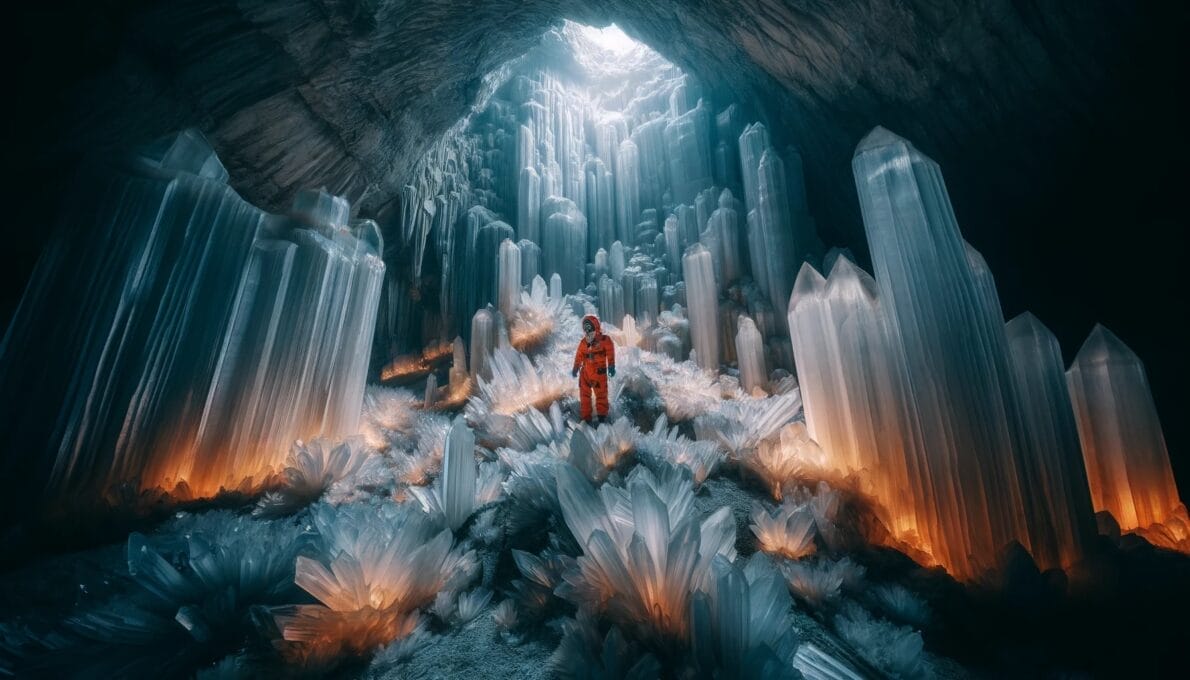

The Largest Cave In The World With Crystals Was Discovered In Mexico And Received The Name Of ‘Sistine Chapel Of Crystals’, Formed Millions Of Years Ago.
About 300 meters deep and connected to a lead, zinc, and silver mine, researchers found a cave with giant crystals in Naica, Mexico. About a decade ago, workers at a mine in the area accidentally reached an aquifer while drilling a tunnel to assist with ventilation. According to reports, when they entered, they discovered a chamber filled with milky-white crystals called ‘Sistine Chapel of Crystals’, where the largest one measures 11 meters in length and 1 meter in width.
The Largest Cave In The World With Giant Crystals Formed 26 Million Years Ago
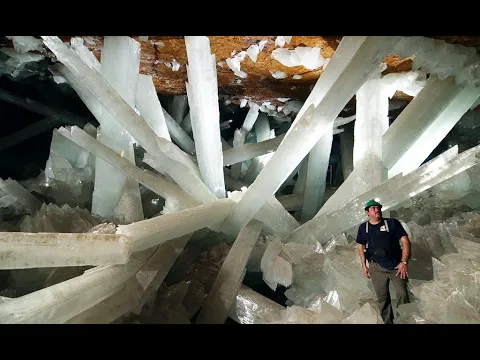

Composed of selenite gypsum, the ‘Sistine Chapel of Crystals’ consists of a sulfate mineral that occurs from salts dissolved in groundwater. According to a scientific publication, the material is so soft that it can be scratched with a fingernail.
Since mining operations began in 1974, several crystal caves have been found. However, this is the largest of them, shaped like a horseshoe, with a diameter of 110 meters and a volume of 6,000 cubic meters, which is more than double that of an Olympic swimming pool.
-
Helicopter Drops 180 Tons of Sand and Gravel on Swedish River to Revive Ecosystem Damaged by Decades of Exploitation

-
Brazilian Company Launches Retro Smartphone with 48 MP Camera, T9 Keyboard, and Privacy Features for Social Media-Free Use

-
Self-Taught Chinese Farmer Builds 5-Ton Submarine from Scrap, Launches It in Anhui River
-
Invisible Induction Technology Enables Wireless Power for Blenders, Coffee Makers, and Air Fryers, Reducing Countertop Cables





According to Juan Manuel García-Ruiz, a geologist from the National Councilfor Scientific Research (CSIC) and the University of Granada in Spain, who studied the cave, told National Geographic in 2007 that this is the ‘Sistine Chapel of Crystals.’
Researchers estimate that the largest cave in the world with crystals formed 26 million years ago, due to a geological fault above a magma reservoir, about 5 kilometers deep in Naica. They understand that the formation of the crystals was facilitated by the scalding water that entered the site and formed deposits that crystallized over time. Subsequently, the stability of the temperature at 58 °C allowed the crystals to grow.
The Largest Cave In The World With Crystals Presents Various Risks
Upon reaching 58 °C, the crystals took on the shape they present today, with a larger dimension. Inside, the environment has an average temperature of 50 °C. Thus, although the environment offers the best conditions for these crystals to have formed, for humans, the largest cave in the world with crystals is absolutely inhospitable.
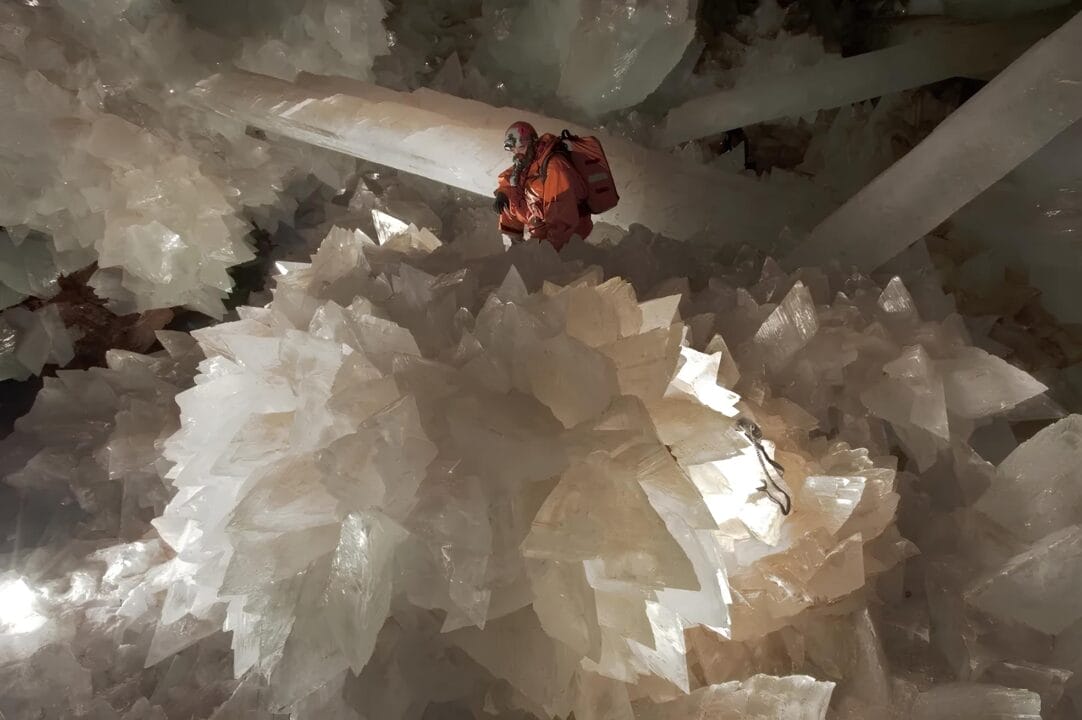
Although the material in the area is not toxic, it is quite hot, and the cave’s humidity is very high, reaching 90%. Thus, human perspiration runs completely inefficiently, or rather, does not occur.
In practice, this prevents anyone from staying in the ‘Sistine Chapel of Crystals’ for more than 10 minutes. Still, researchers who managed to enter the cave swear that it is one of the definitions of the word perfection. However, there is no denying that the environment also poses a mortal risk to its visitors.
How Do Crystals Form?
Crystals form from fissures in the rocks, and this millennia-old geological process begins in the Earth’s center, along with the rock formation. The process of crystal formation begins when the magma in the Earth’s center finds a path through the cracks and fissures to the surface.
As it cools, rocks begin to form. In this process of rock formation, cavities are sometimes created with water that penetrates from the surface towards the underground, and this is where the crystal formation starts.
With the trapped water in contact with the rocks, a liquid rich in minerals is formed, and with the passage of time, crystals begin to emerge. Their creation is similar to that of a pearl: it starts with a tiny core and expands as atoms and molecules join together.





Caverna já é conhecida desde o milênio passado..