Portuguese
  Spanish


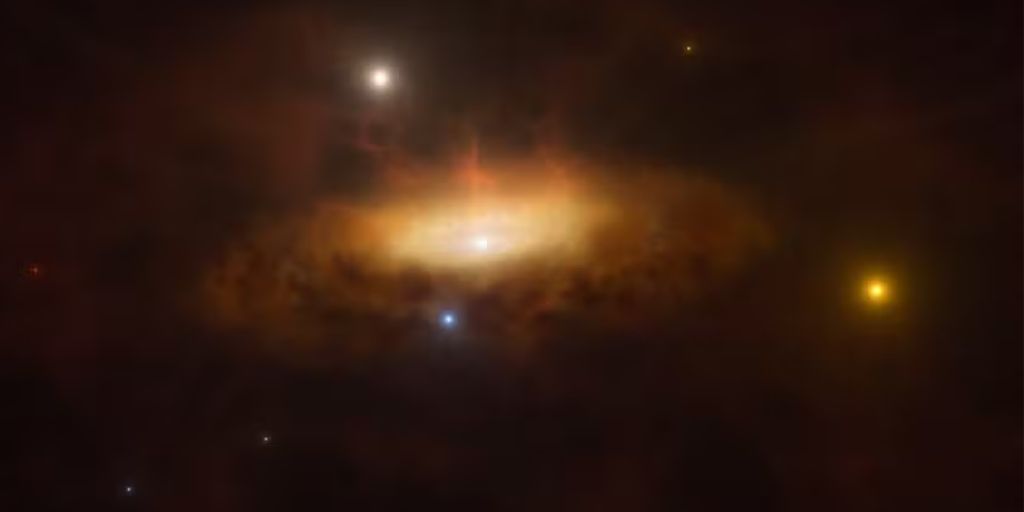

In a Discovery That Could Revolutionize Our Understanding of the Universe, Astronomers Have Observed What Is Likely the Awakening of a Supermassive Black Hole at the Center of the Galaxy SDSS1335+0728, Located About 300 Million Light-Years from Earth.
This event, which began in 2019, has been gradually intensifying over the last four years, culminating in a novel X-ray emission for the region, detected in February of this year.
According to a study published this Tuesday (18) in the journal Astronomy & Astrophysics, the research and findings open a new chapter in the study of these cosmic colossi, which until now had been considered “asleep” and imperceptible to our direct observation.
In the publication, Claudio Ricci, a co-author of the study and a researcher at Diego Portales University in Chile, states that “these giant monsters are normally asleep and not directly visible.”
-
Brazilian Researcher Develops Protein Supplement from Tilapia Waste, Combining Innovation and Sustainability with Economic Potential

-
Women in São Paulo Unknowingly Tracked by Coin-Sized Tags Hidden in Cars and Belongings, Raising Stalking Concerns
-
Near a $750 million AI data center in Brazil, a resident’s well runs dry, leaving her unable to afford the $25,000 needed for repairs.

-
16-Year-Old from Brazil’s Sertão Wins Young Scientist Award for AI Predicting Rainfall with 94.5% Accuracy to Aid Farmers


According to the study, in the case of SDSS1335+0728, scientists witnessed the awakening of the black hole, which fed on the gas around it, emitting an extraordinary brightness.
Initially, it was thought that the luminosity was due to supernova explosions or tidal events, when a star is shredded by the gravitational force of a black hole.
However, the persistence of the brightness for more than four years, contrasting with the short duration of such events (hundreds of days at most), directed the researchers toward another explanation.
In this regard, Lorena Hernández García, who is also a co-author of the research and a researcher at the Millennium Institute of Astrophysics (MAS) at the University of Valparaíso in Chile, reported that “the most plausible reason for this phenomenon is that we are observing the nucleus of the galaxy starting an activity cycle.” If confirmed, this would be the first time we witness in real-time the activation of a supermassive black hole,” she said.
Awakening Raises Questions
This discovery opens the doors to intriguing questions about the future of the Milky Way, which also has a supermassive black hole at its center, Sgr A*.
In this sense, even with uncertainty about the likelihood of a similar event occurring in our galaxy, the data obtained from the research provides valuable information about the origin and development of these cosmic colossi.
“Regardless of the nature of the variations, this galaxy offers us valuable data on how black holes grow and evolve,” says Paula Sánchez Sáez, an astronomer at the European Southern Observatory (ESO) in Germany.
“We believe that instruments like the Muse (Multi-Unit Spectroscopic Explorer) at the VLT (Very Large Telescope) and those that will be installed at the future ELT (Extremely Large Telescope) will be crucial for better understanding the reasons behind the brightness increase of this galaxy,” she concluded, the lead author of the article.