






 Portuguese
  Spanish


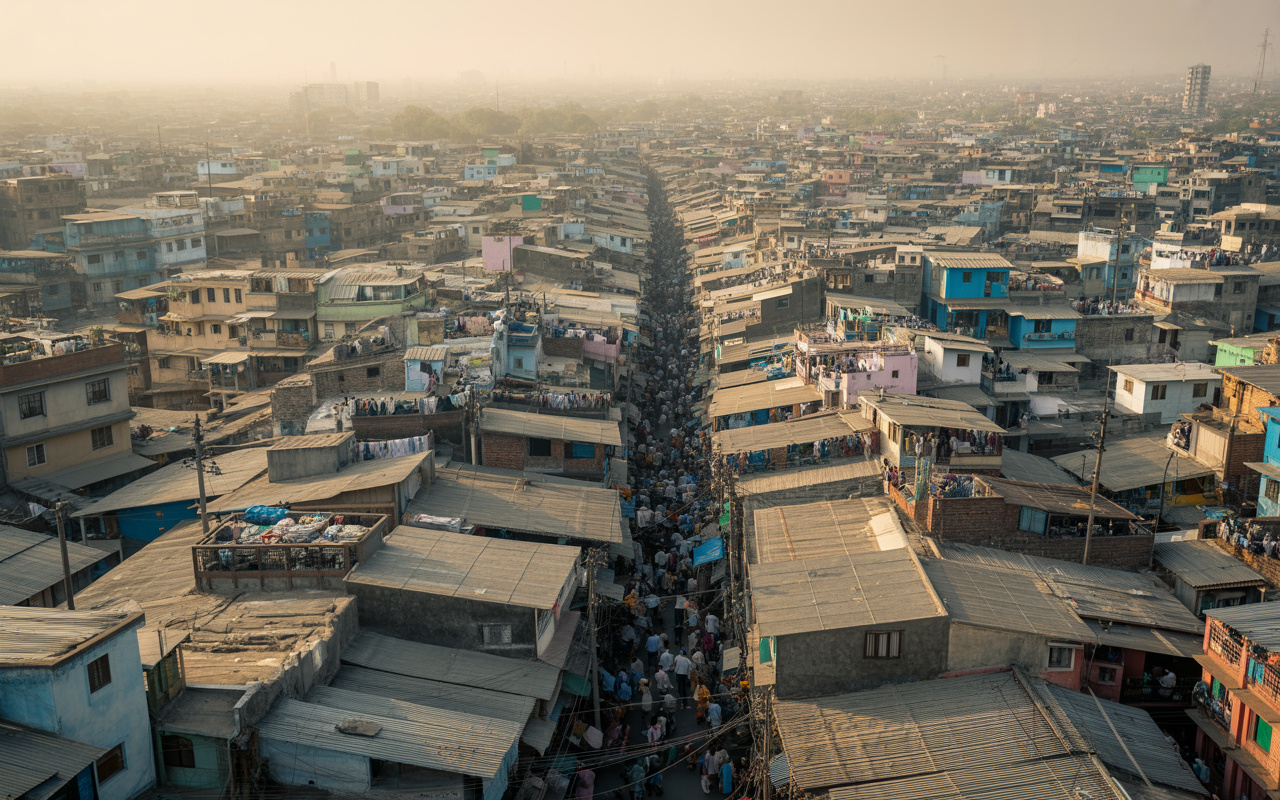


Dharavi in Mumbai Combines Extreme Density, Minimal Housing, and a Million-Dollar Internal Economy, Revealing the Productivity x Urban Precarity Paradox.
On the map of Mumbai, Dharavi is not large. In built area, it occupies only a few hundred hectares nestled between train lines, avenues, and industrial zones. However, when observing what happens inside, the scale changes completely. There are tens of thousands of inhabitants living in homes that often have less than 10 square meters, distributed in alleys where only two people can pass closely. Density, makeshift arrangements, and economic vitality coexist in the same space, forming one of the most complex urban scenarios ever documented in the Global South.
Dharavi has become internationally known as a “slum,” but this word impoverishes the understanding. What exists there is a distinct urban ecosystem, in which housing and sanitation precarity coexist with surprising productivity driven by micro-industries, workshops, handicrafts, and recycling. The contrast generates a paradox: one of the most compressed places in Asia is also an economic hub that, according to estimates cited by urban research organizations and reports from international media, moves hundreds of millions of dollars per year.
The Extreme Density of Dharavi: Geography and Accelerated Urbanization
Dharavi did not emerge as a planned area. Its formation is linked to the rapid growth of Mumbai (formerly Bombay) throughout the 20th century, driven by industrialization, inter-state migration, and the concentration of job opportunities.
-
Award-Winning Japanese Restaurant Reveals It Has Preserved Part of the Same Frying Oil for 66 Years

-
American Youth Transforms from Severe Obesity to U.S. Air Force Enlistment, Losing 90 Kilograms in Two Years
-
11-Year-Old Entrepreneur Sells 60 Homemade Sweets Daily, Mastering Cost Calculation, Social Media Promotion, and Client Negotiation Since Age 7

-
Peruvian Mountain’s 5,200 Aligned Holes May Unveil Ancient Indigenous Market for Corn and Cotton


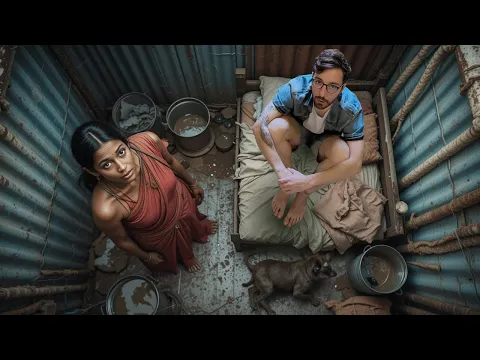

When the population grew faster than the availability of formal housing, informal densification became inevitable. The result is an urban labyrinth where:
- Houses overlap and fit into irregular shapes
- Corridors replace streets
- Workshops share space with kitchens and bedrooms
- Metal roofs create a mosaic observed from above
In many sections, there is no space for vehicles; hand carts, bicycles, and people form the dominant flow. The population density there far exceeds the average for Mumbai, which is already one of the most densely populated cities in the world. The spatial compression creates concrete challenges such as limited ventilation, accumulated heat, health risks, and circulation difficulties.
The Internal Economy that Moves Millions: Industry, Recycling, and Services
It is in the economy that Dharavi differs from other global informal complexes. There exists a functional, decentralized economic system connected to national and international markets. Among the most dynamic sectors are:
- Plastic recycling and reprocessing
- Tanning and leather, with pieces reaching the fashion sector
- Ceramics and pottery, with strong community presence
- Textiles and sewing, with outsourced production for larger companies
- Handicrafts, exported to tourism markets and fairs
Recycling is a hallmark case: daily, tons of waste arrive in Dharavi from all over Mumbai. Small workshops wash, crush, sort, and transform material into pellets that supply the country’s plastic industries. This cycle creates a complete production chain, with local labor and low margins, yet high scale.
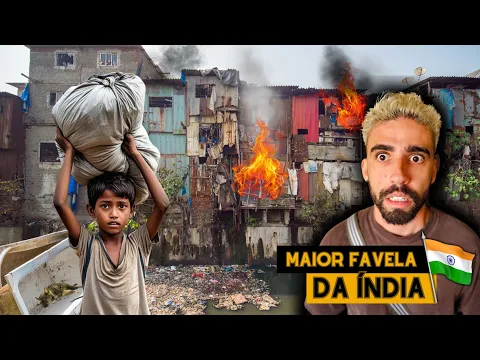
International reports describe Dharavi as “a city within a city,” with markets, schools, medical offices, temples, mosques, churches, and even small bakeries. The local economy ensures employment for thousands of people, which helps explain why so many migrants from rural areas of India arrive there every year.
The Productivity x Precarity Paradox
Dharavi highlights a typical dilemma of megacities in the Global South: the state cannot provide dignified housing at the speed of urban migration, but the informal sector provides immediate work and income. The result is a space where income and precarity coexist. This paradox appears in multiple dimensions:
- Urban infrastructure: Sanitation, water supply, and waste collection face constant pressure.
- Informal real estate market: Tiny rooms are subdivided and rented for high prices due to proximity to jobs.
- Public health: High density favors the spread of respiratory and infectious diseases, requiring periodic vaccination campaigns and emergency actions.
- Mobility: Movement relies almost exclusively on walking, which limits access to external services.
Despite these challenges, Dharavi remains one of the silent economic engines of Mumbai, functioning as a connection point between large companies, export networks, and the informal sector.
Attempts at Reurbanization and Debates about the Future
In recent decades, successive governments have initiated urban renewal programs in Dharavi. The central proposal is to transform the complex into a set of formalized vertical housing units, with sanitation, energy, and land regularization. However, there are real obstacles:
- Multi-billion costs, as relocating a large population requires long-term planning
- Land disputes, as the territory involves multiple actors
- Risk of losing the local economy, as the shift to buildings may dismantle workshops integrated into homes
- Community resistance, as many fear losing income and social ties
Indian urban planners advocate for hybrid solutions: preserving the internal economy, ensuring dignified housing, and formalizing minimal infrastructure without expelling the population to distant peripheries — which has already happened in other failed renewal projects in Asia.
Why Dharavi Matters for the Study of Global Urbanization
Dharavi is closely observed by universities and international institutes because it provides real data on how large cities absorb poor and productive populations without efficient state planning. In debates about global urbanism, Dharavi appears alongside cases such as: Kibera (Kenya), Rocinha (Brazil), Orangi Town (Pakistan), and Payatas (Philippines).
Each with its own model of informality, economy, and housing. What differentiates Dharavi is its economic scale, which has urban planners referring to the place as an “informal industrial zone,” a term rarely seen in other slums worldwide.
Dharavi is a rare synthesis of the 21st century: urban density comparable to the largest megacities on the planet combined with a productive capacity that defies traditional urban development logic. It is a place that raises difficult questions about planning, housing, economy, and human dignity:
How to regularize space without destroying the internal economic engine? How to guarantee housing without breaking social and productive networks? How to urbanize without expulsion? These are issues that Mumbai — and the world — will have to face as the century advances and megacities grow faster than formal planning.


Mundo cão!
Nada diferente das favelas daqui.