






 Portuguese
  Spanish


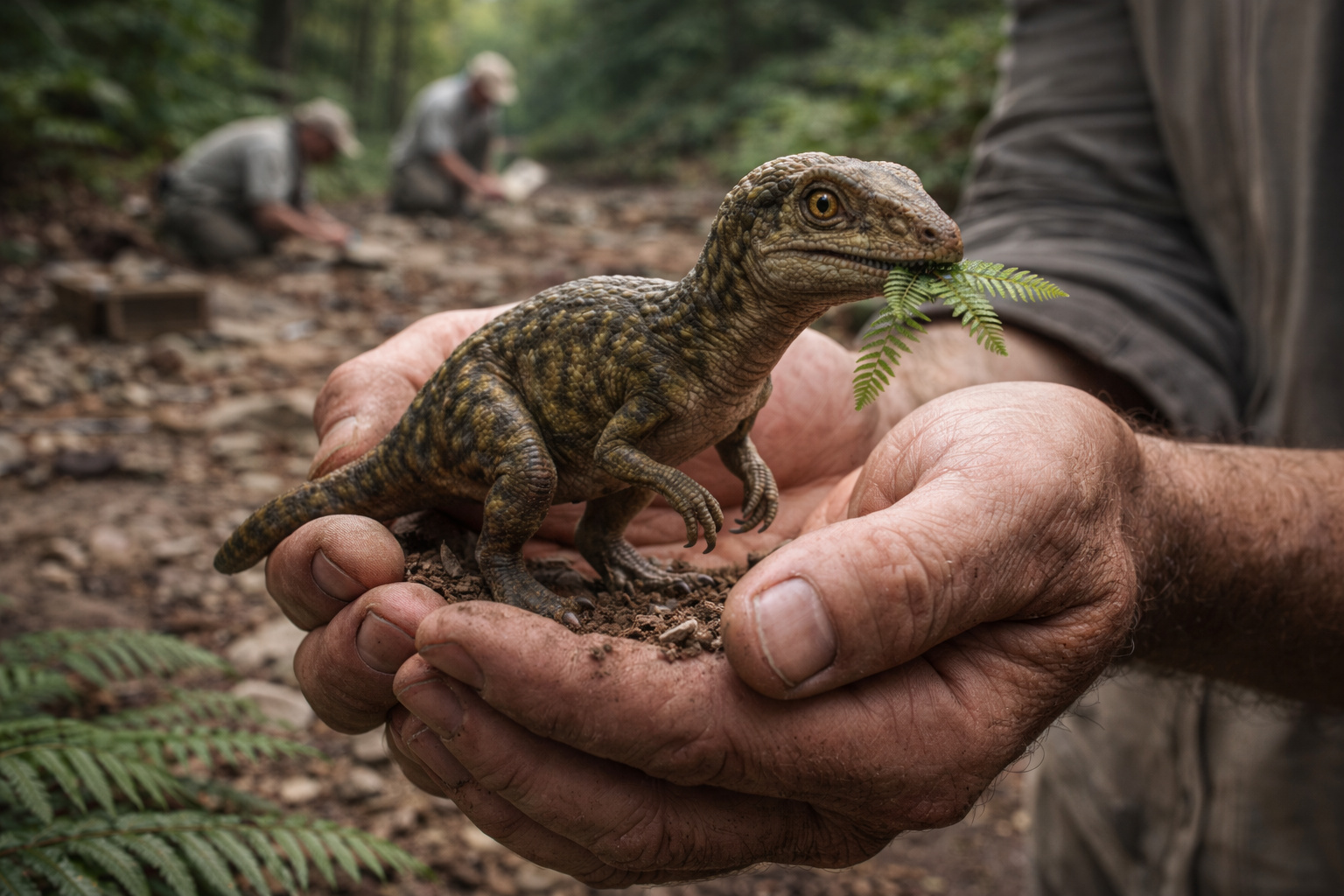


Fossil Found in Northern Spain Exposes 70 Million-Year Gap, Details Unexpected Anatomical Adaptations, and Expands Debate on the Evolution of Herbivorous Dinosaurs
A paleontological discovery of great scientific relevance was recently recorded in northern Spain, attracting the attention of international researchers.
This is a new species of herbivorous dinosaur, named Foskeia pelendonum, that lived during the Early Cretaceous, about 70 million years ago.
Although it measures approximately 50 centimeters in length, the animal exhibits an anatomy considered evolutionarily advanced, challenging established interpretations of the development of small-sized dinosaurs.
Already, scientists emphasize that the small size starkly contrasts with the structural complexity observed in the fossils.

The remains were found in the region of Vegagete, in the province of Burgos, in northern Spain, and belong to at least five distinct individuals.
Initially, the fossils were identified by local researchers and later analyzed by an international team of paleontologists, as per studies released in 2024.
-
Scientists Confirm “Greening” of Antarctica: Ice on the World’s Coldest Continent Turns Green as Mosses Multiply Over Tenfold in Four Decades

-
2,000-Year-Old Gold Rings Found with Human Bones in Thailand Reveal Rare Burial and Feature Ancient Indian Inscription

-
Lenovo Unveils Legion Y700 Tablet with RGB Backlighting, 5G, and SIM Card Support

-
World’s First Nuclear Hydrogen Unit Begins Operation: Copper-Chlorine Technology with Initial Capacity of 150 Liters per Hour, Aiming for 3,000 Liters per Hour



Fossil Record Fills Historical Gap in European Evolution
According to researchers involved in the study, the discovery of the Foskeia pelendonum helps fill an approximately 70 million-year gap in the evolutionary record of herbivorous dinosaurs in Europe.
Additionally, the species was positioned close to the origins of the Rhabdodontidae group, enhancing the understanding of the diversification of European ornithopods.
This data reinforces that the evolution of these animals occurred in a more complex and diverse manner than previously thought.
At the same time, the finding provides new chronological references to reassess evolutionary models used thus far.
Highly Derived Skull Challenges Scientific Expectations
Although it is one of the smallest ornithopods ever identified, the Foskeia features a highly derived skull, with unusual characteristics for a dinosaur of this size.
Thus, scientists emphasize that body miniaturization did not imply anatomical simplicity.
Microscopic analyses of the bones indicate that at least one of the specimens was a fully developed adult, which rules out the hypothesis that the fossils would only represent young individuals.
Therefore, the small body size is now interpreted as a stable evolutionary condition of the species.
High Metabolism and Unexpected Functional Adaptations
Beyond the maturity stage, the bone structure suggests a high metabolism, comparable to that of modern birds and small mammals.
In this way, researchers emphasize that small bodies could also sustain high physiological performance during the Cretaceous period.
Updated evolutionary models released alongside the study also point out that the Foskeia has a closer relationship with the Muttaburrasaurus, a known herbivorous dinosaur from Australia.
Consequently, this association expands the known diversity of the Rhabdodontomorpha group on a global scale.
Evolutionary Debates and New Hypotheses Under Analysis
Meanwhile, the discovery has reignited the debate regarding the possible existence of a large grouping of herbivorous dinosaurs known as Phytodinosauria.
However, as scientists emphasize, this hypothesis still depends on new fossils and additional analyses for confirmation.
Even small, the Foskeia pelendonum showed to be well adapted to the forest environment in which it lived.
The animal had specialized teeth, alternated body posture as it grew, and used short bursts of speed to move through dense areas.
Small Fossil with a Large Scientific Impact
For the researchers responsible for the study, released by European scientific institutions in 2024, the discovery reinforces that evolution operated deeply in both large and small bodies.
Thus, discreet fossils, like that of the Foskeia, may play a central role in reconstructing the history of life on Earth.
In light of this, the finding expands the understanding of herbivorous dinosaur diversity and highlights that there are still important gaps to be explored in the European fossil record.
In your opinion, to what extent can discoveries of small fossils change what we know about the evolution of large dinosaurs?





Inacreditável que a preguiça chegou até no jornalismo, o que que custa colocar a foto na manchete e na matéria DO PRÓPRIO ARTIGO OU DO PRÓPRIO FÓSSIL OU DE UMA ARTE DO ****
Essas ilustrações de Inteligência Artificial são completamente imprecisas e não refletem a anatomia verdadeira do ****, se você se propõe a fazer um trabalho e uma matéria de divulgação CIENTÍFICA é necessário que se tenha o maior respaldo na realidade possível
A matéria em si esta bem escrita, mas fica o meu repúdio como biólogo, paleontólogo, professor, artista e divulgador científico sobre o uso indevido da IA nesse aspecto da ilustração
Eu achei incrível, não sendo os carnívoros tá bom😂,eles eram os lagartos na época, eu não sei como os cientistas ainda não fizeram cópias de dinossauros , se vocês fizerem isso por favor façam só os herbívoros, pra não acontecer igual aos filmes 🤣 trás os parentes das girafas,os mais fofos 🥰
Né os grandes mas os que eram fofos e mansinhos
Era um calango de muro.