






 Portuguese
  Spanish


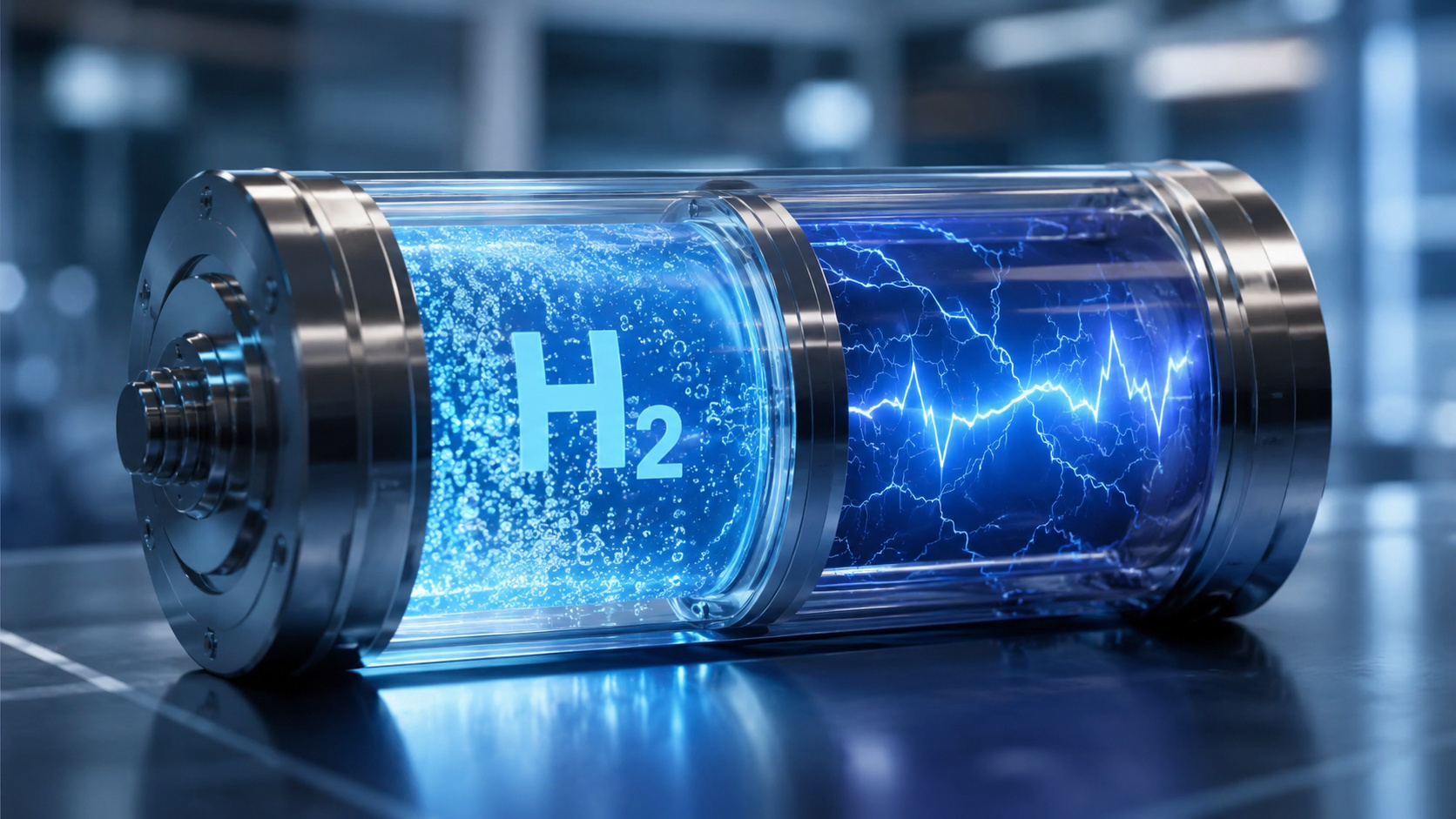


Researchers develop ion battery capable of storing electricity and hydrogen, an advancement that could transform energy storage.
A team of researchers from the Dalian Institute of Chemical Physics in China has developed a technology that could change the way electricity and hydrogen are stored. The new system functions as a hydride ion (H⁻) battery capable of simultaneously storing electrical energy and gaseous hydrogen, combining two functions that usually require separate equipment.
The prototype is still in the laboratory phase but has already demonstrated impressive results. During tests, it achieved an initial discharge capacity of 1,526 mAh g⁻¹, released about 6% hydrogen by weight at room temperature, and maintained more than 70% capacity after 60 operation cycles.
The innovation, reported in an article on Science Direct on May 13, 2026, comes at a time when energy storage has become one of the top priorities for the global expansion of renewable energy and hydrogen.
-
2,000-Year-Old Gold Rings Found with Human Bones in Thailand Reveal Rare Burial and Feature Ancient Indian Inscription

-
Lenovo Unveils Legion Y700 Tablet with RGB Backlighting, 5G, and SIM Card Support

-
World’s First Nuclear Hydrogen Unit Begins Operation: Copper-Chlorine Technology with Initial Capacity of 150 Liters per Hour, Aiming for 3,000 Liters per Hour
-
Mechanics Retrofit Old Fiat Uno with BYD Electric Motor for Silent, Low-Voltage Operation Reaching Nearly 60 km/h in Home Test



Researchers create system that combines battery and hydrogen reservoir
The technology’s differential lies in its concept called gas-solid battery. The equipment uses hydrogen gas as the positive electrode and metallic magnesium as the negative electrode.
According to the study led by Shangshang Wang and his team, during discharge, hydrogen is converted into hydride ions. At the same time, magnesium reacts forming magnesium hydride. When the battery is recharged, the process occurs in the opposite direction.
In practice, this allows the equipment to perform two functions at the same time:
- Storage of electrical energy;
- Storage of hydrogen in solid state.
This combination is considered unprecedented within the experimental battery technologies presented so far.
How the ion battery works during charging and discharging
The ion battery uses hydride ions (H⁻), particles that have high energy density and the ability to transport electrical charge.
Although they have been known for decades by the scientific community, these ions exhibit high reactivity, which complicates their use under normal temperature and pressure conditions.
In recent years, Chinese researchers have developed new electrolytic materials capable of transporting these ions stably. Subsequently, the team managed to create an ultra-fast hydride ion conductor operating at low temperatures.
These advancements paved the way for the construction of the new prototype now presented.
Hydrogen still faces transportation and storage challenges
Green hydrogen is seen as one of the main bets to reduce carbon emissions in industrial sectors and heavy transport. Despite its potential, there is a significant obstacle: storage.
Currently, the most used solutions require extreme conditions, such as:
- Compression up to 700 atmospheres;
- Liquefaction close to -253°C;
- Specialized infrastructure for transportation.
These processes significantly increase operational costs and energy consumption.
For this reason, technologies capable of storing hydrogen under normal environmental conditions have been receiving growing attention from researchers and companies in the energy sector.
Energy storage gains an alternative with dual function
The growth of renewable energy has increased the need for efficient solutions to store electricity produced during periods of excess generation.
Solar plants and wind farms increasingly depend on energy storage systems capable of balancing supply and demand.
In this scenario, the new ion battery presents a relevant feature: besides storing electricity, it also functions as a form of chemical storage through hydrogen.
This creates an alternative that can increase the operational flexibility of future energy networks.
Prototype numbers draw researchers’ attention
Laboratory tests revealed indicators considered promising for a technology still in its early stages.
Among the main results disclosed are:
- Initial discharge capacity of up to 1,526 mAh g⁻¹;
- Release of approximately 6% hydrogen by weight;
- Retention of over 70% capacity after 60 cycles;
- Stable operation between -20°C and 90°C.
Another important milestone was the construction of a stack formed by ten cells connected in series.
The assembly generated more than 2.4 volts of voltage and managed to power a LED, demonstrating the practical feasibility of the concept.
Renewable energy can benefit from the new hybrid architecture
The expansion of renewable energy directly depends on the evolution of storage technologies.
The greater the capacity to store energy safely and economically, the greater the participation of clean sources in the global energy matrix tends to be.
The proposal developed by the researchers presents a different approach because it combines two forms of storage in a single system.
If the technology advances to commercial phases in the future, it could contribute to applications related to solar generation, wind energy, microgrids, and industrial systems that use hydrogen.
What this discovery represents for the future of the hydrogen economy
Although it is still a laboratory prototype, the new ion battery demonstrates a possible route to overcome one of the main bottlenecks of the hydrogen economy.
By eliminating the need for extreme pressures or cryogenic temperatures for storage, the technology opens up prospects for simpler and potentially more accessible solutions.
The researchers still need to overcome challenges related to production scale and long-term durability. Even so, the results obtained show that energy storage and hydrogen can go hand in hand in a new generation of energy systems, more efficient, versatile, and aligned with global decarbonization goals.


