






 Portuguese
  Spanish


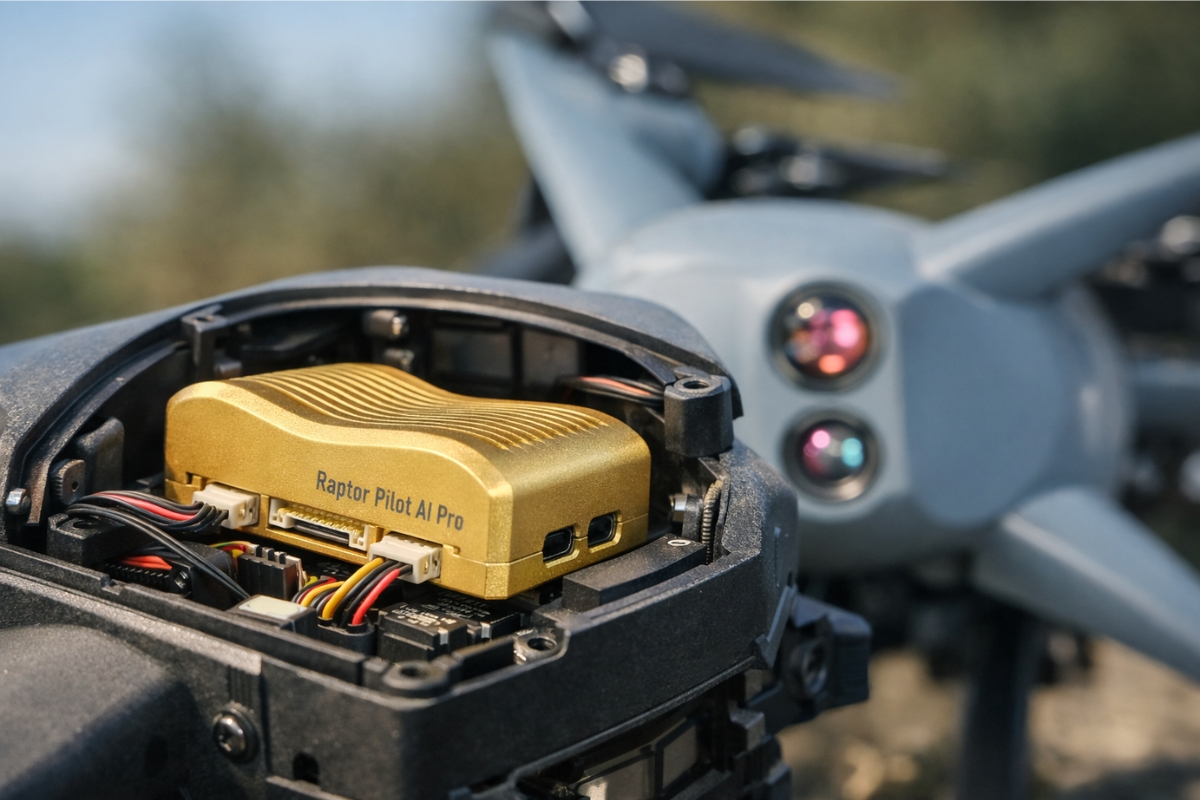


Without Depending On GPS, Without Depending On Continuous Link, And With Only 100 G On Board, The Raptor Pilot Bets On Embedded AI To Identify, Follow And React, And Can Take Small Drones On Missions That Before Required Much Larger Systems
Imagine taking a relatively simple drone — one used for filming or mapping — and, with a module smaller than a cellphone, giving it the autonomy to navigate, recognize targets, and maintain the mission even under interference. This is the promise behind the Raptor Pilot AI Pro, an ultra-compact autopilot created by the British London Defence R&D.
What makes this subject so talked about is not just the size. It’s the context: drones have become central pieces in recent conflicts, and at the same time, electronic warfare has evolved to “erase” GPS, block signals, and confuse operators. In this scenario, solutions capable of continuing to function without relying on satellites or constant control gain immediate value.
Why This Type Of Technology Is Getting So Much Attention Now
Until recently, many drones were heavily dependent on two pillars: GPS for navigation and control link for real-time decisions. The problem is that these pillars are vulnerable. In interference-prone environments, the drone can become “blind”, lose reference, or even become useless.
-
The Trap of Modern Technology: How Screen Overload and Digital Connections Can Impact Your Mental Health and Well-being

-
Wyoming Couple Grows Tropical Fruits Year-Round in -40°C Using Geothermal Greenhouse, Demonstrating Earth’s Heat Can Produce Oranges and Lemons in Snow Without Traditional Heating

-
Ship Returns from Brazilian Coast with Thirty Newly Discovered Life Forms
-
Nigerian Professor Invents Electricity-Free Refrigerator Using Clay Pots and Wet Sand, Extending Shelf Life of Vegetables to 27 Days; 7,000 Units Distributed in Energy-Deprived Villages



The Raptor Pilot AI Pro enters precisely into this gap: it was designed to reduce external dependencies and keep the aircraft operating under adverse conditions. This changes the game for missions where the risk of signal loss is not a remote possibility — it’s the rule.

What The Raptor Pilot AI Pro Does In Practice
The central idea is to give the drone a level of autonomy that goes beyond “flying alone”. The system combines flight control with computer vision so that the aircraft can interpret the environment and react quickly.
In practice, this means the drone can use cameras and internal sensors to detect and track a target, adjust its trajectory, and execute maneuvers with low latency. In military applications, this logic appears in interceptor drones and rapid response platforms.
Even outside of combat scenarios, the same technological foundation has appeal in activities such as monitoring extensive areas, protecting critical infrastructure, and operations in locations with degraded signals.
Where This System Is Already Being Applied
The company itself associates the module with interceptor drones like Baby Raptor and Raptor XL, aimed at short-range air defense tasks. This type of application reinforces an important point: it’s not just “a better autopilot,” but a component designed for quick decision making.
When the mission involves moving objects, little margin for error, and the need for immediate reaction, the integration of vision and flight control becomes the differentiator.
The Part That Many People Want To Know: How It Works Without GPS
Here’s the technological “trick” that makes the system stand out. Instead of relying solely on satellites, the module uses sensor fusion: it combines visual data (from the camera) with inertial data (from the IMU) to estimate position and movement.
In simple terms, it’s as if the drone “navigates” by observing the environment and sensing its own movements. This allows it to continue navigating and executing maneuvers even when GPS is blocked by interference.

Technical Data That Explain The Ability Jump
After understanding the functions, the numbers help to size what is inside those 100 grams:
- Weight: about 100 g (compact and integrated module)
- Processing: Quad-Core CPU at 2.4 GHz
- Computer Vision: video processing at 1080p at 30 fps
- Flight Control: based on STM32F405, with sensors like IMU and barometer integrated
- Power: range of 6V to 28V DC, facilitating use in different platforms
- Connectivity/Interfaces: options like I²C, CAN, UART, USB, plus Wi-Fi and Bluetooth
- Protection: IP65 certification (resistance to dust and splashes)
These details matter because they show that it’s not just a “light accessory,” but a system capable of taking on tasks that previously required multiple boards and auxiliary computers.
What This Indicates About The Future Of Drones
The Raptor Pilot AI Pro is a clear signal of where the market is headed: more embedded intelligence, less reliance on external infrastructure, and modules that fit any platform.
With miniaturization accelerating, it becomes easier to equip smaller drones with advanced capabilities. This can reduce costs, increase scale, and make sophisticated technologies more accessible to various actors — which, in itself, raises strategic discussions.
In the end, the impact is not just about the “new 100-gram gadget.” It’s about what it represents: drones transitioning from being merely remote-controlled vehicles to platforms with real capabilities to perceive, decide, and act in near-instantaneous time.





Vendo fusca 67 documentos ok