






 Portuguese
  Spanish


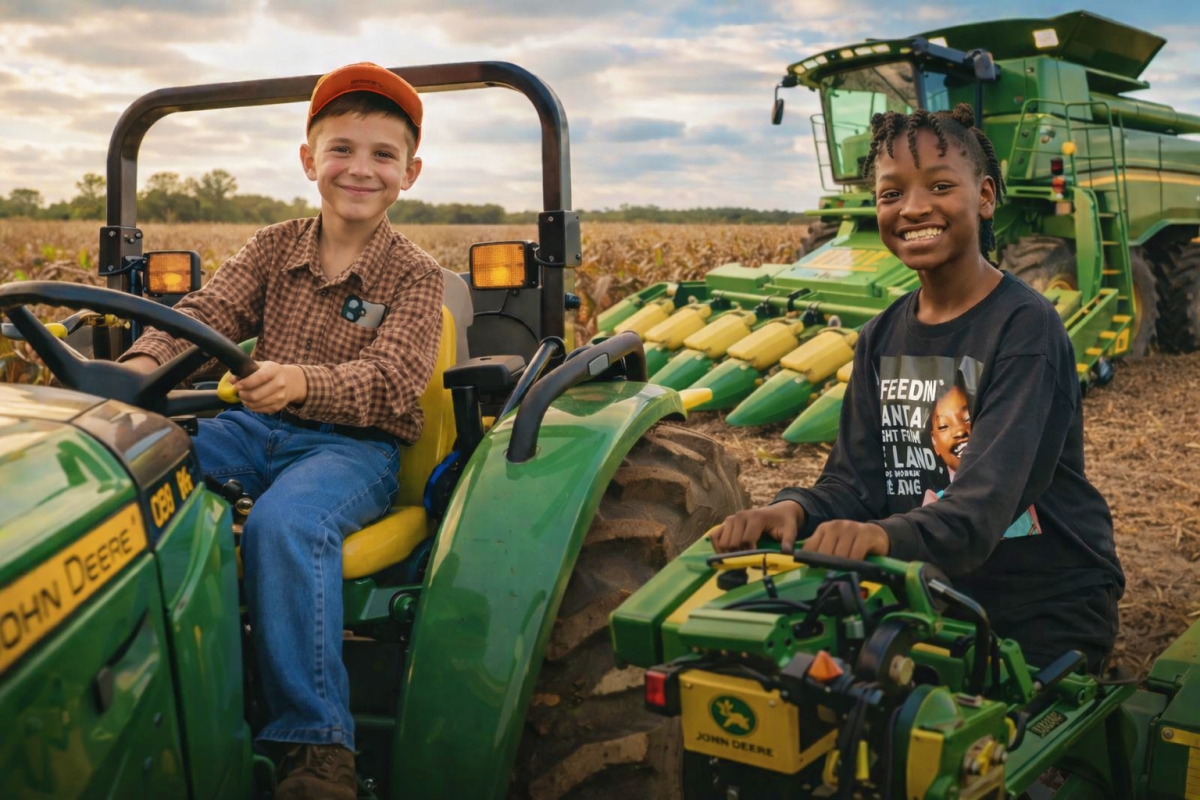


The Contrast of 10-Year-Olds Draws Attention: Jackson Laux, from Indiana, a Country Boy Operating Machinery and Harvesting Numbers That Many Adults Would Celebrate, and Kendall Rae Johnson, from Atlanta, a City Girl Who Transformed a Piece of Land into an Operation with Official Registration and a Project Deadline Until 2027.
Agriculture is often seen as work for older people, with decades of experience and a heavy routine that starts before sunrise. However, two young Americans are turning heads by inverting this logic with a remarkable ease.
Jackson Laux is 10 years old and lives in South Whitley, Indiana, a town with fewer than 2,000 residents in the northeast of the state, west of Fort Wayne. Kendall Rae Johnson is also 10, but she is growing up in Atlanta, in the heart of one of the largest metropolitan areas in the United States.
On the map, the two realities seem opposite. In practice, they intersect in one thing: real agriculture, with land, production, sales, and responsibility.
-
Google Earth Uncovers 260 Mysterious Stone Structures in Sudan’s Atbai Desert, Sparking Archaeological Investigation into Ancient Nomadic Power Dynamics

-
65-year-old man lived in Arizona forest for 8 years, built illegal campsite, and accumulated half a ton of trash before being discovered by U.S. Forest Service agents

-
Former Biology Teacher Turns Financial Education App into a $1.2 Million Success in Brazil
-
Brazilian Entrepreneur Launches Staff-Free Laundry Chain with 636 Locations Nationwide, Generating $5 Million in Revenue



The contrast is striking. A country boy operating machinery and harvesting numbers that many adults would celebrate. A city girl who transformed a piece of land into an operation with official registration and a project deadline until 2027.
Who Are the Two Young Farmers Who Became Role Models in the Countryside and the City
Jackson holds a title that few would imagine: he is the Chief Tractor Kid of John Deere. What makes this newsworthy is not just the aesthetic of a child in farm clothes, but his level of knowledge about equipment and farming.
Kendall Rae has an even more unusual milestone. At 6 years old, she obtained the farming tract ID, an identifier that allows farms to participate in USDA programs.
And she holds a visible position: she is the youth ambassador of the National Urban Agriculture Initiative, a USDA-supported initiative that runs until the summer of 2027.
The two also have a strong presence on social media. Jackson appears as the voice of the small-town farmer. Kendall Rae emerges as the voice of agriculture in the urban environment.
This combination of countryside and metropolis is the kind of contrast that makes many people stop to understand what is happening.
Two Acres with Machinery in Indiana and 1 Acre of Urban Production in Atlanta
In Indiana, Jackson cultivates 2 acres on his grandmother’s property, Laura Laux, about 5 miles east of South Whitley. He is not just following an adult. He runs his own project and participates in the decisions.
The tractor he uses is a John Deere 3020, bought from an uncle. The combine harvester is a Deere 6620, acquired from a farmer near retirement.
In 2025, he planted Stine 9755 20 seed corn, described by him as a newer hybrid.
Before the harvest, Jackson was already talking about productivity goals. He aimed for 180 bushels per acre. If he reached 210, he said he would celebrate a lot. The final result was 213 bushels per acre.
In Atlanta, Kendall Rae works on 1 acre in the southwest of the city, within the aGROWKulture Urban Farm.
Her production includes sweet corn, honey, and kale leaves that ignited her passion for planting. And the sale is not limited to the neighborhood.
She sells through her own page using GrownBy, a direct-to-consumer cooperative, as well as appearing at pop-up markets.
What seemed improbable to many is precisely this: an urban agricultural operation taking shape with product, showcase, and sales channel, while another operation in the countryside gains scale with machinery and measured harvest.
What the Numbers Reveal and Why These Young People Surprise So Many
When the details emerge, the story becomes even more concrete. South Whitley has fewer than 2,000 residents.
Still, from there comes a 10-year-old boy conducting planting on 2 acres, with tractor and combine harvester, and finishing 2025 with 213 bushels per acre in corn.
Atlanta is a metropolis. Within it, a 10-year-old girl works 1 acre, produces sweet corn and honey, sells online and at markets, and also has an official USDA registration obtained at age 6.
The deadline until 2027 also weighs in. Kendall Rae is not in a short or symbolic project. She is a youth ambassador for a USDA-supported initiative that will run until the summer of 2027.
It is enough time to generate influence, create routine, and inspire other families.
The Role of Grandparents and Parents That Changed Everything, Without Taking Away the Youth’s Autonomy
In Jackson’s case, agriculture runs in the family. He credits his love for tractors and farming to his maternal grandfather, Tracy Kuckuck, who cultivates grains in South Whitley.
Jackson remembers spending hours on the tractor with him, sitting on the armrest, building memories and practice.
Jackson’s parents also grew up on farms. His mother, Jessica Laux, on a dairy farm. His father, Joe Laux, on a pig farm.
They no longer produce, but the stories and the experiences with that past helped shape their son’s desire to start on his own.
For Kendall Rae, the spark came even earlier. She says that at 3 years old, her great-grandmother Kate taught her how to propagate kale, and seeing something small become something big was significant.
Her father, Quentin Johnson, recalls that when she saw the first kale grow, she began planting any seed she found in pots in the yard. Soon there were peppers, tomatoes, and cucumbers spreading out, with no trellises or structure.
The difference is what came next: the parents did not stifle her desire. They became support.
Quentin works with Kendall Rae on the farm. Her mother, Ursula Johnson, handles the business side, interviews, calls, notes, and computer work, allowing her daughter to join when she wants, without obligation.
Ursula also counters a common perception: many people think parents push due to age, but she says the opposite is true; the parents are involved because their daughter blazed the trail.
With Jackson, the logic is similar. Jessica manages the social media and schedules interviews. Joe helps with negotiations for equipment purchases.
However, they include Jackson in the decisions and emphasize that the money is his because the production is his. The involvement started early, with the parents teaching and showing how everything works.
What May Happen Now and Why This Points to the Future of Agriculture
Beyond the symbolic impact, there is a practical effect: more young people looking at agriculture as something possible.
Jackson sees himself as a normal 10-year-old boy but makes it clear that he wants to work in agriculture. He thanks his parents and encourages other children to start in simple ways, even with a garden at home.
Kendall Rae also emphasizes the basics. She recommends simple activities, inside or outside a farm, like vermicomposting or planting something easy like tomatoes. She says she has already inspired a friend, Sage, who started a small garden.
Her role goes beyond planting and selling. The farm offers school visits and maintains a program called 2 Peas in a Pod, designed to encourage collaboration and conversation between young people and seniors in Atlanta, with agriculture as the backdrop.
She also mentions a USDA-linked funding path: the youth loan, where individuals aged 10 to 20 can qualify for up to $10,000 to fund agricultural projects that generate income.
With the population of farmers aging, involving children and teenagers in real projects signals a future. And at this point, the story of Jackson and Kendall Rae stands out because there is no fantasy. There is land, method, numbers, and responsibility.
What surprises you more in this story, the 10-year-old boy harvesting 213 bushels per acre in 2025 or the 10-year-old girl with 1 urban acre and USDA registration since she was 6? Comment here which of the two cases caught your attention more.






Achei superinteressante eles terem começado cedo a se interessar em ser ŕesponsaveis,e chegar onde chegaram,parabéns pelo trabalho e levar adiante o legado da família.