






 Portuguese
  Spanish
  5 min of reading
  0 comments


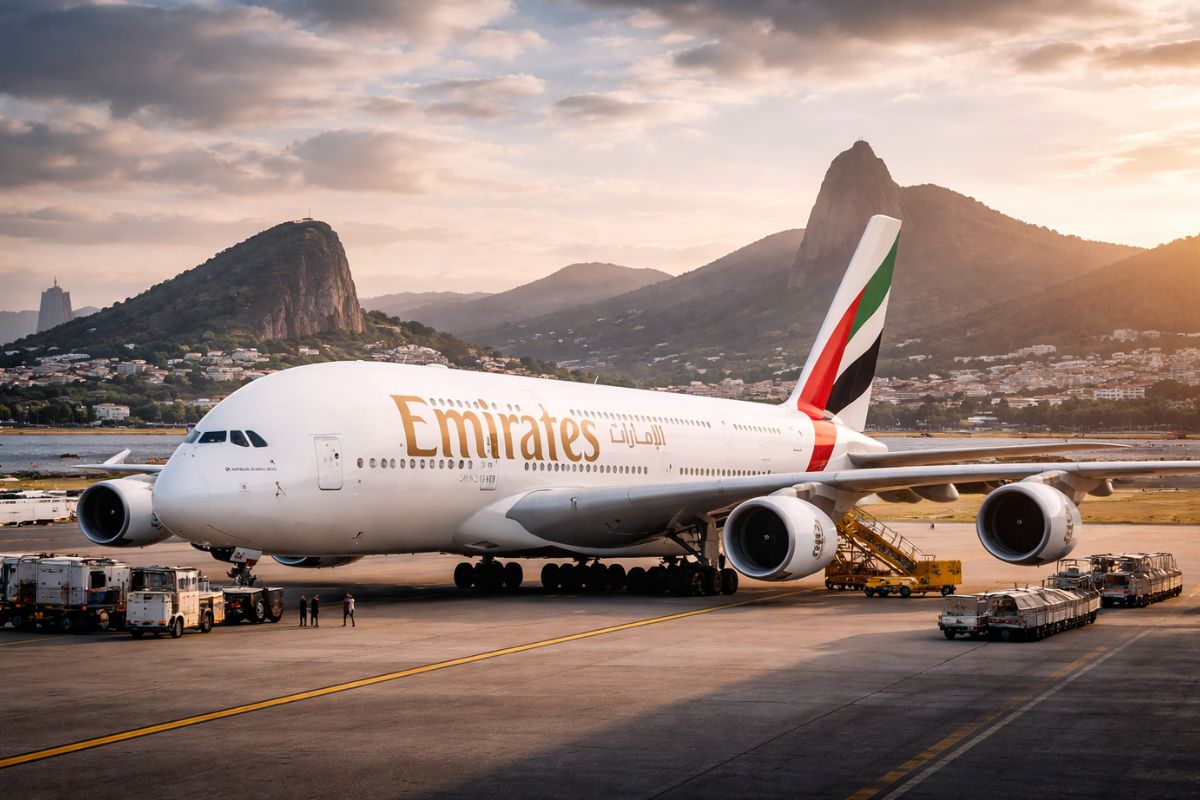
With Guarulhos Closed on Sunday (15) After Eight Drones and New Suspension on Monday Due to Bad Weather, the Airbus A380 Was Diverted to Galeão. Aircraft Followed to Viracopos, Confins, and the Interior of São Paulo. Anac Reinforced the Prohibition While Latam Counted 22 Affected Flights. The Tension Exposed Failures in the Airspace.
The closure of São Paulo’s Guarulhos International Airport pushed a line of aircraft to alternative terminals and ended up placing Galeão, in Rio de Janeiro, at the center of the episode, receiving the Airbus A380, described as the largest passenger plane in the world. The diversion drew attention not for curiosity but for the portrayal of vulnerability when drones enter the game and disrupt the country’s main terminal.
On Sunday (15), Guarulhos was closed for more than two hours after the presence of eight drones in the approach area, and on Monday, operations were suspended again at a similar time due to adverse weather conditions. Among reports from pilots, police activation, and Anac’s guidance, the case exposed a sequence of decisions made in minutes, directly impacting flights and passengers.
The Closure in Guarulhos and the Sequence of Reports
The chronology of Sunday in Guarulhos began with pilots reporting drones around 4:10 PM, which led to the initial closure of the runways for about 20 minutes.
-
Survivor of 1966 SS Daniel J. Morrell Shipwreck in Lake Huron Recounts 38-Hour Ordeal in Extreme Cold

-
The Greatest Hoax in World Cup History? The Film That Denied Brazil’s 1958 Victory and Exposed How Fake Evidence Can Seem Convincing on TV
-
Fake South Korean Online Stores Offer Shopping Thrill Without Spending Money or Receiving Products
-
The War of Jenkins’ Ear: How a Severed Ear Sparked One of the 18th Century’s Most Unusual Conflicts


The interval may seem short on the clock, but at an airport the size of Guarulhos, every minute of runway closure triggers a domino effect on arrivals, departures, and positioning of aircraft.
After the runways reopened at 4:40 PM, a new report prompted another closure.
The pilot of flight LA3429 from Latam stated he saw a drone passing close to the left wing during the approach to runway 10R, the busiest one at the airport.
The repetition of the alert heightened the sense of tension in the airspace and raised the central question: why are drones able to get so close to landing and takeoff routes in Guarulhos?
Chain Diversions and Galeão as a Pressure Valve


With Guarulhos paralyzed, aircraft were diverted to alternative airports, including São José dos Campos, Ribeirão Preto, Viracopos in Campinas, Galeão, and Tancredo Neves in Confins, Minas Gerais.
The list shows how the system resorts to a support network when the main terminal is blocked, and how traffic quickly redistributes to maintain safety and minimal flow.
It was in this context that Galeão, in Rio, received the Airbus A380 over the past two days, after the interruptions in Guarulhos.
When an Airbus A380 needs to change course, the diversion becomes more than just a change of destination, as it requires coordination of the ramp, landing slot, and ground logistics.
In addition to the A380, a Boeing 777 300ER from Qatar Airways, arriving from Doha, also headed to Galeão, reinforcing the weight of international diversions in the routine of the Rio terminal.
The Security Response and the Signal Jammer
The Military Police were called around 4 PM and mobilized teams from Special Operations and Riot Police.
According to available information, the teams used a signal jammer to contain the movement of the drones, a measure that highlights the emergency nature of the incident.
The choice of the signal jammer theoretically attempts to interrupt the remote control of the equipment, but does not resolve the structural problem if the presence of drones is reported again minutes later.
The second closure after reopening suggests that even with a quick response, the operation must deal with operational uncertainty, especially during approaches and departures that depend on predictability.
Affected Flights, Assistance, and Anac’s Rule
Latam Airlines Brazil reported that, by 6:10 PM on Sunday, 22 flights with origin or destination in Guarulhos were impacted.
In a statement, the company said it repudiates the incident, classified the situation as beyond its control, and stated it provided assistance to passengers according to Anac’s Resolution 400.
Among the redirections mentioned, six Latam flights, including international operations coming from Lima, Peru, and Santiago, Chile, were routed to Viracopos.
In this type of scenario, the passenger experience depends on clear information and viable re-accommodation, because the diversion to Galeão, Confins, or Viracopos changes connections, ground transportation, and arrival times.
Why the Airbus A380 Becomes the Symbol of the Day
The Airbus A380 did not enter history due to a planned announcement, but as a consequence of the closure in Guarulhos.
The fact that Galeão received the Airbus A380, defined as the largest passenger airplane in the world, serves as a visual marker of an operational crisis: when the largest aircraft appears off schedule, the public realizes that something has gone awry.
The presence of the Airbus A380 also shines a light on the dependence on hubs and the fragility when a central point fails.
Guarulhos concentrates flow, and this turns any interruption into a reconfiguration of pieces on the board, with alternative airports absorbing what they can and airlines adjusting routes in real-time to keep the chain functioning.
The Alert About Drones, Carnival, and the Pressure for Prevention
The GRU Airport concessionaire confirmed the closure of the runways and warned that the use of drones in the vicinity of the airport facility poses a risk to aviation safety and the integrity of individuals.
The message gains strength because the problem is not theoretical: drones have already been reported by pilots during approaches in the heart of Guarulhos.
Anac reinforced that the use of drones near airports is prohibited by law and urged the public to be more cautious, especially during the Carnival period, when there is an increase in air traffic in the country.
After a day when Guarulhos stopped and the Airbus A380 landed at Galeão due to diversion, the inevitable debate is about prevention before the next closure, and not just the reaction when the sky has already turned into a risk scenario.
The episode that took the Airbus A380 to Galeão, after drones paralyzed Guarulhos for hours and redistributed landings to Viracopos and Confins, leaves an objective mark: the safety of airspace depends on technology, oversight, and coordinated response.
In 2026, with Anac’s alert and the increase in flights during Carnival, the question becomes what needs to change so that drones do not interfere with the operation of the largest airport in the country again.
If you were boarding on Sunday (15), what would give you more confidence: seeing a signal jammer being used, receiving frequent updates from the company, or knowing that there are effective penalties for those who operate drones near Guarulhos? And, after seeing the Airbus A380 stop at Galeão due to diversion, do you think Brazil is prepared for a similar episode during Carnival?





-

2 people reacted to this.