






 Portuguese
  Spanish


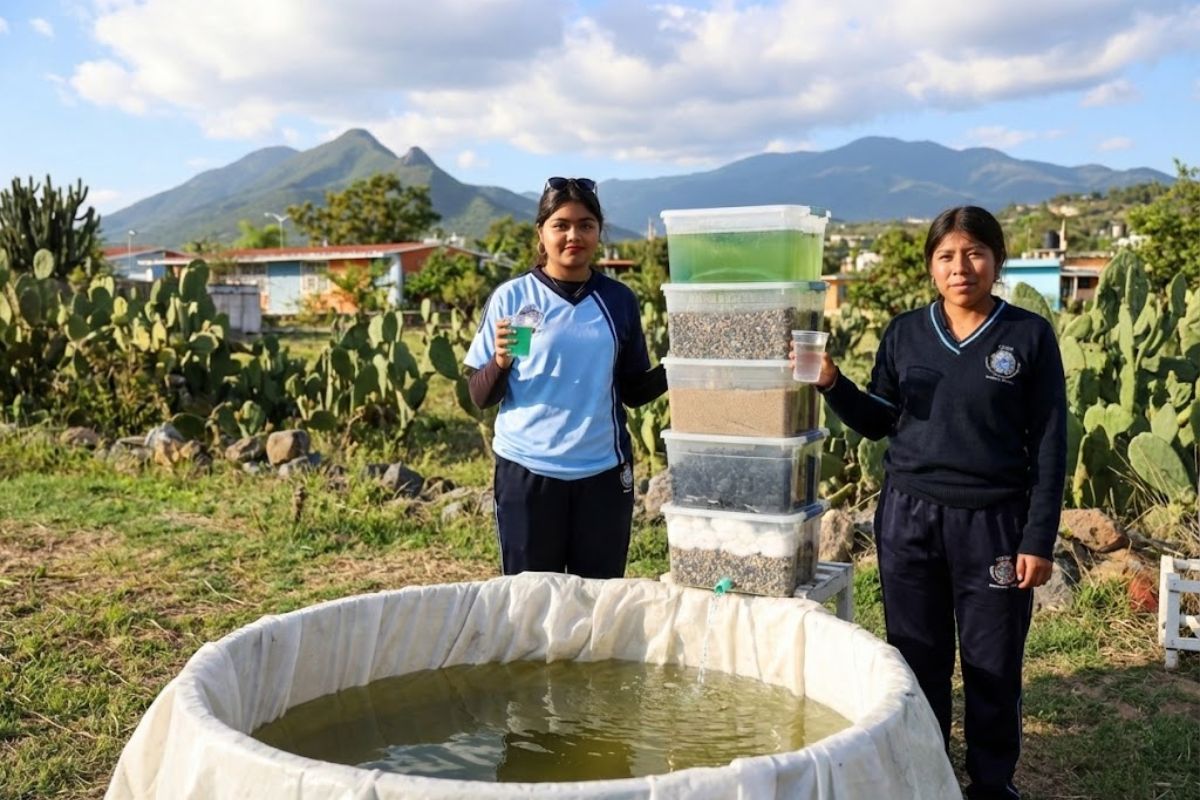


Rosa and Shan, aged 16 and 17, noticed the increase of dyed water in the workshops of Teotitlán del Valle in Oaxaca and set up filters with gravel, sand, charcoal, and cotton to recover up to a thousand liters per week, winning the Youth Water Nobel in Mexico without relying on technology.
In south-central Mexico, in Oaxaca, the color that gives identity to the rugs also leaves a trail that is hard to ignore: jugs and pots with dyed water accumulating in the yards of artisan workshops. It was in this scenario that two teenagers began to look at what almost always remains out of the final picture and decided to act with filters.
The filters created by Rosa and Shan did not come up as a “laboratory idea,” but as a response to a real routine of production, dryness, and costs. The proposal is simple in form and great in effect: to reuse the residual water from dyeing and reduce the disposal that threatens the aquifer and also harms crops when this water is used untreated.
The City That Lives off Fabric and Feels the Pressure of Water

Teotitlán del Valle carries a long relationship with textile production, described as a practice present since ancient times and linked to local identity.
-
China Develops Custom 140-Ton Electric Mining Truck with 770 kWh Swappable Battery, Deploys 290 Units in Xinjiang’s Largest Zinc Mine

-
Meta to Launch Arena, a New Prediction App Targeting 3.56 Billion Users, Competing with Polymarket and Kalshi

-
Scientist Challenges Famous Human Evolution Theory, Argues Homo Sapiens Evolved Gradually Over Thousands of Years
-
15-Year-Old American Builds Ocean Generator with PVC Pipe and 3D-Printed Propeller for $12, Wins National Prize, Presents at White House, and Makes Forbes 30 Under 30 List




It is not just a craft; it is the foundation of life for many families, with around 1,200 households associated with this activity in the community.
However, the continuity of this tradition has started to encounter a hard point: water. In a recent context of scarcity, production stops being just “work” and becomes also the management of a lacking resource.
When water becomes rare, what used to be routine turns into urgency, and daily decisions, such as whether to dispose of or try to reuse, begin to carry environmental and economic weight.
How Much Color “Drinks”: Liters, Square Meters, and an Account That Doesn’t Add Up

The process of making colorful rugs can take weeks of work and also a lot of water, as threads are soaked and treated to receive pigments.
One fact stands out because it transforms feeling into measure: a small area of 1 square meter can require 100 liters.
In workshops producing about 5 or 10 rugs of that size, consumption can reach 500 to 1,000 liters per week.
This volume, in a drought-stricken region, pressures production and raises costs. At a time of drought, there were artisans who had to buy water from tank trucks to fulfill orders, highlighting how the lack of water is not an abstract idea: it alters the local economy.
What the Two Teenagers Saw and Why This Changed the Course of the Project

The turning point begins when Rosa, while working in the workshop yard, faces the increase of the colored water that was accumulating there.
This perception was not neutral: along with concern for disposal came the fear of contamination of the aquifer and the doubt about what that water carried after dyeing.
She returned to high school with a clear goal: to find a solution for the dyed water. Together with her partner Shan, the idea evolved into a system of homemade filters designed to be applied without relying on industrial infrastructure.
The logic is straightforward: if the solution doesn’t fit the community’s reality, it won’t happen, even if it’s “more technological.”
How the Filters with Gravel, Sand, Charcoal, and Cotton Work

The system created by Rosa and Shan is described as jars filled with natural materials. In the first stage, gravel and sand act as layers that retain suspended solids.
Practically speaking, this means holding back some of what arrives mixed with the water, such as particles, residues, and dirt from the process.

Next, charcoal and cotton are added to reduce contaminants, color, and odor. This is where examples of what is intended to be controlled emerge, such as coliforms and ammoniacal nitrogen, along with the pigment load itself.
The central point is that the filters do not “erase” the water from the process; they try to return it to the cycle with less risk and more utility.
Reuse Without Repeating the Error: pH, Dyeing, and Irrigation with Care
The project is presented as an initial phase of experimentation. The young women mention the desire to add new elements to further neutralize the pH of the water and enhance the safety of reuse.
This concern has a reason: many weavers were already using dyed water to irrigate crops, and this was killing the plants, including those from which natural pigments are extracted.
The ambition, therefore, is to close a circular cycle: to treat the water so that it returns to dyeing itself and then can be used in the fields with less impact.
It is not just about “saving water,” but about preventing reuse from becoming a new form of harm, replacing disposal with more responsible reuse.
The Youth “Water Nobel” and the Value of an Innovation That Fits the Community
Even though it may seem rudimentary at first glance, the scientific project was awarded the so-called “Youth Water Nobel” in Mexico.
The recognition points to two axes: innovation and adaptation to context. In a reality marked by economic limitations, the choice of natural, accessible, and less environmentally harmful materials is part of the technology itself.
The vision that sustains the work has a social component: to create something that each family can replicate at home without relying on expensive industrial solutions.
When the problem is collective, the response needs to be shareable, and this helps to explain why simple, well-thought-out, and applicable filters gain strength.
The School as a Motor and the Knowledge That Comes from the Workshop
The story also goes through school and a model that encourages indigenous students to value their own identity, diagnose local problems, and seek solutions consistent with the place where they live.
Agronomist Brenda Jarquín is mentioned as a teacher who promotes this type of approach and helped motivate Rosa and Shan to develop the project.
At the same time, there is a learning that does not begin in the classroom. Rosa learned practical notions of measuring, cutting, and assembling in her father’s workshop, helping with the looms.
This link between practice and study sustains a trajectory where engineering emerges from everyday life, and science becomes a tool to continue living off what the community does, with less waste and more future.
A Prototype with Developments and an Objective That Goes Beyond the Prize
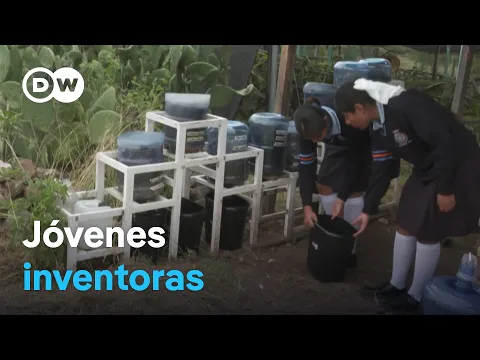

The creators themselves treat the system as a prototype and talk about implementing it in neighboring areas, seeking private or public funding. The impact, however, is not just technical: they have already inspired peers, and the example of young indigenous women gaining recognition creates a concrete reference within the class and the city.
There is also a personal horizon that intertwines with the communal one. Rosa’s father expresses the desire for her to continue studying to have a profession and that young people do not need to migrate due to lack of jobs, in a scenario where textile commerce may become more limited.
Rosa shares this goal and mentions the idea of becoming an environmental engineer to bring technology back to the community. When water is lacking, the solution also becomes permanence: to stay, work, and innovate where one was born.
The case of Rosa and Shan shows how filters can be more than an object: they become a bridge between tradition and survival in times of drought.
By transforming dyed water, once viewed as an inevitable waste, into a reusable resource, they put numbers and method into an old problem and pave the way for a more responsible cycle in dyeing and irrigation.
And in your city, is there any water reuse practice that works “in real life,” without relying on large works or expensive equipment?
If you worked in an activity that consumes a lot of water, what kind of simple filter would you trust to build with your own hands, and why?






