Portuguese
  Spanish


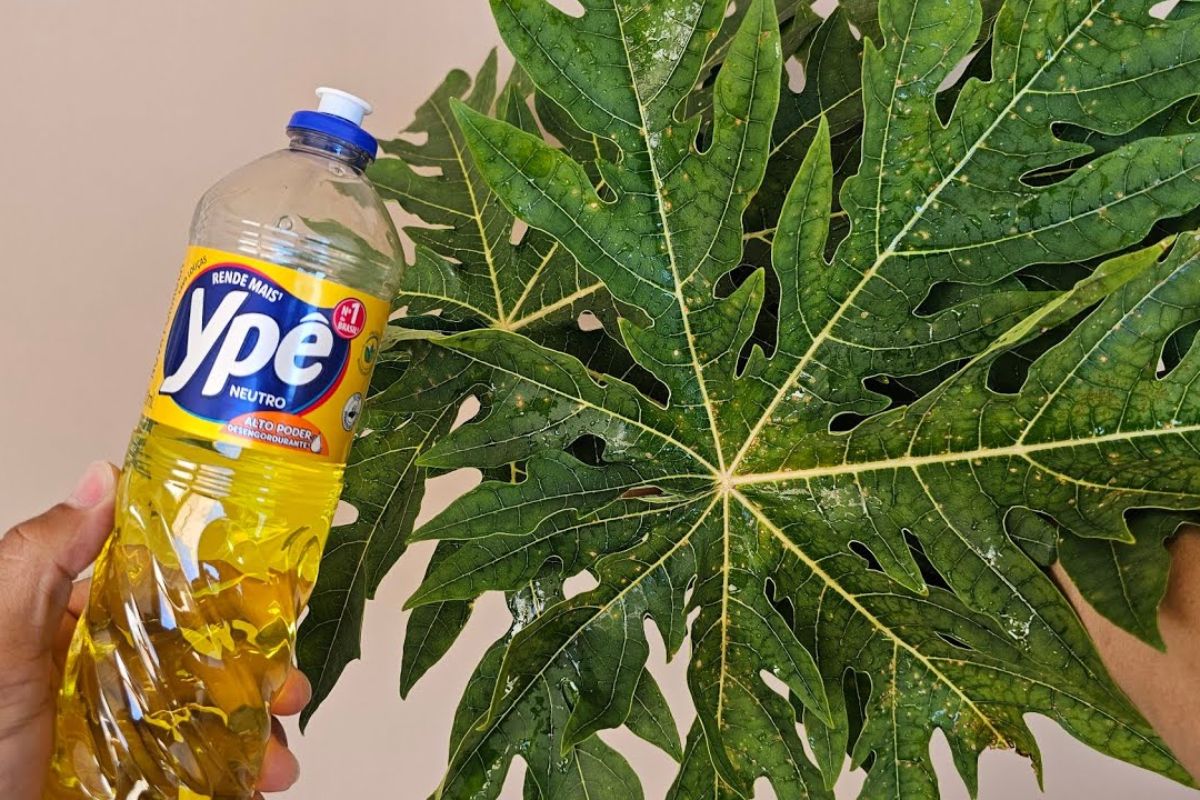


Papaya Leaf Recipe with Detergent Promises to Multiply a Bottle, Using Water, Blender, and Strainer to Extract Only the Juice, Before Mixing Baking Soda and Salt as Preservatives and Thickeners; the Result is Thick, Yields Up to Three and a Half Bottles, and Requires Care with Moisture and Residues
In tight market routines and bills, people turn to papaya leaves with detergent as an alternative to stretch the cleaning product and reduce monthly expenses without giving up having “detergent in the sink” every day. The proposal starts from a simple idea: increase volume and viscosity with water and leaves, and turn a common bottle into more available product.
The central point, however, is not a “miracle” of ingredients; it’s the process. The method depends on blender and strainer to reduce the leaf and, mainly, remove fiber before incorporating baking soda and salt, and finally, the detergent. When the sequence fails, the savings can turn into chaos, whether due to irregular texture, deposits or clogging in the bottle.
Why Papaya Leaves with Detergent Became a Household Shortcut

The economic logic of the mixture appears in repeated numbers in the demonstration: 5 liters of water to blend the leaves and, then, another liter of water in a bucket to receive the strained juice.
-
YouTuber Discovers Surreal Collection in 400-Year-Old Italian Fortress Near Florence: 419 Anvils, Giant Walruses, Ancient Church, and WWII Tunnels

-
Creative Uses for Toilet Paper Rolls That Will Change Your Perspective
-
Crab Trapped in Plastic Bottle for 62 Days Near Okinawa Highlights Little-Known Impact of Marine Pollution on Small Animals
-
Esperanza’s Bamboo Barrier in Oaxaca Redirects River and Reduces Erosion by 85% in Five Years



At the end of the sequence, a bottle of detergent is added, and the reported yield reaches three and a half bottles, “almost 2 liters,” depending on the bottle size and how much was used before.
This type of recipe gains traction because it shifts the focus from “buying more” to “yielding more” and links to concrete tasks.
The proposed application includes dishes, dishcloths, sink, stove, ceramics, and bathroom. The gain lies in cost per use and continuity of domestic stock, not in complex chemical promises.
What the Blender and Strainer Do, Besides Mixing

In practice, blender and strainer are the technical heart of the proposal. The blender is used to chop the leaves in room temperature water for about 3 to 5 minutes, reducing the plant material to a greenish liquid.
The strainer is used to separate what “stays” from what “goes” to the solution and is reinforced by cloth to retain even more fiber.
This straining step with cloth is not just an aesthetic detail: it serves as a control for residues.
The recipe insists on “only the juice” specifically to avoid particles that may interfere with the final texture, form deposits, and hinder use in bottles and dispensing nozzles.
Without proper straining, the product may yield, but the user experience tends to worsen.
Baking Soda and Salt Enter as Preservatives and Thickeners

After the strained juice enters the bucket with water, the recipe adds a tablespoon of baking soda and stirs until dissolved.
The baking soda is described as a preservative and “enhancer,” in an attempt to provide more stability to the solution and prevent the mixture from “going bad” over time.
Next, a tablespoon of salt enters with the same logic. The salt is presented as a preservative and thickener, helping to thicken and give “body” to the product.
The operational point, according to the sequence itself, is simple: baking soda and salt need to dissolve well before the detergent is added to avoid lumps and variations in consistency in the bottle.
Where the Mixture is Applied and Where it Tends to Fail
When papaya leaves with detergent are used for dishes and cloths, the expectation is for a thicker product, with a feeling of “yield” and a texture similar to detergent.
The demonstration mentions use in the sink and stove, suggesting a focus on everyday dirt and surface cleaning, in addition to ceramics and bathroom.
The problem is that “universal” use often stumbles over practical details.
A thicker solution may require more rinsing and, if the strainer did not hold back residues, it may leave traces in dispensing nozzles or accumulate at the bottom of the bottle.
The promise of making things easier can turn into more time scrubbing, especially when the goal was precisely to save time and money.
Yield, Thickness, and the Risk of a Promise Without Control
The phase that changes the appearance is the gradual addition of the detergent while constantly mixing.
The demonstration itself states that “just adding the detergent” makes the solution begin to thicken, changing from green liquid to a denser texture, resembling a product ready for household use.
In the end, the filling is done with a funnel in reused bottles, and the final volume reported reaches three and a half bottles, “a little more,” with the promise of lasting the whole month depending on usage.
Still, there is a technical point that determines if the savings are worth it: moisture control, absence of fiber, and homogenization.
Without proper straining, without an efficient blender, and without complete dissolution of baking soda and salt, the “multiplying” turns into an irregular product.
Storage, Moisture, and What Decides if the Savings Remain
The recipe draws attention to a silent enemy: moisture and residue.
By using a large volume of water, the method creates a product that may vary in consistency over time, especially if exposed or if the bottle does not seal properly.
Hence, the straining step with cloth appears as an attempt to reduce solid material that could accelerate separation and deposits.
Organizational factors come into play as well. A reused bottle requires clear labeling and should be stored out of reach of children and pets, as the thick appearance may confuse.
A homemade product that “yields” only makes sense if it remains usable, without hardening in the nozzle, not separating quickly, and not turning into a source of mess due to leakage.
Limits of Use and Home Safety That Almost No One Takes into Account
Even when the goal is savings, cleaning products require caution.
The recipe uses common ingredients, but mixes concentrates and increases volume, which demands attention to storage and handling.
A thick product in a reused bottle can be confused, leak, or dry out at the nozzle, causing waste and risk of inappropriate contact.
Another limit is use on delicate surfaces.
The proposal mentions kitchen and bathroom but does not provide tests on sensitive materials.
In domestic routines, the most prudent approach is to observe reactions in a small area and avoid combinations with other cleaning agents not mentioned in the sequence.
Papaya leaves with detergent may yield, but do not eliminate the need for basic care.
The real discussion behind papaya leaves with detergent is less about a “secret” and more about method: blender, strainer with cloth, dissolution of baking soda and salt, and final consistency that allows use without clogging bottles.
What seems like quick savings can turn into extra work if the solution becomes unstable or carries residue.
In your home, which product weighs more in the month and which one would you most like to see “yield”: detergent, disinfectant, or multipurpose cleaner? And, if you have tried papaya leaves with detergent, what was your critical point: strainer, blender, baking soda, salt, or the final thickness?