Portuguese
  Spanish


While the US and China compete to be the first to put a hypersonic plane on a commercial route, Japan tested a small demonstrator about 2 meters long equipped with a hydrogen ramjet engine in 2026 under conditions equivalent to Mach 5 flight at JAXA’s Kakuda center, according to a report by AeroTime.
The test exposed the vehicle to temperatures of around 1,000 °C (approximately 1,832 °F) on the outer layer, simulating the air that would envelop the aircraft during actual flight at 5 times the speed of sound.
The thermal protection system kept the interior at normal electronic operating temperatures.
-
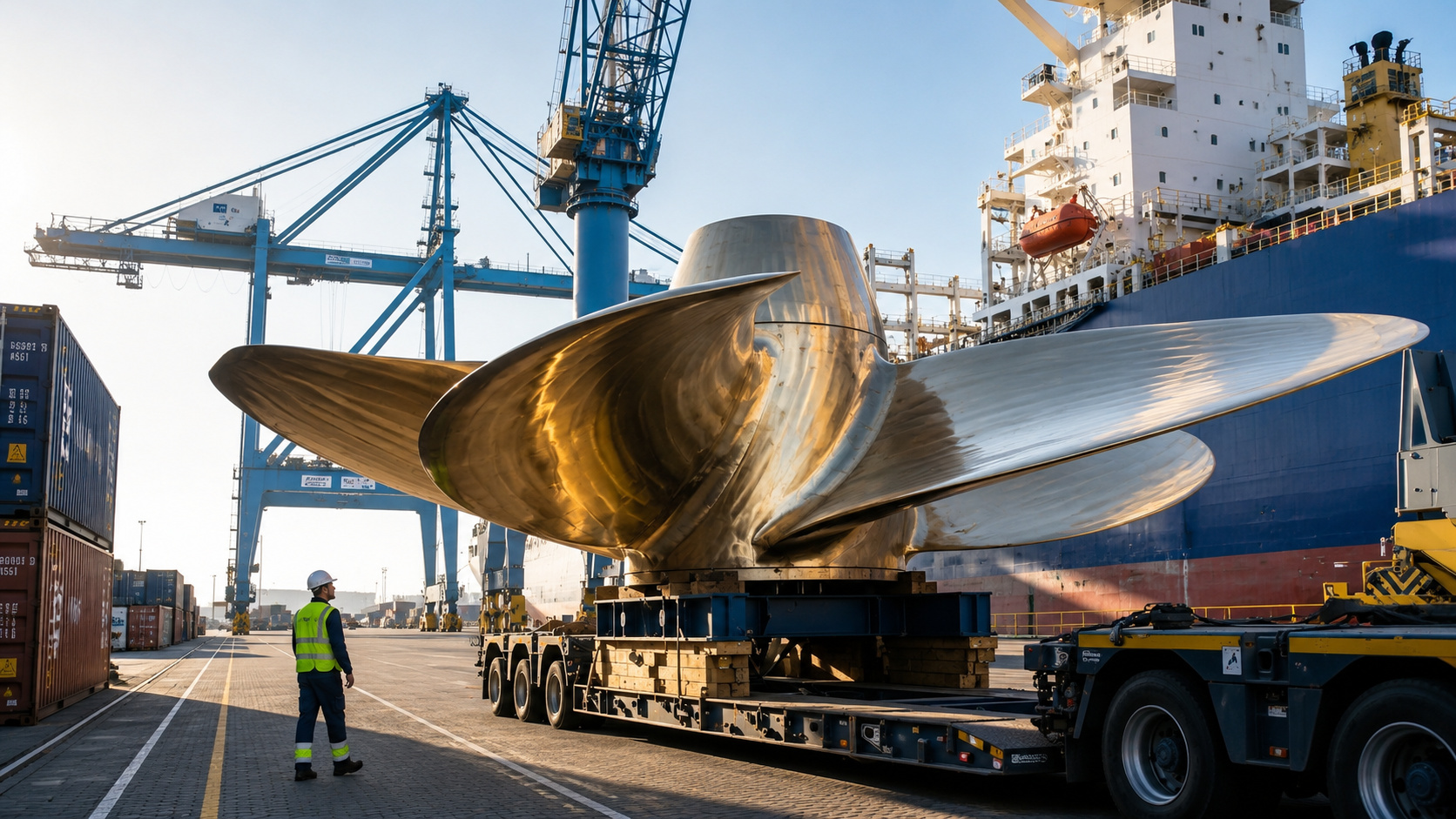
131-Ton Naval Propeller, Costing Up to $4 Million and Taking 4 Months to Manufacture, Powers the World’s Largest Cargo Ships Almost Invisibly

-
Brazil’s Maceió Port Joins Decarbonization Efforts with Study to Supply Clean Energy to Cruise Ships

-
Brazilian Port Expands Ship Capacity to 9.5 Meters, Boosting Cargo Transport and Reducing Logistics Costs
-
New Smart Radar Begins Issuing Fines to Solo Drivers in Carpool Lanes, Uses Cameras to Count Occupants, Changing Traffic Enforcement Rules on Busy European Roads


The test was led by the Japan Aerospace Exploration Agency (JAXA) in partnership with Waseda University, the University of Tokyo, and Keio University.
Funding came from the Japan Society for the Promotion of Science through the KAKENHI scientific research grant program.
What the hydrogen ramjet did under Mach 5 conditions
The ramjet engine differs from the conventional turbojet. Instead of using a mechanical compressor, it takes advantage of the vehicle’s own speed to compress the intake air and burn fuel in an open chamber.
According to technical literature and NASA’s educational page, classic ramjets operate with internal flow slowed to subsonic speed before combustion.
Above Mach 5, scramjet technology generally comes into play, maintaining internal supersonic flow.
The Japanese demonstrator used a classic ramjet in Mach 5 regime, simultaneously validating 3 critical components: high-speed combustion, the thermal protection system, and aerodynamic control surfaces.
On the other hand, data such as the exact duration of the test in seconds, thrust generated, and the free-flight prototype schedule were not publicly disclosed.
JAXA only speaks of gradual steps towards a hypersonic “testbed” launched by a sounding rocket.
The numbers that explain the technical leap of 2026
The Mach 5 regime corresponds to approximately 6,174 km/h at sea level and about 5,300 km/h at a cruising altitude of 25 km.
Commercial planes typically fly at Mach 0.8, close to 900 km/h.
According to Universe Today, in absolute terms, the Mach 5 number equates to 5 times the speed of sound.
The stagnation temperature on exposed surfaces reaches 1,000 °C precisely due to air compression and friction.
Subsonic commercial planes require thermal protection for only a few degrees of aerodynamic heating. Mach 3 aircraft, like the now-retired American SR-71 Blackbird, dealt with titanium fuselage at 300 °C.
Mach 5 multiplies the thermal challenge by more than 3 times.
In parallel, the choice of hydrogen as fuel has 2 advantages. The first is an energy density 3 times higher per unit mass than kerosene.
The second is the very high adiabatic flame temperature, ideal for ramjet at Mach 5.

Technical reveal: integrated airframe-propulsion control
In the background, the demonstrator tested the concept of “integrated airframe-propulsion control.” The central idea is to treat the fuselage and the engine as a single system, not as separate components, according to a report by Aviation Week.
In hypersonic regime, the air compressed by the plane’s own shape functions as part of the engine’s compressor. The ramjet air intake, called the “inlet,” is integrated into the vehicle’s lower surface.
Therefore, any change in the plane’s angle of attack directly alters the engine’s operation.
The Waseda University group developed the automatic control algorithm that synchronizes the 2 systems. The system reacts in less than 50 milliseconds to angle variations, keeping the engine in a stable operating zone.
Above all, the test validated the thermal protection system with advanced ceramic materials. Internal temperatures remained close to 60 °C, according to JAXA, against 1,000 °C on the external surface.
How the Japanese ramjet compares to competitors
The hypersonic race involves 4 main players in 2026. The US has the Quarterhorse program from the company Hermeus, aiming for Mach 5 in a larger demonstrator, with flight in 2027.
The UK bets on the SABRE engine from Reaction Engines, which combines turbojet and ramjet cycles. China operates DF-17 hypersonic missiles with the DF-ZF glider vehicle in production since 2019.
Russia has the Avangard and the Kinzhal missile.
According to the Hermeus website, the Texas company targets Mach 5 commercial flight with an aircraft for 20 passengers.
The public schedule is 2029 for the Quarterhorse flight test and commercial operation starting in 2032.
According to Aviation Week, the Japanese program is in the fundamental research phase. No free-flight schedule has been published.
The comparison brings the current test closer to the 1960s X-15 than to a short-term commercial program.
Human reveal: Hiroshi Yamakawa leads JAXA in the hypersonic race
The human face of the research is Dr. Hiroshi Yamakawa, president of JAXA since 2018. A space engineer with a doctorate in orbital mechanics, he is 65 years old and previously led lunar exploration programs and asteroid missions.
JAXA was founded on October 1, 2003, from the merger of 3 pre-existing entities. The Institute of Space and Astronautical Science, the National Aerospace Laboratory, and the National Space Development Agency came together into a single body.
In parallel, the Japanese industrial ecosystem includes IHI Corporation, founded in 1853 as Ishikawajima shipyard, now a jet engine producer.
The current CEO is Hiroshi Ide. Mitsubishi Heavy Industries has been operating since 1884 under the leadership of President Eisaku Ito.
On the other hand, in the specific case of the 2026 ramjet test, neither IHI nor Mitsubishi Heavy Industries appear in the official statements.
The research is predominantly academic and institutional, with the future possibility of technology transfer to these companies.

Ramjet vs scramjet history since 1960
The concept of ramjet has existed since World War II. The German V-1 missile, launched in 1944, used a pulsejet, a cousin of the ramjet.
The first manned Mach 6 aircraft was the American X-15 in 1967, with pilots like William “Pete” Knight at Mach 6.7.
The scramjet evolved in the 1990s with NASA’s X-43A, which reached Mach 9.6 in 2004. China tested the ZF DF-ZF from 2014.
Australia demonstrated scramjet in a sounding rocket in the 2000s with the University of Queensland’s HyShot program.
In parallel, commercial hypersonic transport is a long-term projection. According to JAXA, the ultimate goal is to cross the Pacific in about 2 hours, i.e., flights like Tokyo-Los Angeles in 120 minutes.
The suborbital version rises to 100 km altitude, at the so-called Kármán line.
As detailed by Universe Today, this commercial scenario is at least 15 to 20 years from the current state. The 2026 test is fundamental but far from operation.
It is worth remembering the advancement of centralized digital platforms in other sectors as a reference for technological transformation.

Future reveal: the hypersonic testbed launched by a sounding rocket
The next step planned by JAXA is the development of a larger hypersonic “testbed.” The vehicle would be launched by a sounding rocket to Mach 5 altitude and then separated for free flight.
In parallel, there is a long-term plan for 2 distinct categories of commercial aircraft. The first is a hypersonic commercial plane for transpacific routes in about 2 hours.
The second is a suborbital spaceplane reaching altitudes close to 100 km at the Kármán line.
According to Aviation Week, a specific free-flight schedule for the testbed has not been disclosed. Similar programs like the X-43A took approximately 10 years from concept to flight.
The American Hermeus Quarterhorse projects free flight in 2027.
- Test location: JAXA’s Kakuda Center, in combustion wind tunnel
- Demonstrator: about 2 meters long, ramjet engine
- Fuel: hydrogen
- Equivalent speed: Mach 5 (≈ 6,174 km/h at sea level)
- External temperature: 1,000 °C (≈ 1,832 °F)
- Internal temperature: close to 60 °C
- Partners: JAXA + Waseda + Tokyo + Keio (JSPS KAKENHI funding)
- Long-term vision: Pacific in 2 hours + suborbital spaceplane 100 km

The points that still require additional research
Despite the progress, 3 fronts still require additional research. The sustained duration of the engine in actual free flight is the first.
In a wind tunnel, the test lasts seconds. In flight, the engine needs to operate for several minutes.
On the other hand, integration with landing, takeoff, and cruising systems at different speeds requires a combined engine, not just a ramjet. Solutions like the British SABRE attempt to address this.
Finally, certification for human commercial hypersonic transport is still an open regulatory territory by the Federal Aviation Administration and the International Civil Aviation Organization.