Portuguese
  Spanish


Project in Martiherrero, village of Ávila, uses wool from local producers to cover municipal pool umbrellas, after low prices made shearing unprofitable, according to Xataka and cited rural entities, while the initiative Shadow of Origin tries to test a thermal use for previously undervalued material in the Spanish countryside.
Wool became an unexpected solution in Martiherrero, a village with less than 400 inhabitants in the province of Ávila, Spain, after the price drop turned the material into an economic problem for rural producers. The solution found was to cover the municipal pool umbrellas with locally sourced wool.
The initiative was named “Shadow of Origin” and is supported by the Martiherrero City Council and the Kerbest Foundation. According to Xataka, the pilot project used more than 160 kilos of raw wool, which was selected and conditioned before being applied as thermal coating on the umbrellas.
Wool lost value and became a challenge for rural producers
The devaluation of wool at its source changed the economic logic of a material that, in the final trade, is still associated with expensive pieces and natural fabrics. The problem is that the price paid to the rural producer has fallen to very low levels, while shearing remains a necessary stage of the activity.
-
Brazilian Ship Refuels with 30% Renewable Fuel in Rotterdam: Transpetro Tests B30 for the First Time, Aiming to Reduce Maritime Emissions and Showcase a Quiet Transition in Key Global Ports

-
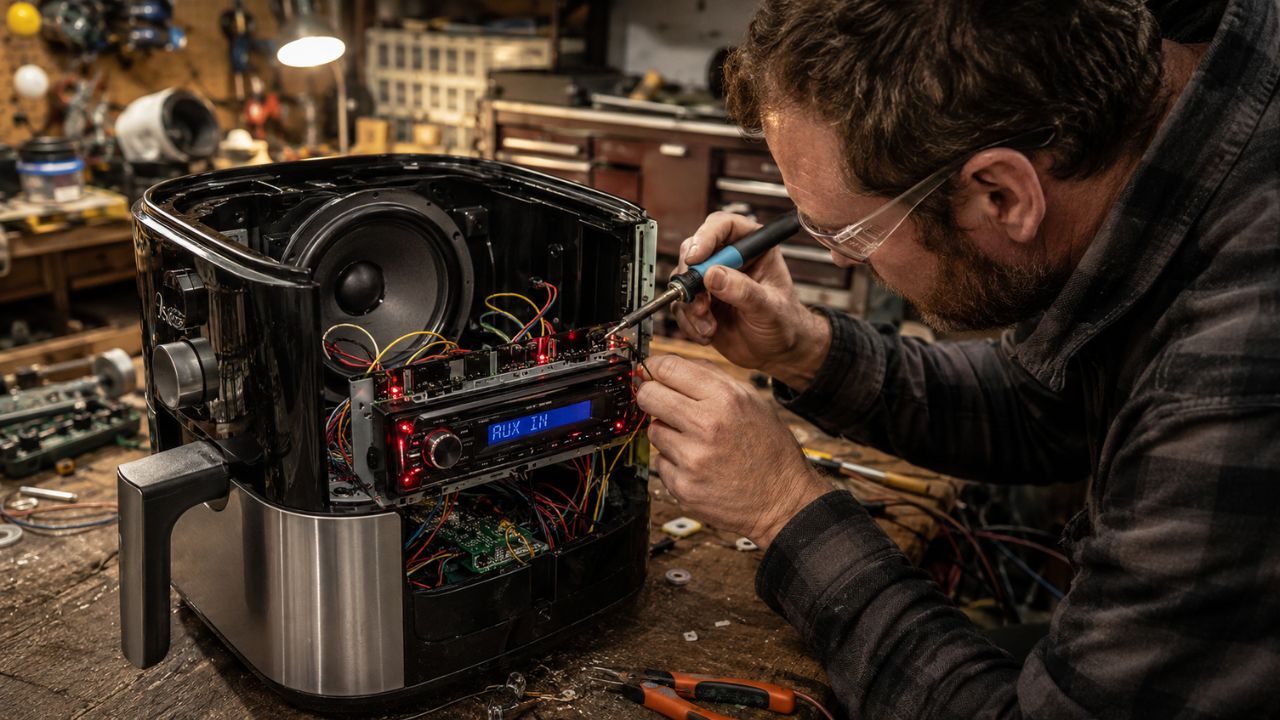
Brazilian Man Ingeniously Transforms Air Fryer into Functional Speaker with Radio and Volume Controls
-
Rows of “stone balls” emerge at low tide on California beach, with formations up to 1.5 meters aligned like a Pacific bowling alley

-
Japan Installs 800 Cameras in Tohoku Mountains Amid Rising Bear Attacks




According to data cited by Xataka from the Avicom Cooperative, the cost of shearing is €1.50 per animal, while wool from common breeds such as Assaf, Churra, and Castellana can yield about 5 cents per kilo. With an average production of 2.3 kilos per unit, the math doesn’t add up for many in the countryside.
Pool umbrellas became a showcase for the material
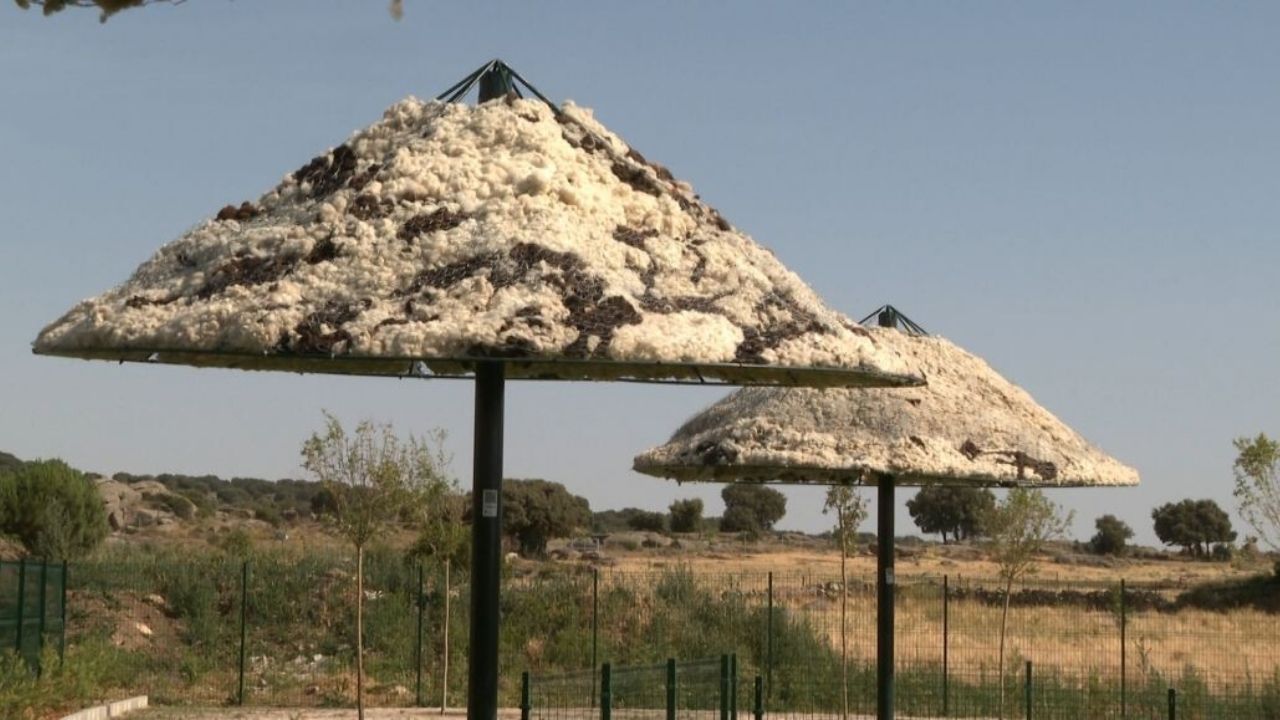
Instead of treating wool merely as waste or a worthless byproduct, the project in Martiherrero tested a different use: applying it as a coating on umbrellas at the municipal pool. The proposal transforms a rural problem into a visible solution for residents and visitors.
The result draws attention because it shifts wool from its traditional place in clothing and places it in an urban summer equipment. The idea seems contradictory at first glance, but it makes sense when the material is viewed as thermal insulation, not as a piece of clothing.
Thermal property explains the use on hot days
Wool is known for retaining heat in winter clothing, but its function as an insulator is not limited to cold. The source highlights that the material has low thermal conductivity, with values between 0.0324 and 0.0436 W/mK, a range compatible with thermal insulation standards used in construction.
This helps explain the test on the umbrellas. The goal is not to “heat” the pool, but to create a barrier against heat transfer, using a natural material that also presents acoustic behavior and fire resistance, according to the technical data cited in the original text.
Project is small compared to the volume produced in Spain
Despite the visual appeal, the “Origin Shade” project still has a limited scale. Just over 160 kilos of wool were used, while the annual Spanish production exceeds 20,000 tons, according to MAPA data cited by Xataka.
The source also mentions about 9,500 tons annually of medium-fine wool, the most produced variety in the country. This means that the initiative does not solve the sector’s crisis alone, but it serves as a practical demonstration of new possible uses for an undervalued material.
Wool crisis is related to the international market
The drop in wool prices in Spain did not arise from a single factor. The source points out that, before the pandemic, China was the main destination market and absorbed about 70% of the supply. With the pandemic, exports were interrupted and stock increased.
Later, the Chinese market partially closed after outbreaks of sheep pox recorded in Spain since 2022. The competition from Australian wool also pressured the sector. In practice, a traditional material from the Spanish countryside was caught between market loss, accumulated stock, and global competition.
Circular economy appears as a path, but not as a magic solution
The umbrella project fits into the logic of the circular economy because it attempts to reuse a rural by-product instead of discarding it or selling it at negligible prices. Wool gains a new function and starts to be seen as a raw material for thermal comfort.
Even so, the source’s own analysis indicates that the selection and conditioning processes make the operation difficult to profit from under current market conditions. For the idea to grow, continuous public or private investment would be necessary, along with scale and organization in the production chain.
Use in construction expands possibilities beyond the pool
The experience in Martiherrero also points to a broader field: the use of wool as an insulating material. Low thermal conductivity, acoustic behavior, and fire resistance help explain why it can be considered for applications related to construction and environmental comfort.
This does not mean that wool will immediately replace industrial materials on a large scale. What the project shows is more specific: a devalued rural product can gain new functions when it moves away from the traditional logic of clothing and enters solutions for insulation, shade, and reuse.
A curious idea for a real rural problem
The story of Martiherrero draws attention because it combines simplicity and symbolic scale. Covering umbrellas with wool does not solve the entire sector’s crisis, but it transforms an economic problem into something visible, testable, and easy for the public to understand.
The question that remains is whether such initiatives should be treated as interesting local experiments or as a starting point for larger policies of rural material reuse. Do you think wool can gain a new market in construction and thermal comfort solutions, or does this type of project tend to remain just a curiosity? Leave your opinion in the comments.