Portuguese
  Spanish


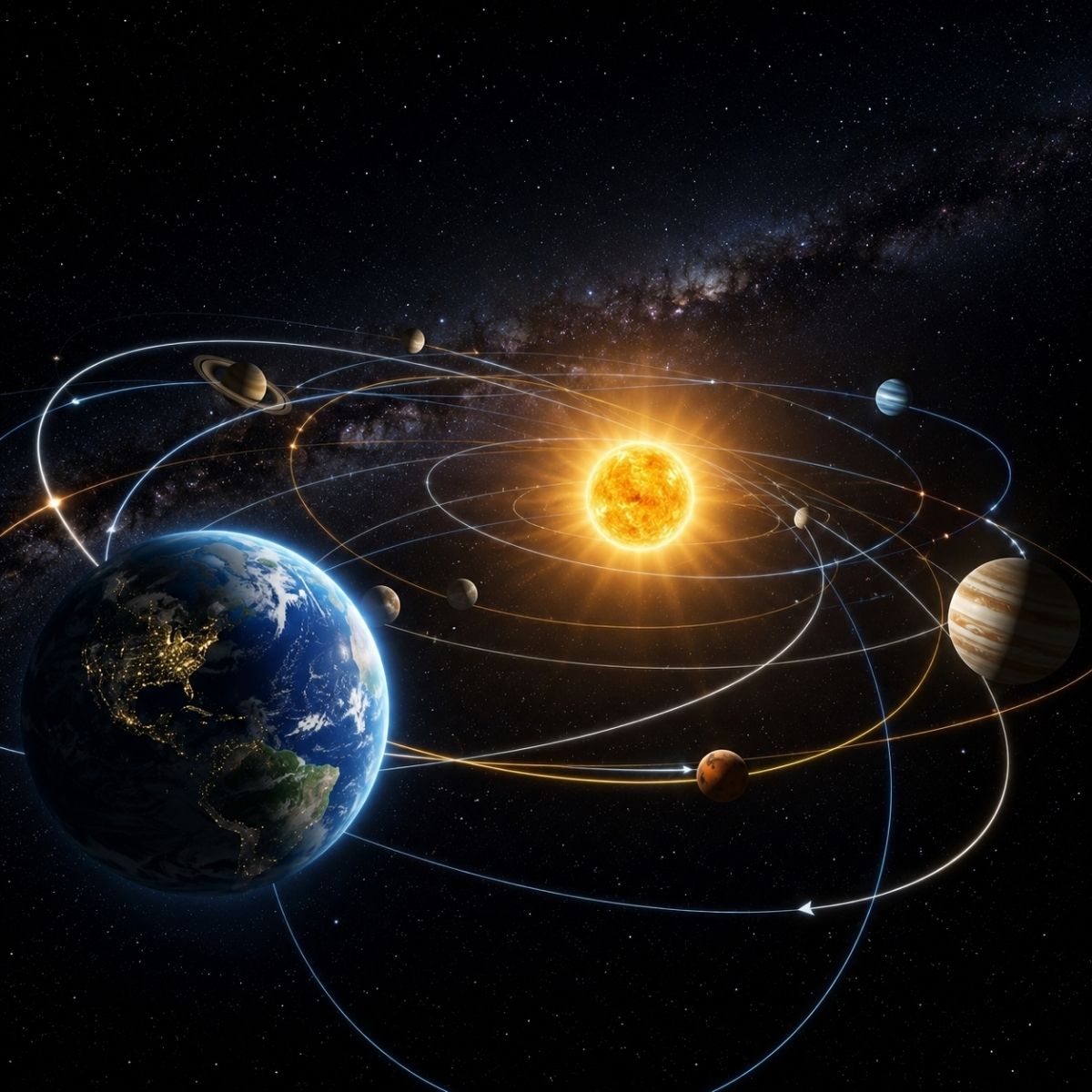


The Earth does not orbit exactly around the Sun: all planets orbit the Solar System’s barycenter, a point near the Sun but which Jupiter and the gas giants displace outside the star’s surface when they align, a phenomenon that school simplified by teaching that the Sun is the fixed center of orbits.
Those who learned in school that the Earth orbits the Sun received an explanation that was correct in essence but simplified in a detail that changes the perspective on how the Solar System truly works. The Earth and all other planets do not orbit exactly the center of the Sun: they orbit a point called the barycenter, which is the center of mass of the entire Solar System, located very close to the Sun (because the star concentrates 99.86% of the system’s mass) but not necessarily within it. The difference seems subtle, and in most school explanations it is irrelevant, but when considering the gravitational influence that massive planets like Jupiter exert on the star, the barycenter can shift outside the solar surface, and in that scenario, the Earth ceases to orbit the Sun in the literal sense of the word.
The explanation we received in school was not a lie: it was a necessary simplification to teach a complex concept in an accessible way. Saying that the Earth orbits the Sun is such a good approximation that it works for practically any everyday calculation, and the difference between orbiting the center of the Sun and orbiting the Solar System’s barycenter is small enough not to affect anything an elementary school student needs to know. According to Revista FT, what changes when one understands the concept of the barycenter is the understanding that gravity is not a one-way street: the Earth pulls the Sun just as the Sun pulls the Earth, and Jupiter pulls the Sun with enough force to displace the point around which both revolve outside the star itself.
What is the barycenter and why does it change where Earth orbits

Every system of two or more bodies has a center of mass, and it is around this point that the bodies mutually orbit. In the case of the Solar System, the barycenter is the point where all the system’s mass is concentrated for gravitational calculation purposes, and since the Sun represents 99.86% of this mass, the barycenter remains very close to the center of the star in most planetary configurations. Close, however, does not mean identical: the remaining 0.14% of the mass is distributed among planets, moons, asteroids, and comets, and the position of each of these bodies influences where the barycenter shifts at any given moment.
-
She spent 73 years breathing inside an iron lung, survived the aftereffects of polio, and became the last woman in the United States dependent on the equipment before dying at 78 years old.

-
Brazilian students created a $1 filter using pine bark, cotton, and 3D-printed parts to clean cassava wastewater, reduce the toxicity of a hazardous waste, and transform contaminated water into biofertilizer.

-
Astronaut from Artemis II steps down after mission to the Moon and decision surprises after a record of 406,771 km, a historic 10-day journey, and an unprecedented achievement for Canada.

-
A fossil kept for years in a small museum in Montreal concealed 450-million-year-old soft tissue, a discovery that has only happened once before in history.


The concept works the same way on smaller, more intuitive scales. A ruler of homogeneous mass has its center of mass at its midpoint, and if supported on a finger in that position, it remains in balance, but a hammer has its center of mass shifted towards the heavier end, and the finger needs to be positioned closer to the hammer’s head to balance it. In the Solar System, the “hammer’s head” is the Sun, but the planets act as additional weight that shifts the balance point: the more massive the planet and the farther away it is, the greater the displacement it produces in the barycenter, and therefore the greater the distance between the point around which the Earth actually orbits and the geometric center of the Sun.
Why Jupiter is the planet that most affects Earth’s orbit

If the Sun concentrates 99.86% of the Solar System’s mass, Jupiter accounts for about 70% of the remaining mass. This proportion makes Jupiter the planet that individually displaces the Solar System’s barycenter the most, and the effect is so significant that the point around which Jupiter and the Sun mutually orbit lies outside the solar surface: Jupiter does not orbit the Sun in the traditional sense, but around a point in space that is not within the star. The other giant planets (Saturn, Uranus, and Neptune) also contribute to the displacement, but none individually as much as Jupiter.
Earth, being much smaller than Jupiter, shifts the barycenter imperceptibly when considered alone. If the Solar System had only the Sun and Earth, the barycenter would be practically at the center of the star, and the school’s simplification would be almost perfect. But Earth is not alone: it shares the Solar System with Jupiter, Saturn, and the other planets, and the position of all of them influences where the barycenter is at any given moment. When the gas giants align on the same side of the Sun, they pull the barycenter out of the solar surface, and in this scenario, Earth orbits a point in the empty space between the Sun and the giants, not the center of the star that illuminates our days.
How the barycenter moves and what this changes for Earth
The barycenter of the Solar System is not a fixed point: it continuously shifts as the planets move in their orbits. The most useful analogy is that of sailors walking on a ship’s deck, where the vessel’s center of mass changes as people distribute themselves, and in the Solar System, the heaviest “sailors” are Jupiter, Saturn, Uranus, and Neptune, whose orbital positions determine whether the barycenter is inside or outside the Sun at any given moment. The movement of the barycenter is measurable and has been documented by astronomers studying exoplanets, because the same technique (detecting the wobble that planets cause in their stars) is used to discover planets around other suns.
For everyday life on Earth, the barycenter’s displacement produces no perceptible effect. Earth continues to receive the same amount of sunlight, the seasons continue to function by the same mechanism of axial tilt, and no practical consequence arises from the fact that the point around which our planet orbits is a few thousand kilometers closer or further from the center of the Sun. The difference is conceptual, not functional: it matters to those who want to truly understand how gravity works and to astronomers who use stellar wobble to hunt for planets in other systems, but it changes nothing in the routine of those who live on Earth’s surface and only need to know that the Sun rises in the east and sets in the west.
What happens between Earth and the Moon is the same phenomenon on a smaller scale
The barycenter between Earth and the Moon illustrates the concept in a way that helps visualize what happens in the entire Solar System. Earth is much more massive than the Moon, but the Moon has enough mass to shift the barycenter of the Earth-Moon system to a point that does not coincide with the center of our planet: it is about 5,000 kilometers from Earth’s center, still within the planet but significantly displaced relative to the geometric center. This means that Earth and the Moon mutually orbit around this point, and an outside observer would see not a Moon revolving around a stationary Earth, but two bodies dancing around a common point that is closer to the heavier partner.
The difference between the Earth-Moon system and the Jupiter-Sun system is one of scale. In the case of Earth and the Moon, the barycenter remains within Earth because our planet is proportionally much more massive than its satellite, but in the case of Jupiter and the Sun, the barycenter lies outside the solar surface because the mass ratio between the two is less unequal than it seems. The physics is the same: two bodies orbit their common center of mass, and the position of this center depends on their mass and the distance between them. What changes is that in Jupiter’s case the effect is large enough for the barycenter to escape the more massive body, a phenomenon that schools choose not to explain to avoid complicating a concept that is already difficult to visualize without advanced mathematics.
And you, did you know that Earth doesn’t always orbit the Sun? Do you think schools should teach the concept of the barycenter? Leave your opinion in the comments.