Portuguese
  Spanish


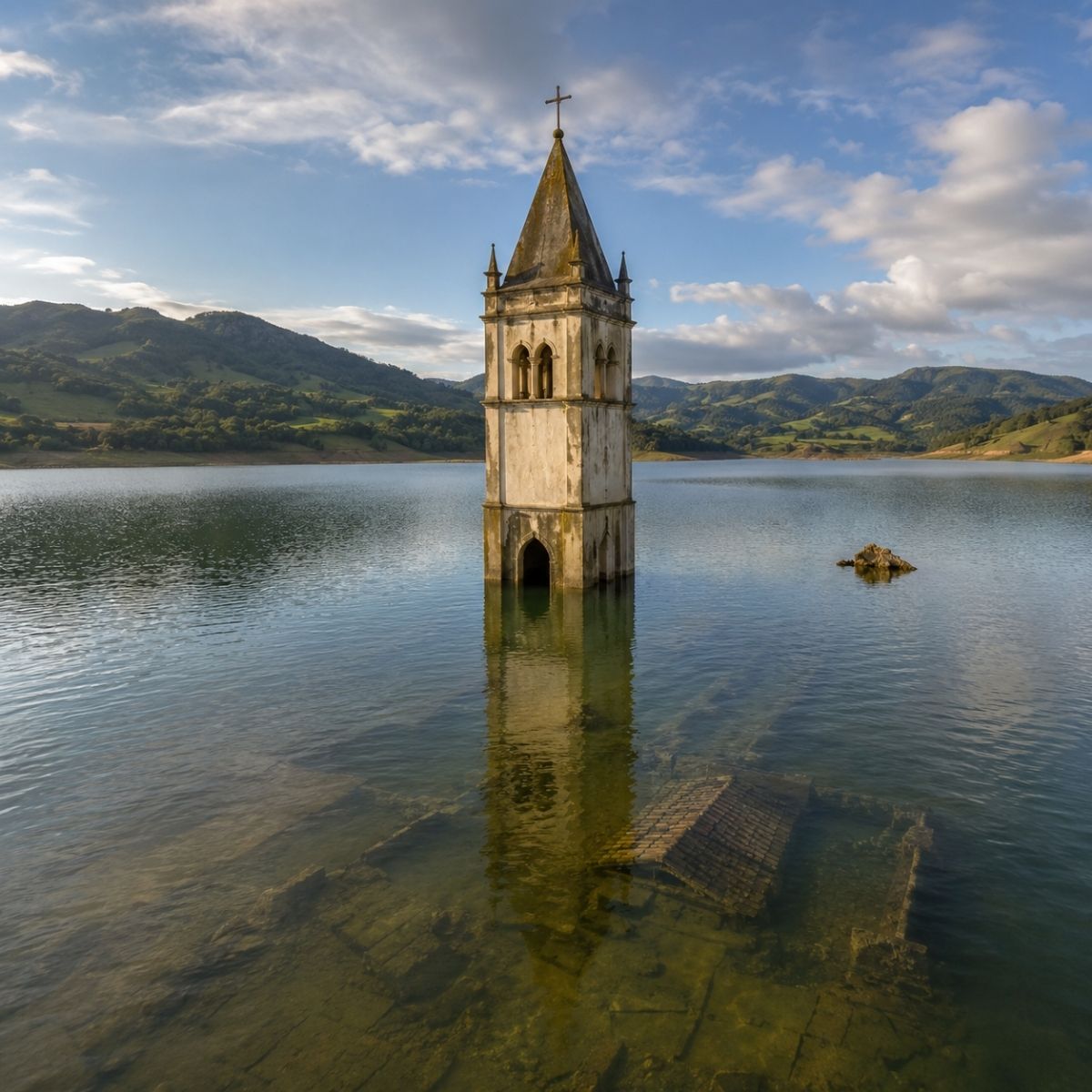

The submerged city in the Rio São Bento dam in Siderópolis (SC) preserves an intact church tower at the request of the families from the São Pedro community, expropriated around 2000, in a 450-hectare lake that supplies six municipalities and became an unusual postcard of Southern Santa Catarina.
Visitors to the Rio São Bento dam in Siderópolis, in Southern Santa Catarina, find a scene that looks like something out of a movie: the tip of a church tower rises solitarily amidst the waters of a 450-hectare artificial lake, as if an entire submerged city rested beneath the surface. The reality is not far from what the landscape suggests: the community of São Pedro, which housed about 80 families around the year 2000, was expropriated to make way for the dam built in response to the water crisis exacerbated by coal mining in Southern Santa Catarina, and when the last families left their homes, they asked for the church tower to be preserved as a symbol of the faith that united the group. The dam builders granted the request, and the tower that should have disappeared under the waters became the most unlikely postcard of the submerged city that the region created to solve a problem and ended up producing a tourist attraction.
The lake that flooded the old community is not just a landscape: it is infrastructure that supplies hundreds of thousands of people. The Rio São Bento dam provides water for six municipalities in Southern Santa Catarina: Siderópolis, Criciúma, Forquilhinha, Maracajá, Içara, and Nova Veneza, a function that justified the expropriation of the submerged city and that remains the reason for the structure’s existence more than two decades after the relocation of the São Pedro families to areas near the old site. The Southern region of the state faced a water crisis aggravated by the environmental damage from coal mining, an activity that for decades contaminated rivers and springs and compromised the supply of potable water, a context that made the construction of the dam a decision of survival, not choice.
How coal mining created the crisis that resulted in the submerged city

The relationship between the submerged city of Siderópolis and mineral coal is part of the industrial history of Southern Santa Catarina. Coal mining was for decades the main economic activity in the region, employing thousands of people and fueling thermoelectric plants such as the Jorge Lacerda Complex in Capivari de Baixo, but the environmental legacy of this activity includes rivers contaminated by acid mine drainage, compromised springs, and degraded areas that made the region’s water unfit for consumption in several places. The water crisis that led to the construction of the Rio São Bento dam and the flooding of the São Pedro community was a direct consequence of this environmental liability left by mining, which Southern Santa Catarina still faces today in recovery programs costing hundreds of millions of reais.
-
Collector adapts forklift electric motor in a Kombi Corujinha pickup, hides 16 batteries under the bed, and makes the Brazilian classic run silently with up to 90 km of range.

-
Goodbye traditional vacuum: Samsung surprises and launches 2-in-1 robot with steam, AI that recognizes floors and stains, self-cleaning station, hot air drying, automatic emptying, water refill, and app control.
-
Brazil is transforming acerola waste discarded by the pulp industry into an ambitious and surprising project that could forever change the way the country utilizes one of the most invisible by-products of the fruit sector.
-
Scientists have created a colossal digital twin to predict tsunamis in real time, a simulation of 55.5 trillion unknowns run on 43,520 GPUs that reduced 50 years of calculation to 0.2 seconds and could change the defense of coastal cities.


The decision to create the dam required the sacrifice of an entire community. The approximately 80 families of São Pedro were expropriated and relocated nearby, a process that involved negotiation, compensation, and the loss of a way of life built over generations on that piece of land that is now under meters of water. The church tower that remains visible above the surface is, at the same time, a monument to the faith of the community that left their homes and a permanent reminder that the submerged city existed as a real place where people were born, grew up, and lived before the water covered everything, except for the concrete and faith-filled tip that the last families asked to keep standing.
Why the church tower of the submerged city became a postcard

The visual contrast between the solitary tower and the vastness of the lake is what transforms the submerged city of Siderópolis into an attraction that surprises visitors. The tower rises as a unique vertical element in the flat surface of the water, surrounded by Atlantic Forest on the banks of the dam, and the scenery produces an effect that photographers and tourists seek especially on clear sky days, when the reflection of the tower in the water creates a symmetrical image that has become one of the most shared in Santa Catarina tourism on social media. The fact that the tower was kept at the community’s request, and not by a technical or tourist decision, adds an emotional layer that differentiates the submerged city from other artificial attractions and gives the landscape a meaning that goes beyond aesthetics.
The story behind the tower is what makes visitors stay longer than necessary for a photo. Those who arrive at the Rio São Bento dam and discover that there was a community with houses, streets, a school, and a church underneath often reflect on what it means to sacrifice an entire place to solve a collective problem, a reflection that the silent tower provokes without needing an explanatory plaque. The submerged city of Siderópolis joins other Brazilian cases of communities flooded by dams, such as Canoas de Pedra in Rio Grande do Sul and old Jaguara in Minas Gerais, stories that combine the need for infrastructure with the loss of local identity and that the church tower represents better than any document.
How to visit the submerged city and the church tower in Siderópolis


The Rio São Bento dam is open to the public, and access to the landscape where the submerged city’s tower stands out does not require an entrance fee for distant observation. Those who want to see the tower up close can visit Parque Aguaí, a private enterprise located on the banks of the dam that offers kayak and pedal boat rentals to navigate near the tower, as well as a gondola ride that allows viewing the submerged city from a privileged angle on the water. The park access fee is R$ 20 per person, and in addition to water activities, the site offers a zip line, trails through the Atlantic Forest, a farmer’s museum, lunch, colonial coffee, and a bar with drinks, a program that allows transforming the visit to the tower into a full-day outing.
The dam region is also sought after for picnics and contemplation of the nature that has regenerated around the artificial lake. The Atlantic Forest surrounding the 450 hectares of water has created an ecosystem that shelters birds, fish, and native vegetation, an environment that contrasts with the areas degraded by coal mining that still exist in other parts of the municipality of Siderópolis and that reinforces the paradox of the submerged city: the same activity that destroyed the environment and caused the water crisis that justified the dam ended up generating, involuntarily, an environmental reserve and a tourist destination that today drive the local economy. For those visiting Southern Santa Catarina with an itinerary that includes the beaches of Criciúma, the Italian gastronomy of Nova Veneza, or the coal route in Lauro Müller, the submerged city of Siderópolis is a stop that adds to the trip a rare combination of history, landscape, and reflection on the choices communities make when water is scarce.
And you, did you know the story of the submerged city of Siderópolis? Have you visited the church tower at the dam? Share your experience in the comments.