Portuguese
  Spanish


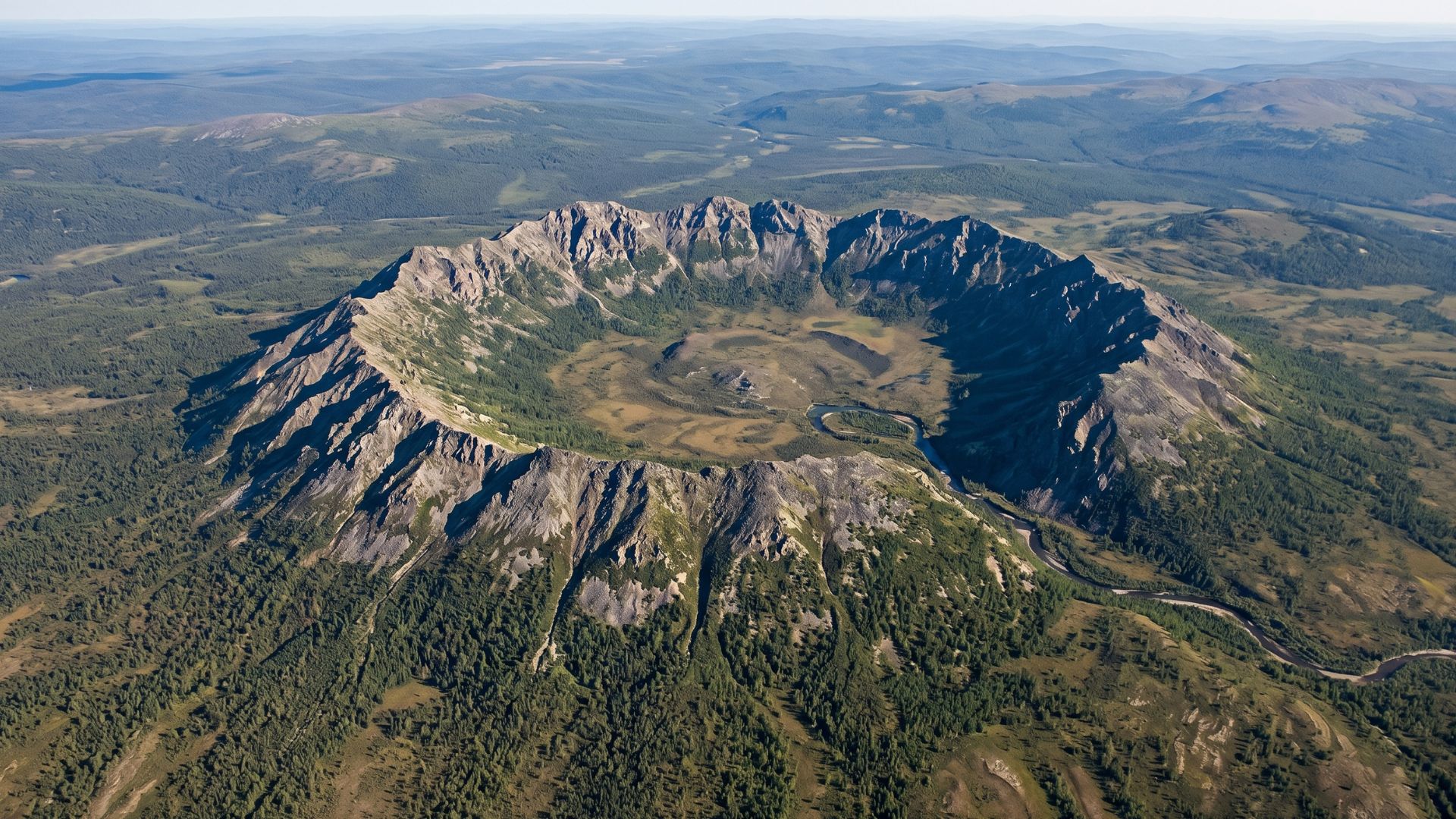


The Kondyor Massif in Russia looks like a giant crater seen from space, but its geological origin intrigues scientists and caught NASA’s attention.
In the far east of Russia, isolated among the remote mountains of the Khabarovsk Krai region, there exists one of the most unusual geological formations ever recorded by NASA satellites. Seen from space, the Kondyor Massif looks like an almost perfect circle drawn in the middle of the landscape, about 6 kilometers in diameter and so symmetrical in appearance that many mistake it for an impact crater caused by a meteor or an ancient collapsed volcano.
The images attracted international attention because the structure really looks artificial when viewed from above. The mountainous ring has elevated edges, a relatively lowered center, and rare geometry for common natural formations. The site became known in NASA Earth Observatory publications precisely for looking “too good” to be just an ordinary mountain.
But most impressively, geologists claim that Kondyor is neither an impact crater nor a classic volcano. According to geological studies, the structure was created by a gigantic push of magma coming from the depths of the Earth, which slowly deformed the surface rocks without being able to completely break through the ground.
-
11-Year-Old Entrepreneur Sells 60 Homemade Sweets Daily, Mastering Cost Calculation, Social Media Promotion, and Client Negotiation Since Age 7

-
Peruvian Mountain’s 5,200 Aligned Holes May Unveil Ancient Indigenous Market for Corn and Cotton
-
The Little-Known Story of a Home-Built Airplane That Promised Freedom but Faced Safety Issues After Numerous Accidents

-
He Didn’t Build a Plane, But Spent Decades Trying to Make Bicycles Fly with Wings and Pedals; Remaining Models Tell This Unusual Story in Germany



The Kondyor Massif looks like a giant crater seen from space, but it was born from magma trapped beneath the Earth’s crust
According to NASA Earth Observatory, the Kondyor Massif is an ultramafic igneous complex located in the far eastern part of Russia. The circular structure is approximately 6 kilometers wide and stands out strongly in the landscape because of its almost perfectly ring-shaped relief.
The visual appearance is so unusual that the site is often mistaken for meteorite craters. However, researchers claim that its origin is linked to the intrusion of magma from the Earth’s mantle. Instead of exploding like a traditional volcano, the magmatic material slowly pushed the upper layers of the crust, forming a circular elevated structure.

Over millions of years, erosion, rain, ice, and rivers wore down the outer parts of the formation, exposing the inner rock core. The result was an extremely rare geological landscape that today appears clearly in orbital images.
The formation is in such a remote region that few people can reach it
The Kondyor Massif is located in an isolated area of Khabarovsk Krai, in the far east of Russia, near the mountains of eastern Siberia. The region has a severe climate, limited infrastructure, and extremely difficult access.
Much of the known images of the location come precisely from satellites and space missions because few land expeditions can easily operate in the area. The geographical isolation has helped preserve the structure virtually intact for millions of years.
According to NASA, the mountainous ring rises about 600 meters above the surrounding areas. Rivers descending from the edges of the formation create radial patterns visible in satellite images, further enhancing the appearance of a “perfect crater.”
The contrast between the almost artificial geometry and the wild landscape around it has helped transform Kondyor into one of the most curious geological formations recorded from space.
Scientists claim that the structure formed millions of years ago during deep processes of the Earth’s crust


Researchers classify Kondyor as an ultramafic-alkaline intrusive complex. This means that the formation is linked to magma extremely rich in metallic minerals and specific elements coming from great depths.
According to Russian geological studies, the magma slowly ascended through the Earth’s crust but did not generate a conventional volcanic eruption. Instead, it pushed the upper rocks forming a kind of giant underground dome.
Over geological time, the more fragile parts of the structure were removed by erosion. What remained was precisely the most resistant portion of the magmatic intrusion, creating the mountainous ring observed today.
This origin helps explain why Kondyor does not have typical impact crater features, such as ejected material, deformations associated with extreme shock, or classic signs of meteorite collision.
The location also draws attention for the presence of platinum and rare minerals
Besides its unusual appearance, the Kondyor Massif gained economic importance because of mineral deposits associated with the geological formation.
The region is known for natural concentrations of platinum, as well as gold and other minerals linked to deep ultramafic rocks. Mineral exploration has helped scientists better study the internal composition of the structure over the past decades.

According to geological records, platinum deposits in Kondyor are directly linked to the magmatic processes that originated the complex. During the slow cooling of the magma, heavy metallic minerals concentrated in certain parts of the intrusion.
This turned the area into one of the best-known platinum deposits in eastern Russia, although exploration remains limited by the region’s extreme logistical difficulties.
NASA images helped turn Kondyor into a global phenomenon of geographical curiosity
The Kondyor Massif gained enormous international attention after images released by NASA Earth Observatory showed the formation seen from space. The almost perfect geometry quickly fueled theories, speculations, and comparisons with extraterrestrial craters.
On social networks and geographic forums, the site began to be frequently described as “a structure that doesn’t seem real.” The visual effect is reinforced by the fact that the circle appears isolated in the middle of much less symmetrical mountainous and forested areas.
NASA highlighted precisely this contrast in its publications, explaining that the shape was not created by cosmic impact, but by much slower and quieter internal geological forces.
The case shows how modern orbital images can reveal geological patterns that would be very difficult to perceive only at ground level.
Kondyor helps show that the Earth still has landscapes that seem impossible even to scientists
Many people associate “impossible” landscapes with other planets, distant moons, or digital scenarios. The Kondyor Massif shows that the Earth itself still harbors natural structures capable of challenging human perception.
The most curious thing is that the site does not rely on artificial colors, image editing, or temporary phenomena. The formation truly has an extremely unusual geometry, the result of millions of years of interaction between magma, internal pressure, and natural erosion.

For geologists, Kondyor also serves as a window to understand deep processes within the Earth’s interior, especially related to the ascent of ultramafic magmas and the formation of rare mineral deposits.
The structure became a classic example of how the planet can produce seemingly artificial patterns using only extremely slow natural processes.
The perfect circle in the middle of Russia remains one of the strangest landscapes ever recorded by satellites
Even after decades of geological studies, the Kondyor Massif continues to impress with its almost surreal appearance. Few places on Earth manage to combine extreme isolation, rare geometric shape, and unusual geological origin in the same way.
The site also reinforces how space observations have changed the way we study the planet. Many giant structures only fully reveal their patterns when viewed from space, something impossible for ancient civilizations or even for researchers before the satellite era.
Today, Kondyor remains one of the most curious formations ever recorded by the NASA Earth Observatory, resembling a gigantic circular scar hidden in one of the most remote regions of Russia.
And precisely because it seems like something that “should not exist,” the Kondyor Massif has become one of the most intriguing geological landscapes of the modern planet.