





 Portuguese
  English
  Spanish
  4 min of reading
  4 comments


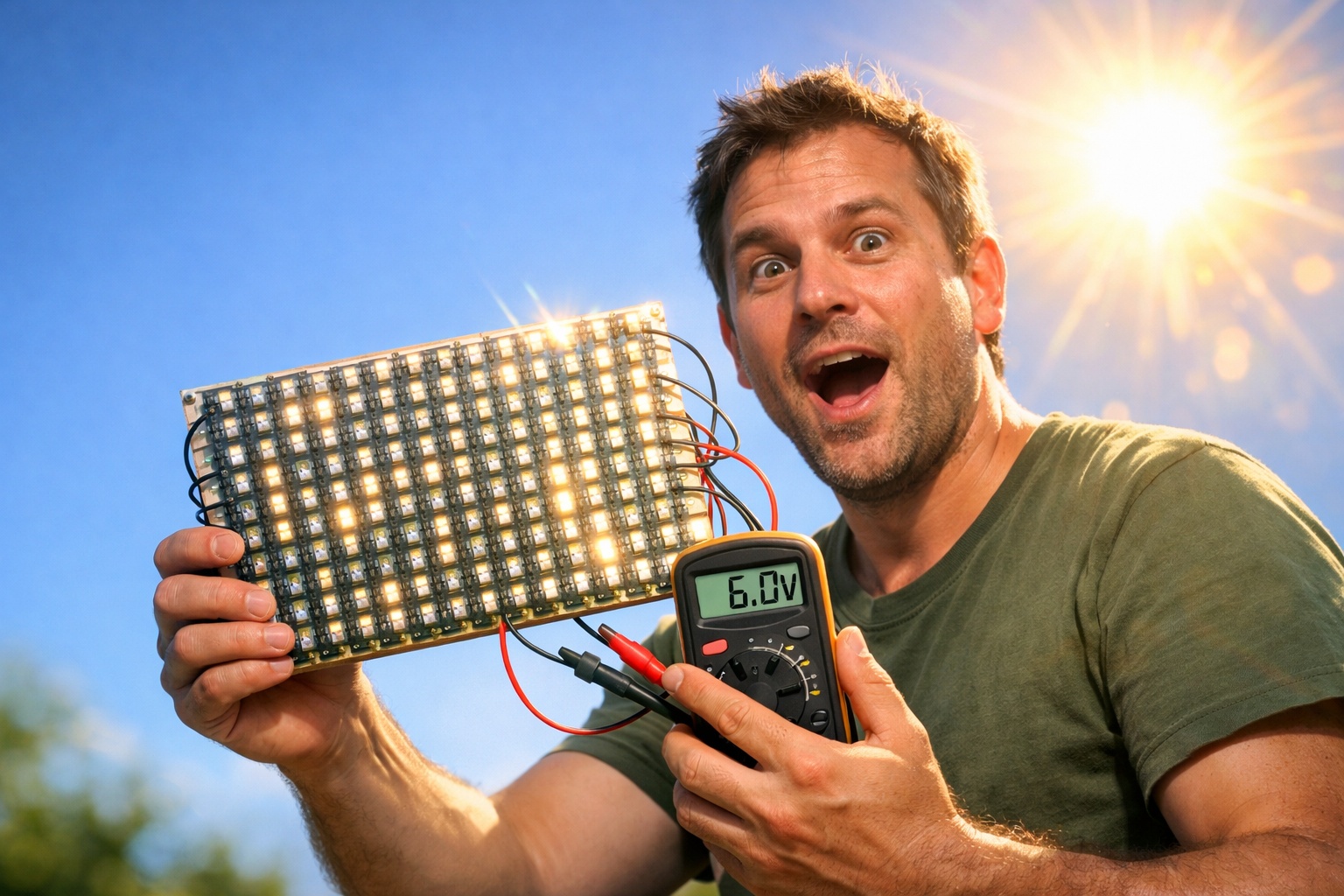


Experiment Shows That Common Red LEDs Can Generate Energy When Exposed to the Sun. Project with 200 Units Achieves About 6 Volts and Demonstrates Basic Principles of Solar Energy.
The idea seems unlikely at first: using common LEDs as small solar cells. However, from a physical standpoint, the concept is real. An LED (Light Emitting Diode) is a semiconductor device that emits light when it receives electric current, but the process can also work in reverse: when exposed to light, it can generate a small electric potential difference.
The experiment presented in the video is based exactly on this principle. Instead of using traditional silicon photovoltaic cells, the project utilizes high-brightness red LEDs, connected in series and parallel, forming a handmade panel capable of generating approximately 6 volts under direct sunlight.
Why Can an LED Generate Energy?
An LED is basically a semiconductor diode. Like solar cells, it has a PN junction. When light strikes this junction, photons can excite electrons, creating a small electric current. This phenomenon is known as photovoltaic effect, the same physical principle that governs conventional solar panels.
-
Scientists were impressed to see birds with tiny heads solving problems like large primates: crows memorize hundreds of food caches, use tools, and even pass on knowledge to the group, challenging everything that was believed about the limits of the animal brain.

-
Almost 10,000 km/h, 110,000 feet altitude, and New York–Paris in less than an hour: Venus Aerospace tests a rotating detonation engine and aims to transform the Stargazer into a reusable Mach 9 hypersonic plane, but still needs to prove that the promise moves beyond the prototype.

-
Air bubbles from 3 million years ago extracted from Antarctic ice reveal that the current level of CO₂ has already surpassed that of the ancient, warm world, when the sea was up to 20 meters higher and there were no factories or cars burning fuel.
-
Brazil went to China to seek money and technology to reinvent TV and bring the internet to places where fiber does not reach. The mission negotiated with the BRICS Bank led by Dilma and paved the way for a Chinese rival of Starlink to connect the Amazon.




However, LEDs are not designed to maximize light capture, but rather light emission. Therefore, their efficiency as generators is significantly lower than that of commercial solar cells.
Initial Tests: Voltage and Current of an Individual LED
In the experiment, the first test consists of measuring the voltage of a single red LED under direct sunlight. The result shows that an isolated LED can generate a voltage close to 1.5 to 2 volts, a value similar to that of a common battery.
However, the critical point lies in the electric current (amperage). Although the voltage is relatively high, the current generated is extremely low, insufficient to power larger devices.
This behavior occurs because the active area of the LED is very small, limiting the amount of captured energy.
Series and Parallel: How to Increase Voltage and Current
To make the system minimally functional, the video demonstrates two types of electrical connections:
Series Connection
- Increases voltage (volts)
- The current remains limited to the smallest element of the circuit
Parallel Connection
- Increases current (amperes)
- The voltage remains constant
By combining both arrangements, it is possible to create a set capable of generating about 6 volts, a value suitable for small low-power circuits.
Construction of the Panel with 200 LEDs
The final project uses approximately 200 high-brightness red LEDs, organized on a perforated board.
The process involves:
- Precise drilling of the base
- Manual insertion of the LEDs
- Soldering the terminals
- Organizing the groups in series and parallel
- Final connection of the positive and negative poles
The work requires meticulous attention, especially to the correct polarity of each LED.
The result is a small experimental panel that generates approximately 6 volts under intense direct sunlight.
Comparison with Commercial Solar Panel
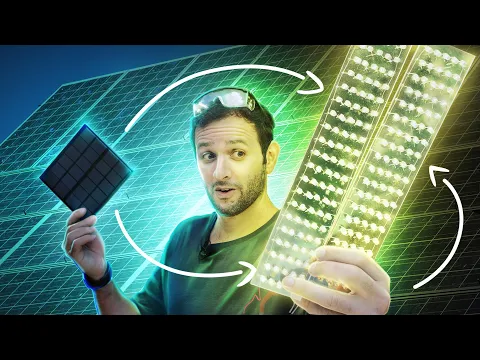
To evaluate the real efficiency, the experiment compares the LED panel with a simple commercial solar panel, found for about R$ 80.

Although both may show similar voltage under certain conditions, the commercial panel generates significantly higher current, resulting in much greater actual power.
The difference occurs because:
- Commercial solar cells have a much larger active area
- They are specifically designed for maximum photon absorption
- They use treated silicon for efficient conversion
While the LED panel demonstrates the physical principle, it does not compete in energy efficiency.
Efficiency: The Central Point
Energy efficiency is determined by the ability to convert sunlight into usable electrical energy. In simplified terms:
- Commercial Panel → Larger Area + Optimized Material → More Power
- LED → Tiny Area + Emission-Focused Material → Low Current
Thus, even with 200 LEDs, the gain in current remains limited.
What the Experiment Demonstrates
Despite the practical limitation, the project proves three important points:
- LEDs can function as small photovoltaic generators.
- The combination of series and parallel alters voltage and current.
- The photovoltaic effect can be observed in common semiconductors.
This transforms the experiment into an excellent didactic demonstration of principles of electronics and solar energy.
Possible Applications
Although it cannot replace a real solar panel, a mini LED panel can be used to:
- Power small low-power sensors
- Educational projects
- Scientific demonstrations
- Experimental circuits
Technical Limitations
Among the main limitations are:
- Extremely low current
- Sensitivity to solar intensity
- Low efficiency compared to photovoltaic cells
Moreover, the cost of acquiring 200 LEDs may exceed the value of a simple commercial panel.
The experiment shows that it is technically possible to build a homemade solar panel using common LEDs and achieve about 6 volts under direct sunlight. The initiative practically demonstrates the functioning of the photovoltaic effect and how different electrical arrangements influence voltage and current.
However, when compared to a low-cost commercial solar module, the efficiency of the homemade solution is significantly lower.
The project stands out as an educational and experimental demonstration of electronics applied to solar energy, highlighting how simple components can reveal fundamental principles of physics and energy generation.








Quando eu tinha 11 anos, medi a diferença de potencial de um led ao sol e fiz a mesma “descoberta”. Comprei alguns leds e fiz a ligação entre eles, mas fui frustrado quando percebi que os leds acenderam sob a luz do sol. Entendi que não poderia fazer muita coisa, já que eles próprios iriam consumir a potência obtida. Eu ainda não tinha noções de série ou paralelo.
Isso não é novidade, eu já ensinava isso no meu curso sobre energia solar 3 anos atrás
Legal.. a diferença é que agora milhares de pessoas sabem.
O que quero dizer, é:
Divulgue também as suas descobertas e seu conhecimento! REGISTRE! A Internet leva seu conhecimento para o mundo!
Didático