Portuguese
  Spanish


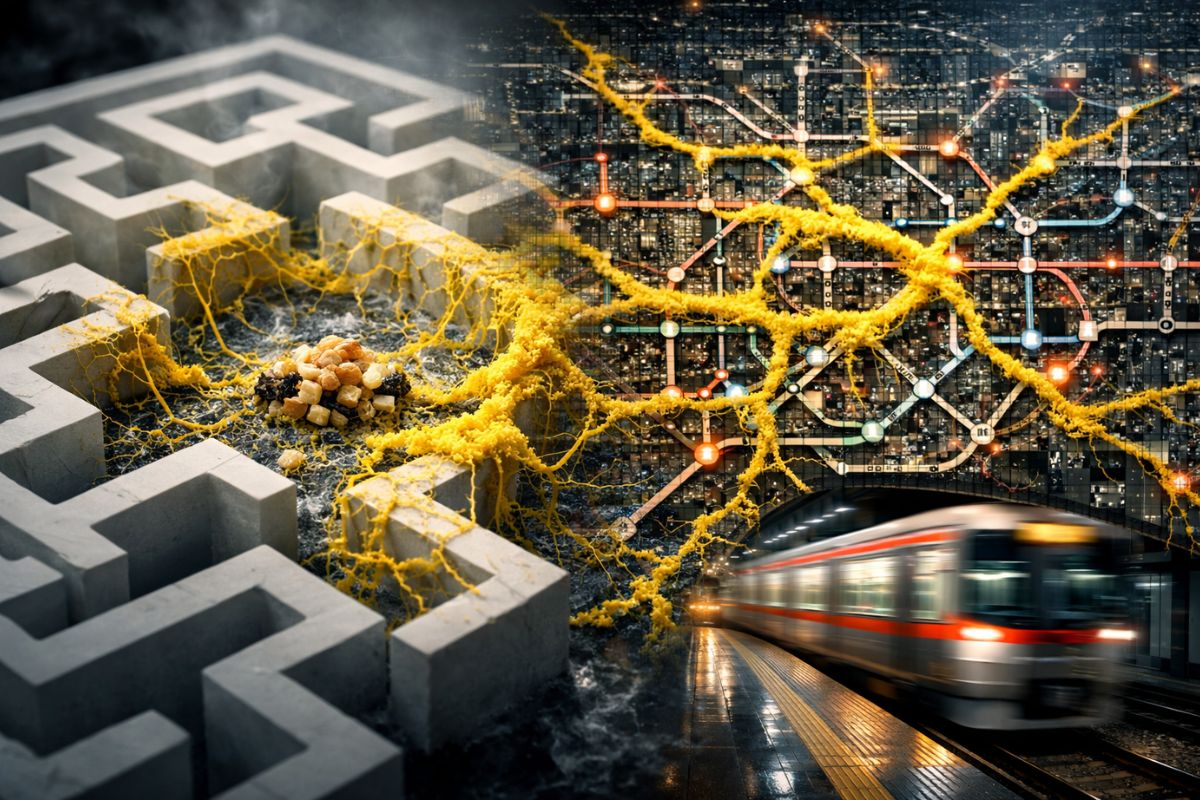


Called Physarum polycephalum, the organism challenges the idea that thinking requires a brain: it explores paths, optimizes routes, and reorganizes its own structure in response to the environment. In tests with maps and food, it reproduced urban networks and solved mazes with surprising efficiency, according to Japanese scientists in already published studies.
The organism Physarum polycephalum seems to contradict what many people have learned about intelligence. Without a brain, without neurons, and without a central nervous system, it still finds short paths, avoids waste, and adapts its shape to the environment. Rather than a simple automatic response, its behavior shows choice, adjustment, and prioritization.
This dynamic has led researchers to rethink a classic assumption: that making good decisions necessarily depends on a neural command center. In the case of this slime mold, organization emerges from the body in motion. Decision-making appears in the process, not in a biological “boss.”
The Organism That Lives in Discrete Environments but Executes Complex Solutions
Physarum polycephalum is a slime mold found in moist, shady environments where organic matter is decomposing. In this scenario, it feeds and grows, forming a living mesh that expands, retracts, and continuously reorganizes. It is a simple organism in structure, but sophisticated in behavior.
-
AI Video Generator Automatically Creates Subtitles and Animated Captions

-
São Paulo Unveils Latin America’s Largest Underground Reservoir, Holding 900 Million Liters, in the Greater São Paulo Area

-
Chinese Teen Wins Gold in Germany for Invention Turning Air Moisture into Underground Irrigation in Drought-Stricken Areas

-
Desertification Threatens Brazil’s Caatinga: 85% of Semi-Arid Region Affected, 30 Million at Risk, and Efforts Underway to Restore 10 Million Hectares by 2045




The comparison with high cognitive-performance animals often draws attention, but the central point is not to turn this living being into an “alternative version” of a mammal or an octopus. Scientific interest is directed elsewhere: understanding how a body without neurons can produce efficient responses to real obstacles, such as distance, travel costs, and resource availability.
Distributed Intelligence: Decisions Without a Brain, but With Functional Logic

Researchers from the University of Tokyo classified this behavior as distributed intelligence, a model in which there is no single command.
The orientation arises from internal flows of protoplasm, a substance that circulates rhythmically through the organism and practically alters which paths will be reinforced or abandoned. The “reasoning” is in the flow.
When Physarum encounters multiple options, it explores several at once. Less advantageous routes lose activity; more efficient paths gain stability.
This mechanism generates an effect reminiscent of network optimization: testing, filtering, and consolidating. There is no symbolic calculation like humans, but there is functional selection of solutions in real time.
From the Maze to the Tokyo Subway: Where Efficiency Became Visible

One of the most well-known experiments took place in Japan, with the organism positioned over a map of the Tokyo area.
Small food points represented major stations. Within a few days, the network formed by Physarum showed remarkable similarities to the real subway design. Nature “drew” infrastructure based on cost and connection.
In some cases, the connections created by the organism were even more streamlined, reducing unnecessary links without compromising the overall connectivity.
In maze tests, the pattern repeated: it can discard less efficient paths and converge toward shorter routes between two points. The result is not magical; it is continuous adaptation with a criterion of efficiency.
How Much Does This Comparison with Humans Explain and How Much Does It Distort
Claiming that Physarum is “smarter than humans” serves as an impactful headline but needs context.
What the experiments show, more accurately, is that this organism surpasses human strategies in specific spatial optimization tasks, especially when the problem involves network, path, and structural cost.
This is not general intelligence; it is extremely effective localized competence.
This distinction matters for maintaining impartial analysis. Humans continue to excel in abstract language, symbolic planning, and accumulated cultural construction.
Meanwhile, Physarum impresses for another reason: it proves that efficient decisions can emerge without a brain, as long as there is a dynamic interaction between body and environment. It is a process intelligence, not a verbal representation.
Why This Organism Is So Interesting to Applied Science
The study of this organism has been inspiring fields such as robotics, networking engineering, and biocomputation because it offers a natural model of decentralized adaptation.
In complex systems, centralizing everything can generate bottlenecks; in Physarum, the solution emerges from multiple points at the same time, with continuous adjustment as the scenario changes. It is a living laboratory of operational resilience.
This logic also relates to current urban and technological challenges: transportation, logistics, and design of efficient infrastructures under resource constraints.
By observing how the organism distributes flow and eliminates redundancies, researchers gain clues for designing systems that respond better to failures and variations in the environment, without relying on a single decision center.
The case of Physarum polycephalum shifts the discussion about intelligence to a deeper question: perhaps the point is not “who thinks like us,” but how different forms of life solve real problems with the resources they have.
This organism does not humanize nature; it broadens what we understand by decision, efficiency, and adaptive learning.
If you had to choose an area to apply this logic—urban traffic, internet, delivery logistics, or energy management—which would have the greatest practical gain in your city, and why?