






 Portuguese
  Spanish


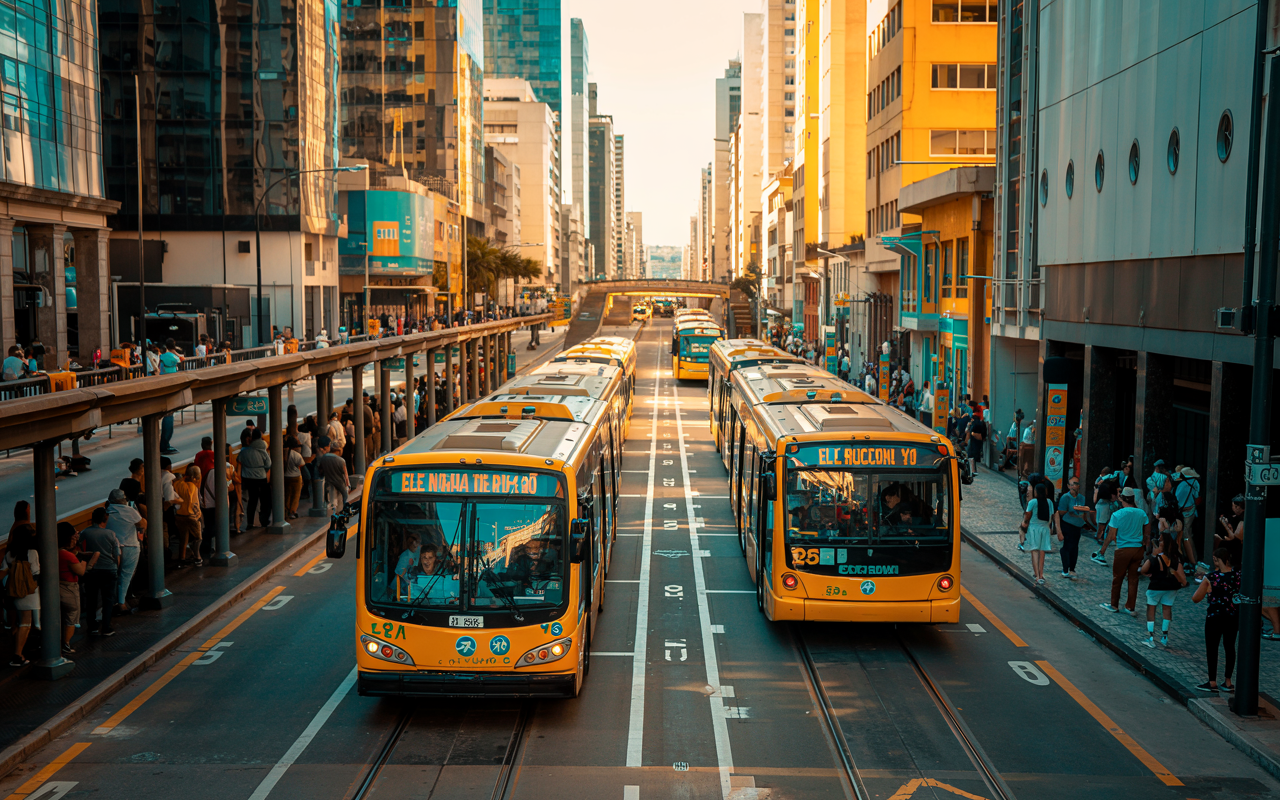


Bus System That Works Like a Subway in Colombia Stands Out for Its Efficiency, Cost-effectiveness, and Sustainability. Meet TransMilenio, a BRT System Capable of Serving 2.4 Million People a Day.
TransMilenio, a mass transit system in Bogotá, Colombia, is an example of how a city can revolutionize its urban mobility without investing billions in rail infrastructure. Although it has no tracks, this bus system that functions like a subway operates with efficiency comparable to that of traditional metro systems. With the capacity to serve around 2.4 million passengers daily, it has become an international benchmark for efficient, cost-effective, and scalable urban mobility.
As cities face growing challenges with congestion, pollution, and high infrastructure costs, the model adopted by Bogotá demonstrates that smart solutions can create a positive impact without relying on underground or elevated trains. TransMilenio is a Bus Rapid Transit (BRT) system that proves that innovation in public transport does not necessarily depend on rail technology.
What is TransMilenio?
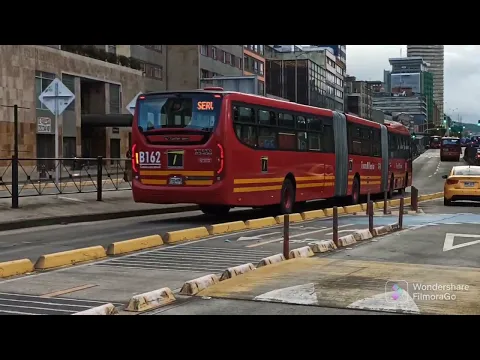

Officially launched on December 18, 2000, TransMilenio is a high-capacity bus system that operates on exclusive corridors throughout Bogotá. Inspired by the pioneering system in Curitiba, the Colombian model was adapted and expanded to serve the capital city, which has over 7.5 million inhabitants.
-
The Port of Itaqui closes the best first semester in history with over 17 million tons and takes off as the locomotive of the Northern Arc.

-
Brazil’s North-South Railway to Auction Two Grain Terminals in Central Tocantins

-
AI-powered traffic cameras in São Paulo now issue fines for cellphone use and seatbelt violations around the clock

-
Free Upgrade to Professional Driver’s License Categories in Over 130 Locations in Brazil, Including Exams and Courses


The project consists of articulated and bi-articulated buses that run on exclusive lanes and utilize elevated stations with level platforms, similar to those of metros. Passengers board after passing through turnstiles at the stations, which reduces the stopping time of vehicles and improves the fluidity of the system.
Currently, the system has over 115 km of exclusive lanes, 12 main trunk routes, 147 stations, and a fleet of over 2,000 high-capacity buses. It also integrates with feeder routes (feeder buses), allowing peripheral neighborhoods to access the main transport network easily.
Why Does TransMilenio Function Like a Subway?
Although it uses buses, the system offers features typically associated with subways, such as high frequency, quick boarding at stations, separation from general traffic, and express lines. This makes it commonly referred to as a bus system that functions like a subway.
Furthermore, the system allows for the operation of different services on the same corridor. While some routes stop at all stations (local service), others operate as express lines, stopping only at strategic points — further optimizing travel time.
This hybrid model considerably reduces travel time, making it competitive with other mass public transport modes. Additionally, studies show that the buses in the system are as fast as the New York subway and transport more passengers daily than most European metros.
Economics and Viability
The main advantage of the BRT system compared to traditional rail systems is its low implementation cost. While constructing a kilometer of subway can exceed US$ 100 million, the average cost per kilometer of TransMilenio ranges between US$ 5 and US$ 15 million, according to a study by the World Bank.
These figures make the BRT system an attractive solution for cities in development or with budget constraints. Moreover, the construction time is significantly shorter. The project’s first phase was completed in less than two years — an almost impossible timeframe for subway construction.
Besides the direct savings, the system also generates substantial indirect benefits, such as reducing CO₂ emissions, decreasing urban congestion, and encouraging public transport use over private vehicles.
Social and Environmental Impact
The project has brought about a profound transformation in urban mobility and the quality of life for the population of Bogotá. The system primarily serves workers, students, and low-income populations, providing quick and safe access to various regions of the city.
Environmentally, the impact is also significant. Studies estimate that by 2012, TransMilenio avoided approximately 3.8 million tons of CO₂ equivalent based on a reference scenario.
Additionally, the increased use of public transport contributed to a reduction in private vehicles on the streets, lowering levels of noise and air pollution, while also improving urban traffic flow.
International Recognition
The Bogotá project is often cited as a model of an efficient bus system, being a reference for similar projects in various parts of the world. Places like Mexico City, Santiago, Jakarta, and Guangzhou have adopted or adapted the BRT system inspired by the Colombian model.
The ITDP (Institute for Transportation and Development Policy) ranked TransMilenio as one of the most successful BRT systems in the world, highlighting its capacity, regularity, and modal integration.
Challenges Faced by the Bus System That Works Like a Subway
Despite its success, TransMilenio faces challenges, especially related to overcrowding, fleet aging, and infrastructure, as well as the need for expansion to keep up with the city’s population growth.
Public protests and criticisms of the municipal administration point to issues such as delays, insecurity, and inadequate maintenance. The Bogotá city hall has been working on renewing the fleet with less polluting vehicles and planning new trunk corridors to expand coverage and improve user comfort.
Another critical point is governance and coordination between private operators and public management, a factor that directly influences the efficiency and financial sustainability of the system.
The Importance of Investing in BRT Systems
Cities around the world are facing increasing pressure for accessible, sustainable, and quickly implemented mobility solutions. In this context, Bogotá’s model shows that a well-planned bus system functioning like a subway can offer similar benefits to metro systems, at much lower costs.
The BRT system is especially relevant for medium and large cities with limited budgets, as it can serve large volumes of passengers with flexibility and lower environmental impact. Furthermore, it is a scalable model that can be adapted according to demand and local needs.
TransMilenio has proven that it is possible to create an efficient, sustainable, and high-capacity public transport system without relying on tracks. This bus system that works like a subway has established itself as a global model for its cost-effectiveness, rapid implementation, and positive impact on urban quality of life.
With over 2.4 million passengers daily, TransMilenio stands out not only for its scale but also for its operational efficiency and innovation. Its success shows that the future of urban mobility can — and should — involve creative solutions like BRT systems.
For public managers and urban planners, the Bogotá example is a concrete inspiration that investing in accessible and well-structured public transport is essential for transforming cities into fairer, more sustainable, and smarter spaces.








Ideal seria utilizar trólebus. Ônibus a diesel contribui pra meio ambiente???
O trólebus é o mais indicado pra corredores segregados.
A matéria cita Curitiba como pioneira e outras cidades no mundo onde o sistema foi implantado posteriormente mas não cita o BRT do Rio de Janeiro que é muito eficiente tem três grandes ramais que cortam diversas regiões do município e tem integração com outros modais (ônibus, trem, metrô)
Depende do tipo de brt os bi articulados são bons as cidades de faixa longa como Belém, aqui em São luis não a muitos pontos para se colocar brt o único ponto bom é na praia que já tem um espaço para ele,e já teve uma obra que as pessoas reclamaram muito da faixa por onde ele passa no meio da br e nisso teve que gastar mais dinheiro público, mas estamos esperando o brt até agora e sem nenhuma notícia deles e teve um cara que disse que iria colocar o vlt do centro até um outro ponto,só era para nos dar esperança de um transporte melhor,quando veio o dinheiro ele pegou tudo.