






 Portuguese
  Spanish
  7 min of reading
  0 comments


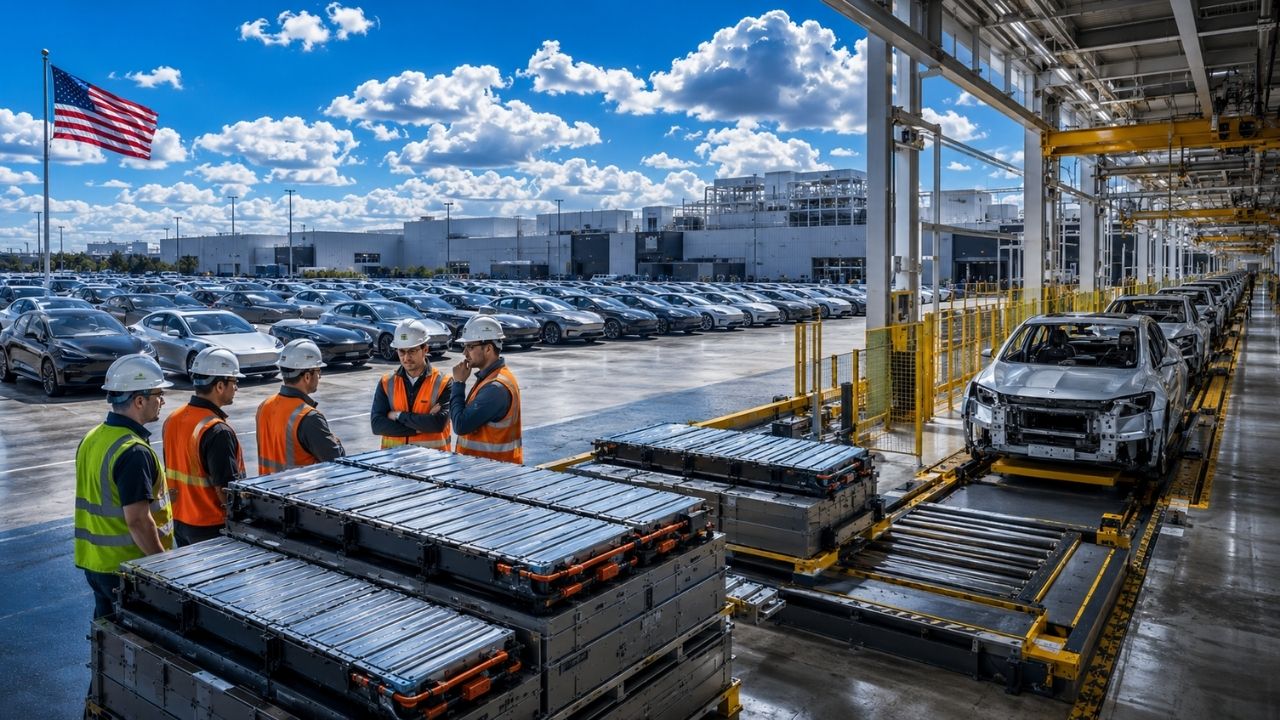
The Ultium Cells battery factory, linked to General Motors and LG Energy Solution in Ohio, postponed the return of 850 employees to August. The measure exposes pressure on electric cars after the end of the federal credit of up to $7,500 for new eligible vehicles purchased in the United States.
The electric car industry in the United States faces a new sign of adjustment: Ultium Cells, a battery manufacturer owned by General Motors and LG Energy Solution, postponed the return of temporarily laid-off workers to its unit in Warren, in the northeast of Ohio. The confirmation was released on May 29, 2026.
According to an exclusive report by Reuters, the 850 employees had been out of work since January and were initially informed that they could return in June. Now, the company states that the return will occur starting in August, after evaluating the behavior of the electric vehicle market in the first months of the year.
Battery factory postpones return of 850 workers in Ohio

The battery factory of Ultium Cells produces cells intended for General Motors’ electric vehicles and occupies a strategic position in the automaker’s attempt to expand its share in the new generation of automobiles. The postponement of the workers’ return shows that the production planned for the unit is still being calibrated according to the level of demand observed in the market.
-
Used Civic and Corolla have been stuck in stock for months. “People are preferring Chinese cars,” says the car dealership owner.

-
Toyota Sienna becomes a “VIP lounge on wheels” in Brazil after receiving a Chinese luxury kit, seats with massage, Starlink, refrigerator, and a 245 hp hybrid engine, targeting high-income families, artists, and executive transport in an almost million-dollar van.

-
Two new 300cc models from QJ Motor are expected to arrive in Brazil as SBM to target the CB 300F and shake up the low-displacement market, with more power and liquid cooling than Honda.

-
Camaro may reappear in 2027, but not as you remember: Chevrolet prepares the return of the icon with four doors, manual transmission, and an extreme performance version to face the new era of sports cars.


In a statement informed to Reuters, the company stated that the temporarily laid-off employees at the Ohio plant are now expected to return in August for the production of cells intended for GM’s electric vehicles. Before that, a reduced number of workers had already returned to the factory during May.
The new schedule represents a two-month delay compared to the timeline initially communicated to employees. The change occurs in a facility created precisely to meet an expected expansion of electric cars in the North American market.
Ultium Cells had already announced mass layoffs and furloughs
The postponement did not arise in isolation. In the second half of 2025, Ultium Cells announced that it would temporarily furlough 850 workers from the Ohio plant and permanently lay off another 480 employees amid a review of production plans related to electric vehicles.
The temporarily furloughed employees stopped working in January 2026, with the expectation presented of returning in June. The new communication changes this schedule and indicates that the planned recovery of activity has not yet occurred at the expected pace.
For the workers, the difference between June and August means more time away from the productive routine. For the industry, the decision exposes a larger issue: even factories set up to support the advancement of electric cars can operate below the expected pace when automakers adjust their volumes to real consumer demand.
Demand for electric cars pressures battery production

The decision was linked by the company to an analysis of the electric vehicle market throughout 2026. Ultium Cells did not inform, in the statement cited by Reuters, what volume will be produced after the employees return nor did it present a new long-term projection for the unit.
Even so, battery manufacturing directly follows the automakers’ planning. If the production of electric cars is reduced or slowed down, the immediate need for cells also decreases, affecting facilities that had been planned to supply models on a larger scale.
The pressure does not mean that GM and other manufacturers have abandoned electric vehicles. Companies continue to produce and sell electrified cars, but they have been adjusting the pace of assembly lines to avoid excess capacity at a time of weaker demand.
The battery factory functions as a thermometer for automotive production: when its schedule is delayed, the signal reaches the entire chain linked to electric vehicles.
End of Federal Credit of Up to $7,500 Changed the Scenario in the USA
One of the factors that altered the conditions of the American market was the termination of the federal credit aimed at the purchase of eligible clean vehicles. The benefit could reach up to $7,500 for new vehicles that met the requirements established by the government.
According to the guidelines of the Internal Revenue Service, the tax authority of the United States, the credit for new clean vehicles became available only for cars purchased until September 30, 2025. In specific situations, vehicles delivered after this date may maintain eligibility when the acquisition was formalized within the stipulated deadline.
The removal of the incentive reduced an important financial advantage for consumers considering the purchase of electric cars. As these vehicles often have higher initial prices compared to alternatives powered by traditional fuels, the federal credit helped to reduce part of the difference at the time of purchase.
Without the rebate of up to $7,500, automakers began to face a market where the consumer needs to absorb a larger portion of the cost of the electric vehicle.
General Motors and Other Automakers Slow Down to Keep Up with the Market
General Motors is not the only manufacturer adjusting plans in light of the new scenario. According to the information released, American automakers have been moderating the production of electric vehicles after the end of the federal incentive and the reduction in demand recorded in the short term.
This movement involves an operational choice: producing below the initially planned capacity can reduce inventories and limit losses while the market seeks a new balance. On the other hand, the adjustment affects workers, suppliers, and factories created during a period of accelerated expectations for electrification.
In the case of Ultium Cells, the impact appears directly on the employee return schedule. The Ohio unit belongs to a joint venture created by General Motors and South Korean LG Energy Solution to produce essential batteries for the American automaker’s electric models.
The slowdown is not only occurring at dealerships; it reaches the plants that manufacture the most important components of electric cars.
Battery Factory in Ohio Was Created to Support the Expansion of Electric Vehicles

The Ultium Cells battery factory in Ohio is part of an industrial strategy for domestic battery production in the United States. The joint venture between GM and LG Energy Solution is also linked to facilities in other states, designed to expand the supply of cells used in electric vehicles.
The industrial plan was born at a time of strong expectations about market expansion, driven by incentives, public investments, and commitments announced by manufacturers. The battery has become a central component of this race, as it influences the autonomy, cost, and production capacity of automobiles.
Now, the unit in Warren faces a more cautious reality. A factory created to keep up with the expansion of electric cars needs to adjust its workforce because the immediate demand does not match the previously expected pace.
This does not eliminate the strategic relevance of battery production in the United States. However, it indicates that investments made in the sector will increasingly be tested by companies’ ability to adapt volumes, costs, and jobs to the real market conditions.
Workers are at the center of the production review
Although the debate involves technology, incentives, and industrial planning, the most immediate effect falls on the factory employees. The 850 workers temporarily laid off were expecting to return in June and now will have to deal with the extension of the period until August.
The situation occurs after the unit also recorded permanent layoffs of hundreds of employees. For a region that received investments linked to battery production, successive changes in the work schedule affect not only directly involved families but also local economic expectations.
The announcement of a return in August keeps the possibility of resuming activities for the temporarily laid-off employees, but does not end doubts about the future stability of production. The actual volume of work will depend on the demand for battery cells and the pace GM decides to maintain in its electric cars.
Transition to electric vehicles enters a more difficult phase
The expansion of electric vehicles has been presented for years as one of the main changes in the automotive industry. The growth of the sector stimulated new factories, investments in batteries, technological research, and public policies aimed at accelerating the adoption of the models.
The case of Ultium Cells shows, however, that the transition does not occur in a linear fashion. Changes in government incentives, prices, consumer interest, and automaker strategies can produce pauses, delays, and temporary reductions in capacity.
In the United States, the end of the federal credit of up to $7,500 removed one of the most relevant instruments to stimulate the purchase of eligible new vehicles. As a result, manufacturers need to assess how much to produce without relying on the same level of incentive previously available.
Electric cars remain present in the market, but the current phase requires companies to prove that they can sustain production and sales in an environment less favorable to consumers.
Delay in Ohio reveals challenge for the future of electric cars
The decision by Ultium Cells to postpone the return of 850 workers until August exposes a moment of caution in the American battery industry. The Ohio plant, linked to two major global companies, was created to meet an expansion that now faces more moderate demand and less federal support for vehicle purchases.
The move does not determine the fate of electric cars in the United States, but it reveals that the automotive transition is subject to significant adjustments. Factories, jobs, and production volumes will depend not only on the available technology but also on consumers’ decisions to buy vehicles without the same financial incentive previously existing.
In your opinion, will electric cars regain momentum in the United States even without the federal credit of up to $7,500, or could the removal of the incentive permanently change automakers’ plans? Comment.


Be the first to react!