Portuguese
  Spanish


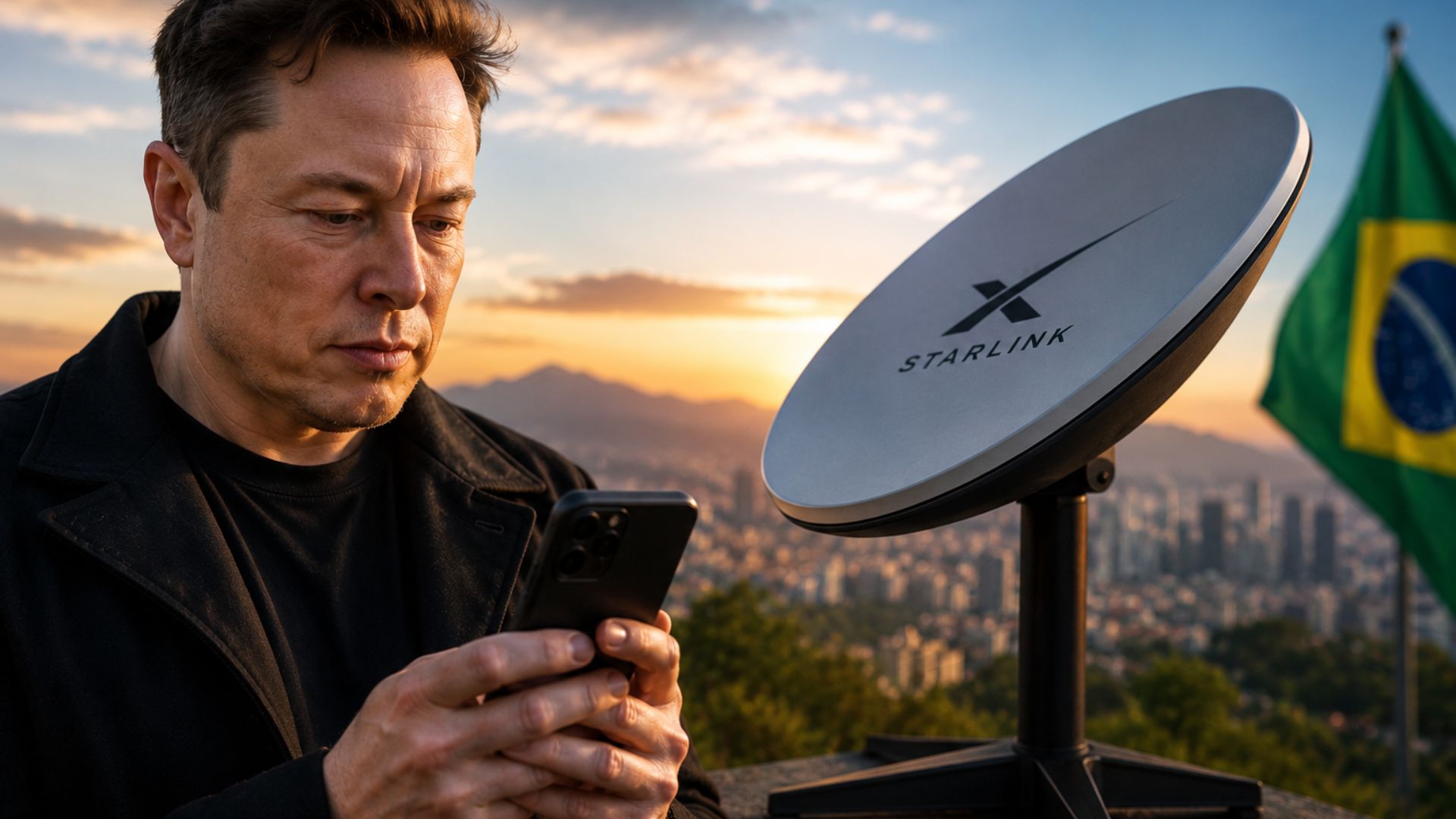

Starlink’s expansion in Brazil accelerates negotiations with cell phone manufacturers, operators, and Anatel to enable satellite internet directly on smartphones, a technology pointed out by the telecommunications sector as an alternative to expand mobile coverage in remote areas and emergency situations starting in 2027.
Starlink, a satellite internet company linked to Elon Musk, has requested authorization from the National Telecommunications Agency to launch in Brazil, in 2027, a service aimed at direct connection between cell phones and satellites, without the need for routers or antennas installed in properties for immediate network operation.
According to an investigation by Broadcast Estadão in an article published this Thursday (21), the request was submitted to Anatel in February and represents a new stage of the company’s operation in the country, where the customer base already exceeds 1 million users, making Brazil Starlink’s second-largest market, only behind the United States.
Currently, the service provided by the company mainly functions as fixed satellite broadband, a model that depends on the installation of specific equipment for internet access in homes, rural properties, and areas without traditional coverage.
-
World’s Most Powerful Solar Installation Hidden in the Pyrenees: Odeillo Solar Furnace Concentrates Sunlight 10,000 Times, Reaching 3,500°C to Demonstrate Solar Energy’s Potential for Future Materials and Fuels Production

-
DNA Analysis Reveals How Five Cattle Survived Over 130 Years on a Deserted Brazilian Island

-
Private Spacecraft Intercepts Another for First Time in History During U.S. Space Force Mission Completed 11 Hours Early with Rocket Launched in Record 16 Hours

-
Scientists Predict Earth’s Habitable Lifespan: 1.8 Billion Years Before Oceans Evaporate and Sun Forces Planet Out of Life Zone


In this format, the consumer needs to use their own antenna and router, a scenario different from the proposal under analysis by the company, which foresees direct connection on smartphones compatible with satellite communication technology.
How Starlink’s internet will work directly on the cell phone
The technology that Starlink intends to explore is known as direct to device, or D2D.
In practice, the technology allows compatible cell phones to communicate directly with satellites in orbit, a feature pointed out by companies in the sector as an alternative to expand coverage in regions without conventional signal or available terrestrial infrastructure.
In different markets, this type of connection is still in the initial phase and depends on technical adjustments, specific regulation, and compatibility between satellites, mobile operators, and device manufacturers.
While Starlink is already working with D2D services in countries like the United States, Canada, Japan, and Chile, the Brazilian market still depends on regulatory authorization and technical definitions before receiving a potential commercial offer.
The company seeks to use the 2 GHz frequency, in the so-called S band, to enable direct connection to devices.
According to telecommunications industry experts, this band is considered strategic for mobile satellite services, although commercial use depends on technical evaluation and final approval from Anatel.
Dispute over the S band increases pressure on Anatel
The issue gained more weight after Anatel authorized AST SpaceMobile, a Texas-based company, to operate in Brazil with a satellite constellation aimed at D2D.
The decision involves sub-bands of the S band and, according to sources linked to the sector, reduced part of the regulatory space available for companies interested in offering similar services in the country.
In the case of Starlink, the operation also depends on the transfer of a license related to EchoStar, a company that held rights to use the S band in the country.
SpaceX, owner of Starlink, bought spectrum assets from EchoStar in 2025, but the change needs to be approved by the Brazilian agency.
In recent months, representatives of Musk’s company have been holding talks in Brasília to discuss the issue with Anatel members and monitor the progress of regulatory analyses related to the project.
According to sources heard by Broadcast, the regulatory evaluation will directly influence the commercial implementation schedule of the service in Brazil.
Apple, Samsung, and Motorola enter negotiations
In addition to the regulatory front, Starlink is discussing commercial agreements in Brazil.
One of the negotiations involves Apple, Samsung, and Motorola, manufacturers that hold significant market share in the national smartphone market and can expand the offer of models compatible with the 2 GHz frequency.
Device compatibility is a central point for the advancement of D2D.
Currently, few phones available in the Brazilian market are capable of operating in this band, a factor that limits the initial scale of the service and requires coordination between satellite companies, manufacturers, and mobile operators.
Another negotiation involves Vivo, Claro, and TIM.
Starlink is evaluating partnerships with one or more operators to distribute direct satellite connection plans, in a model that would function as a complement to traditional mobile service.
According to sources heard by Broadcast, the company does not intend to present itself as a direct substitute for 4G and 5G networks.
According to sources linked to the negotiations, the company’s strategy is to complement mobile coverage in locations where terrestrial infrastructure faces technical or economic limitations.
New generation of satellites will be essential for the project
To offer the service in Brazil, Starlink still needs to launch a new generation of satellites into orbit.
The launch of this equipment is scheduled to occur between the end of 2026 and the beginning of 2027, a stage considered necessary to support the operation of direct connection between satellites and cell phones.
The expansion of the constellation had already been addressed by Anatel.
In 2025, the agency authorized SpaceX to add 7,500 satellites to Starlink’s local operation, more than doubling the volume of equipment previously allowed in the country, although the authorizations remain subject to Brazilian rules.
At the same time, the advancement of D2D occurs amid debates involving competition in the sector, efficient use of the spectrum, space sustainability, and operational rules for global connectivity companies.
Anatel has indicated that the growth of this market requires regulatory updates to deal with new connectivity models.
Coverage in remote areas is Starlink’s main bet
Direct satellite connection could expand coverage in rural areas, highways, Amazon regions, border zones, and locations where terrestrial towers do not yet offer conventional mobile phone signals.
Moreover, industry representatives state that the service could be used in emergency situations when storms, floods, power outages, or other events compromise conventional telecommunications networks.
Even with ongoing negotiations, the commercial arrival of the service will depend on a combination of regulatory, technical, and operational factors involving different companies and responsible bodies.
Starlink needs authorization for spectrum use, approval of the transfer linked to EchoStar, compatible satellites in operation, and cell phones prepared to connect to the desired frequency.
When contacted, Starlink did not comment on the negotiations.
Until Anatel completes the analysis, the service remains unauthorized for commercial offer in Brazil, despite ongoing discussions with manufacturers, operators, and regulatory bodies.