Portuguese
  Spanish


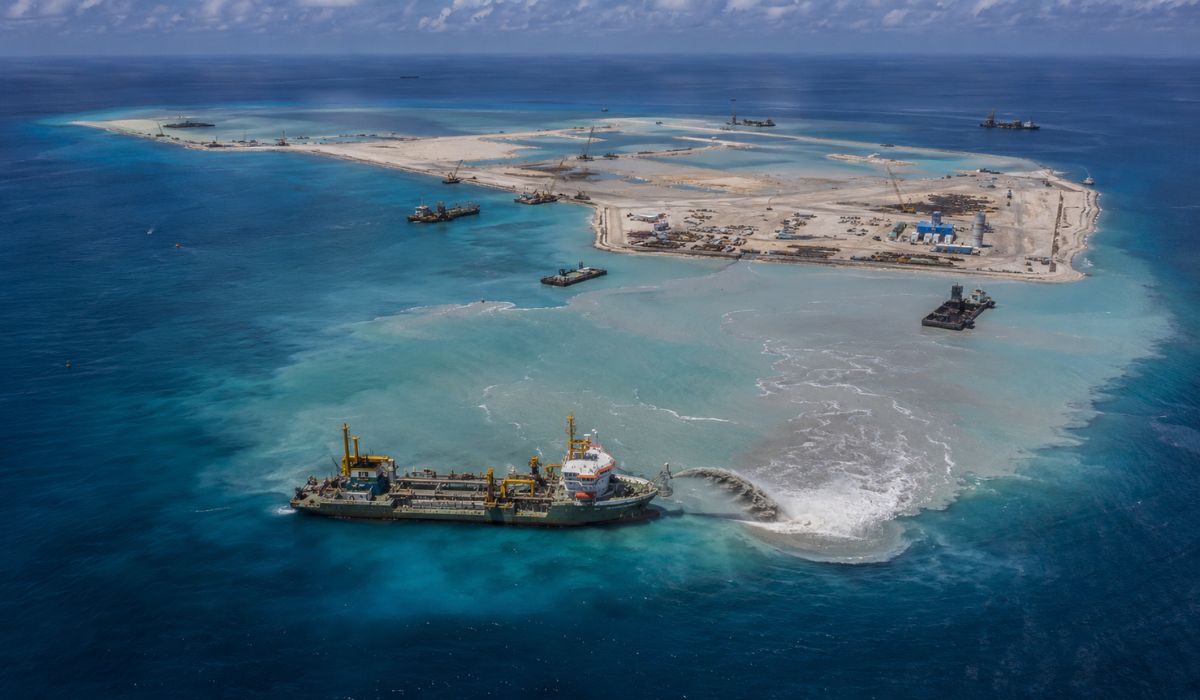

Expansion on disputed reefs renews attention on maritime construction, strategic infrastructure, and environmental impacts in the South China Sea, in an area marked by overlapping territorial claims and growing military presence.
Vietnam expanded by 534 acres, equivalent to about 216 hectares, the area of artificial lands built in the Spratly archipelago, in the South China Sea, over the last year.
The information is included in a report released on Friday (08) by the Asia Maritime Transparency Initiative, linked to the Center for Strategic and International Studies, in Washington.
With the new stage of dredging and land reclamation, Hanoi now totals approximately 2,771 acres of artificial land in the disputed region, about 11.2 km².
-
Kazakhstan’s Torysh Valley Holds Thousands of Giant Stone Spheres, Intriguing Scientists with Ancient Oceanic “Cannonballs”

-
Egypt Discovers 18 Ancient Tombs with Gold Tongues, Unveiling Unusual Funeral Rituals and Amulets Believed to Give Voice to the Dead

-
Nigeria Dumps 120 Million Tons of Sand into Atlantic to Build Massive City with 8.4 km Sea Wall for Protection Against Ocean Waves and Erosion
-
German Engineer Developed Diesel Engine Running on Vegetable Oil Decades Before Electric Cars Became Popular; Can This Forgotten Idea Work in 2026?



The expansion occurs in an area marked by overlapping territorial claims.
China, Vietnam, the Philippines, Malaysia, and Brunei are among the countries claiming islands, reefs, or maritime zones in the South China Sea.
The region concentrates shipping routes, fishing areas, natural resources, and the presence of military and maritime patrol forces, factors that help explain the diplomatic and territorial dispute.
Vietnamese Expansion in the Spratly Islands
According to the report, Vietnam continued construction of artificial islands after completing, in the spring of 2025 in the northern hemisphere, land reclamation operations at Barque Canada Reef.
The formation has been described by AMTI as the largest Vietnamese base in the Spratly archipelago.
After this stage, Hanoi began smaller expansions in other formations starting in the second half of 2025.
The work involves dredging, sand displacement, and creating reclaimed areas over previously submerged or partially exposed reefs, according to the analysis made with satellite images.
The constructions also began to include infrastructure in areas where land reclamation had already advanced.
According to AMTI, this movement shows that part of the interventions has shifted from focusing solely on the physical expansion of the reefs to incorporating operational support structures.
The report states that new interventions appear on larger and more developed reefs.
Among the points mentioned are Grierson Reef, Petley Reef, and South Reef, where three new ports are under construction.
With this, the number of Vietnamese ports in the Spratly reaches 15, of which 11 were created since 2021.
Ports expand capacity in the South China Sea
The construction of ports increases the capacity for docking, refueling, and circulation of vessels in remote points of the South China Sea.
The report does not state that all structures will have direct military use, but this type of installation can serve naval vessels, maritime patrol units, and logistical operations.
In Landsdowne Reef, AMTI identified initial signs of construction that could be another port.
Meanwhile, in Barque Canada Reef, satellite images indicate the installation of a communications structure that, according to the entity, had not yet been observed in other formations occupied by Vietnam.
The construction of this structure began in August 2025 and appeared completed in April 2026, according to the report.
AMTI states that the equipment resembles a DVOR-type navigation beacon, used as an aid for aircraft.
The entity also points out that similar structures have been identified on Chinese-built runways in the Spratly.
This type of infrastructure can enhance air and maritime navigation resources in areas remote from the mainland.
Still, AMTI emphasizes that the full effects of the Vietnamese expansion will depend on the completion of the facilities and the use that will be made of them by military forces, law enforcement authorities, or other state structures.
Dredging and environmental impact on reefs
Territorial expansion also increased the area of reefs affected by the works.
According to AMTI, the total areas impacted by Vietnam reached approximately 4,120 acres, or about 16.7 km², including reefs covered by landfill and sections dredged for channel opening and port construction.
Dredging alters the physical formation of reefs, removes sediments, and interferes with marine habitats.
In the South China Sea, this type of intervention has been monitored by research centers and organizations focused on maritime security analysis, especially because of the combination of territorial dispute and environmental impact.
In early 2025, Vietnamese construction seemed to approach the Chinese scale in the Spratly, according to AMTI.
The difference grew again after new activities attributed to China in Antelope Reef, which increased the totals of artificial land and affected reefs under Chinese control.
With the inclusion of Antelope Reef, China would have reached about 5,460 acres of artificial land, approximately 22.1 km², and 6,224 acres of destroyed reefs, about 25.2 km², according to the survey.
These numbers keep China ahead of Vietnam in total land area and in the extent of impacted reefs.
China contests works at Barque Canada Reef
China claims almost the entire South China Sea, although there are overlapping claims from other countries in the region.
Beijing has already declared opposition to Vietnamese activities at Barque Canada Reef, which it considers Chinese territory, according to a Reuters report.
The Vietnamese embassy in Washington did not immediately respond to the agency’s request for comment on the report.
Until the publication of the original report, there was no Vietnamese statement cited by Reuters on the latest data released by AMTI.
The dispute in the South China Sea also involves the 2016 arbitral decision in a case initiated by the Philippines against China.
The tribunal constituted under the United Nations Convention on the Law of the Sea concluded that core elements of China’s claims had no legal basis under the terms evaluated.
Beijing rejects the decision.
The ruling did not end the disputes in the region.
Since then, different countries have maintained a presence in claimed areas, while works, patrols, and episodes of diplomatic tension continued to occur in points of the South China Sea.
Artificial islands and permanent presence in the ocean
The creation of artificial land alters the possibility of permanent presence on reefs, sandbanks, and maritime formations previously limited by natural conditions.
Once filled and equipped, these locations can host ports, runways, radars, communication systems, accommodations, and support structures.
In the Vietnamese case, the advancement described by AMTI indicates a physical consolidation in areas already occupied by Hanoi.
The expansion does not resolve the territorial dispute, but increases the infrastructure available for operations in the archipelago and reinforces the Vietnamese presence in points also claimed by other countries.
China remains ahead in total constructed area and in the extent of destroyed reefs, according to the report data.
At the same time, the Vietnamese expansion shows that the dispute over the Spratly continues to involve permanent works, and not just diplomatic statements or maritime patrols.
With dredging, ports, and navigation structures expanding, the dispute begins to produce visible effects on the physical environment of the reefs.
The progress of the works also expands the presence of state infrastructure in a region where maritime boundaries remain contested.
The new areas reclaimed by Vietnam show that the transformation of the Spratly continues, while countries in the region maintain competing claims and expand structures at strategic points in the South China Sea.