






 Portuguese
  Spanish


In the Middle of the Tariff Dispute Between Brazil and the United States, Embraer Projects Billion-Dollar Imports from the USA by 2030, Reinforces Presence in Global Negotiations and Expands Market Diversification Strategies While Political Pressures Continue.
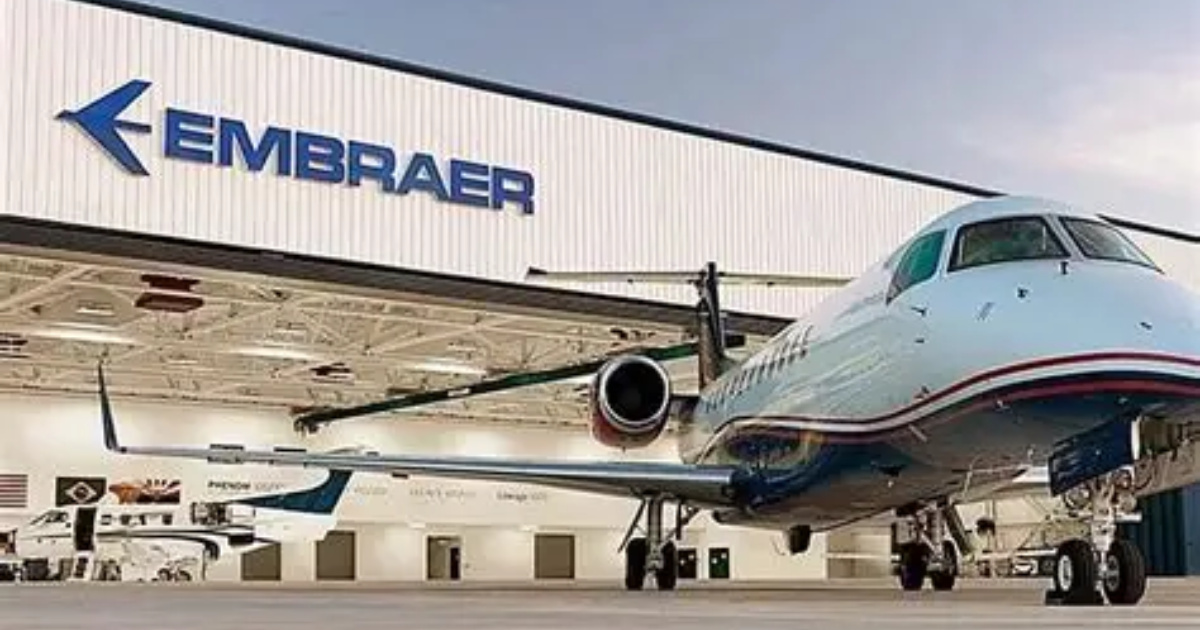
A Embraer is now out of immediate reach of the 50% tariff applied by the United States to Brazilian products, preserving its aircraft sales to the country.
However, the manufacturer remains subject to the 10% rate already in effect since April and operates against the backdrop of a Section 301 investigation into Brazil’s trade practices.
In this scenario, the company projects to import US$ 21 billion in inputs and services from the USA by 2030, a figure reiterated amidst new rounds of business dialogue.
-
Petrobras and Engeko’s New Investment Plan Promises Billions and Thousands of Jobs, Capturing Market Attention

-
JBS Halts Beef Production for China as Brazil Exceeds 50% of 1.106 Million-Ton Quota; Tariff May Rise from 12% to 67%, Raising Concerns Over Cattle Prices.

-
Brazil’s Social Security Alters Biometric Rules for Pensions and Benefits, Sets 30-Day Deadline, Expands Requirements, and Clarifies Who Is Exempt from Immediate Update
-
Major Brazilian Supermarkets, Including Carrefour and Assaí, May Close Earlier to Prevent Price Increases


Event in São Paulo Reinforces Dialogue Amidst the Clash
According to Times Brasil, on Tuesday (26), Fiesp and the Council of the Americas gathered in São Paulo, executives from companies with a presence in both countries and authorities to discuss Brazil-U.S. relations in a tense commercial environment.
The agenda addressed the role of the private sector in maintaining investment flows, innovation, and jobs, with Embraer, Boeing, Amazon Web Services, JBS, and Salesforce among the participants.
Juliana Villano, from Embraer, was one of the invited speakers. Also at the same meeting, business leaders argued that economic cooperation should not be paralyzed by the tariff dispute.
For Fiesp, negotiation remains the preferred path to reduce uncertainties and safeguard productive chains with strong bilateral integration.

50% Tariff Saved Aircraft, But 10% Remains in Effect
The exemption of civil aircraft and components from the additional tariff of 40 percentage points — which raised the total burden to 50% for a large part of Brazilian goods — avoided a direct shock to orders and deliveries in the aerospace sector.
The measure, formalized by executive order at the end of July, confirms the exclusion of the aeronautical segment while maintaining the base tariff of 10% from the “reciprocal” regime established in April.
In parallel, a Section 301 investigation is underway, conducted by the U.S. government to assess practices deemed “unfair” in trade with Brazil.
The procedure, aimed at the country and not specific companies, increases regulatory uncertainty and may result in new restrictive measures.
Projection of US$ 21 Billion in U.S. Purchases by 2030
In detailing its supply and export plan, Embraer projected to purchase US$ 21 billion from U.S. suppliers and, in the opposite direction, export US$ 13 billion to the USA by 2030.
According to the company, the estimated volumes imply a surplus of US$ 8 billion for the U.S. side during this period, reinforcing the narrative of interdependence of the chains and helping to qualify the debate on tariffs.
The number has circulated again in the business networking environment in São Paulo, serving as a reference to show the weight of the USA as a source of components, technology, and services in the ecosystem of the Brazilian manufacturer.
Industry insiders believe that maintaining predictable trade channels is essential for the timing of the company’s commercial, executive, and defense programs.
Market Diversification and BNDES Reading
Under tariff pressure, Embraer has sought to diversify markets and advance negotiations in countries outside the traditional axis, such as India, according to government insiders.
In a tone of encouragement for the strategy, the president of BNDES, Aloizio Mercadante, stated that the American market will remain important, but the company “is diversifying and building relationships with other markets.”
He added: “We will have news soon, and BNDES will be ready to finance.”
This statement aligns with the movement of financing and capitalization of technological initiatives linked to the company.
BNDESPar announced an investment of US$ 74.9 million in Eve Air Mobility, a subsidiary dedicated to eVTOL, and now holds 4.4% equity in the company.
The operation was part of a fundraising of US$ 230 million that included BDRs listed on B3 and resources to support the development and certification phase.
Why the “Relief” Does Not Eliminate the Risk
Even with the exclusion of aircraft from the 50% surcharge, the “reciprocal” 10% tariff continues to apply and may affect parts, components, services, and logistics related to aerospace programs, depending on the tariff classifications.
The additional risk arises from the very political dynamics: the White House linked new steps to potential retaliations from Brazil, which keeps the sword of adjustments hanging over supply chains.
On the Brazilian side, authorities have opened formal processes to evaluate countermeasures and are exploring ways to mitigate the sector’s impact.
Among them are public purchases and the redirecting of exports, while monitoring legal and multilateral avenues.
Although short-term measures provide some breathing room for specific segments, the prevailing sentiment among market agents is that the cost of uncertainty rises as long as the dispute lasts.
Institutional Pressure and Next Steps
The Fiesp conference with the Council of the Americas served as a pressure platform for the bilateral agenda to remain open to technical adjustments and sector exemptions, reducing collateral damages.
By highlighting numbers of imports and exports between the parties, executives reinforced the argument that integrated chains tend to suffer from widespread tariff shocks.
In this sense, they argued that calibrations by tariff code would be more effective in avoiding disruptions.
Meanwhile, Embraer maintains a dual strategy: it preserves its presence in the USA — the main regional market for jets with up to 100 seats and relevant for defense and services — and, in parallel, accelerates talks in other hubs to dilute exposure to political pressures.
The practical result of this stance will be measured by the ability to maintain order flow, navigate the tariff regime, and secure competitive financing for its development programs.
In the end, the equation Embraer is trying to present — sector exemption, purchase projection in the USA, and geographic diversification — seeks to transform a hostile environment into operational predictability.
The question remains whether business dialogue and regulatory windows will be sufficient to contain the political escalation and shield the supply chains until a negotiated solution emerges.
In your view, does the combination of market diversification and greater integration with American suppliers strengthen the company’s position or increase dependence on a single axis?





-

2 people reacted to this.