Portuguese
  Spanish


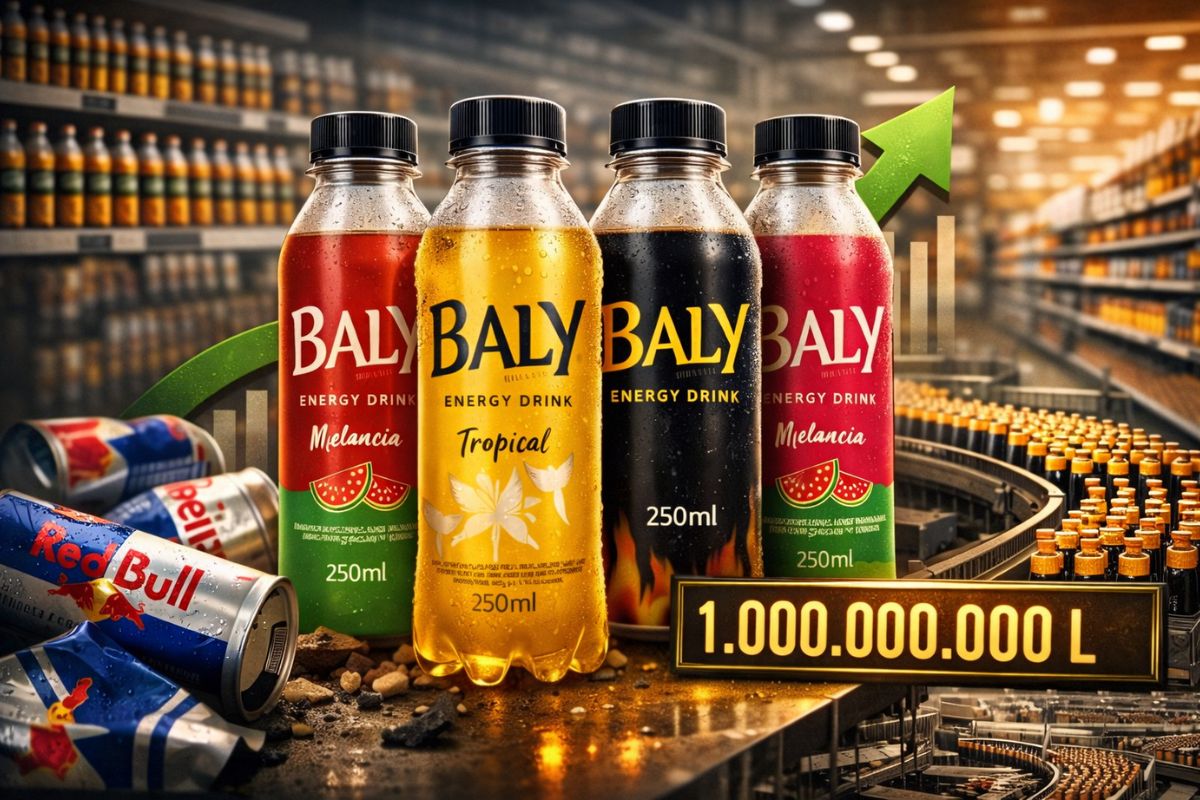

Since 2009, the Family Company Baly from Santa Catarina has turned a bottling limitation into a competitive advantage by launching an energy drink in PET bottles, first in 1 liter and then in 2 liters. The strategy repositioned consumption and, by 2025, placed the brand above Red Bull in volume and in direct competition with Monster.
The Santa Catarina company behind Baly entered a market where cans and the “premium” image seemed undisputed, but the operation itself pushed the decision: without the capacity to can, the energy drink was born in a PET bottle. What seemed like improvisation became a path to occupy shelves and refrigerators where the product barely circulated.
By 2025, this Company earned R$ 1.8 billion and ended December with 34.9% of the national energy drink market, while Monster held 30.4% and Red Bull 13.3%. The goal now is to grow to R$ 2.5 billion in 2026 and, for the first time, exceed 1 billion liters produced in the year.
From Bottling Scarcity to Defining a Category

In 2009, when the Brazilian energy drink market was still small and concentrated, the family company from Santa Catarina, which produced wines and cachaças, decided to enter the segment without the most common “uniform” of the category: the can.
-
Brazil’s 2026 Tax Refund: Record 9.58 Million Filers in Largest Payout Ever, But a Key Detail on Priority Recipients Draws Nationwide Attention

-
Itaú Alters Hybrid Work Model, Increasing Office Days from 2028, Prompting Employees to Adjust to New Routine
-
Facing Labor Shortage, Japan Plans to Invest $34 Million to Attract Foreign Workers in Construction, Healthcare, Industry, and Commerce

-
Brazilian City Makes Remarkable Leap, Becomes 4th Wealthiest in the Country with GDP of R$ 134.1 Billion




The choice of PET began as a solution to an industrial bottleneck, not as a brand manifesto.
This operational detail, however, changed the logic of distribution and purchasing.
By enabling larger formats, the Company opened space for consumption less associated with nightlife and more connected to home stock, neighborhood bars, and cash-and-carry stores. A factory limitation became a market choice.
What It Meant to Sell Energy Drink in 2-Liter PET Bottles
The migration to the 2-liter PET bottle was the point where the proposition became impossible to ignore. In practice, the format resonates with different purchasing behaviors: replenishment for home, shared consumption, and the search for cost per volume, something rare when the energy drink was viewed as an occasional item.
The Company itself acknowledges that there was initial resistance, a “prejudice” from consumers who associated the popular packaging with inferior quality.
However, the retail perspective was different: there was pent-up demand for an energy drink that fit within budgets and routines, without relying on the party context to make sense.
When price and volume change, the consumption ritual also changes.
How the Company Became a Leader in 2025 and What the Numbers Say
The leap in 2025 is not limited to perception; it is evident month by month in volume. Baly Company surpassed Red Bull in sales volume every month in 2025 and led the market for four months, also surpassing Monster during those periods.
In December, the numbers show the extent of the turnaround: 34.9% market share for the Santa Catarina Company, against 30.4% for Monster and 13.3% for Red Bull, according to Scantech data.
In a sector where brand and “status” have always mattered, the data suggests that distribution, availability, and format have begun to influence as much as the image built over the years.
The Shift in Consumption: From the VIP Area to Home, Work, and the Road
The energy drink that used to appear in “buckets of ice” and VIP areas has gained new settings. The executive from the Company describes the product as part of the “warm-up,” of parties among friends, and even barbecues – a symbolic shift: it moves from exceptional consumption to a broader social routine.
The pandemic accelerated another decisive change. Between 2020 and 2021, consumption at home increased in situations such as studying and working, and the interest in flavored and sugar-free versions grew, according to the Company itself. Today, reported uses include gyms, intense routines, gaming, and long trips, with drivers consuming to endure long roads – a repositioning to “functional product”. And here lies a point of responsibility: due to involving stimulants, consumption requires individual attention, especially for those more sensitive to caffeine.
Industrial Capacity in Santa Catarina and the Goal of 1 Billion Liters
Increasing market share is one thing; sustaining supply is another. To pursue the goal, the Company has planned an aggressive expansion: between 2024 and 2026, total production of energy drinks is expected to increase almost fivefold, from 205 million liters to an estimated 1 billion liters in 2026.
The chosen path was investment in capacity: acquiring two new plants between 2025 and 2026 and, in January 2026, purchasing a factory in Araranguá (SC).
The site has a total area of 500,000 m² and will be 100% dedicated to energy drink production. The Company maintains two other manufacturing parks and a distribution center, all in Santa Catarina, with 1,500 direct jobs – an indication that the strategy is not only commercial but also industrial and logistical.
PET Still Reigns in Revenue and the Company Diversifies Its Portfolio
Even with canned versions already in the lineup, PET remains central: the bottles account for 50% of the Company’s revenue from energy drink sales.
This helps explain why the brand does not treat cans as a replacement, but as a complement, while still preserving the differential that led it to gain scale.
The productive reorganization also indicates diversification. With the new acquisition, the Tubarão unit will be exclusively dedicated to alcoholic beverages, such as vodka and gin, and the executive states that the Company is betting on innovation in this market, mentioning the launch of the world’s first canned vodka and the intention to produce Ice and Ready To Drink mixes. The message is clear: increase energy drink capacity without abandoning other revenue streams.
The Sector in Numbers and What Leadership Will Need to Prove Going Forward
The market is not stagnant, and this changes the degree of difficulty for any Company that assumes the lead. Euromonitor projects that the sector will reach R$ 30 billion by 2029.
Per capita consumption in Brazil is 4.2 liters per year and the projection is to reach 7 liters by 2029, meaning there is room for market growth, not just to swap leaders.
Still, growing faster than the market is what separates “trends” from “structural change.” In the last six months, Baly Company grew 31% in value and 27% in volume, while the market grew 13.5% in value and 10.9% in volume, according to NielsenIQ.
From here, the question changes from whether the PET bottle worked to whether the operation will be able to maintain innovation, distribution, and perception of quality at the same pace as it expands production and volume.
The trajectory of the Santa Catarina Company shows how an industrial detail of being unable to can can turn into a strategy capable of reshaping retail and consumer behavior: from the party to the supermarket, from can to PET bottle, from niche to massive volume.
With 34.9% of the market in December, R$ 1.8 billion earned in 2025, and the ambition of 1 billion liters in 2026, the challenge now is to sustain leadership without becoming hostage to price, maintaining portfolio, capacity, and trust.
And now, looking at your routine: do you think the PET bottle really changes the way energy drink is consumed, or is it just a matter of price? At home, at work, or on the road, when did this type of beverage enter (or exit) your daily life, and which packaging makes the most sense for you?