






 Portuguese
  Spanish
  3 min of reading
  1 comment


American Company Launches New Line Of Solar-Powered Electric Vehicle Chargers That Can Also Function As Light Poles
Beam Global, a company from the United States specializing in sustainable solutions for transportation electrification, recently launched an innovative line of solar-powered electric vehicle (EV) chargers.
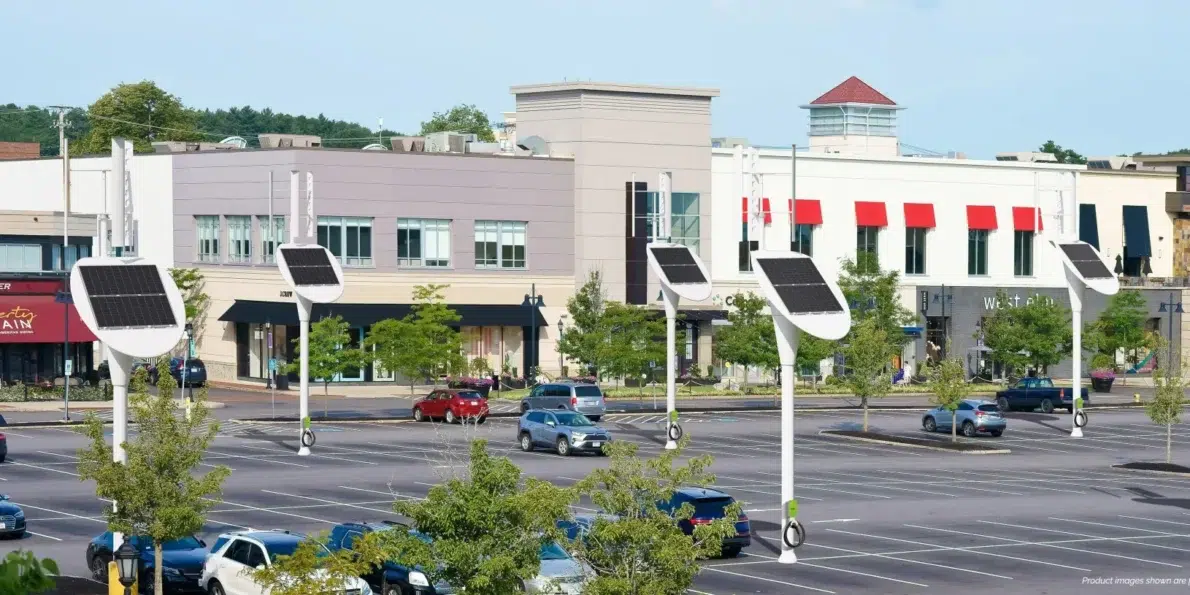
In addition to charging vehicles, the product, called BeamSpot, can replace public lighting poles, providing a multifunctional and eco-friendly solution for urban areas.

Electric Vehicle Chargers Powered By Renewable Energy
The BeamSpot system combines solar and wind energy with electricity supplied by utilities, storing energy in patented batteries. The goal is to provide not only public lighting but also charge electric vehicles directly on the sidewalk, without the need for significant changes to existing urban infrastructure.
-
Solar energy can increase property value by up to 10% and become a selling point.

-
Solar and wind energy surpass natural gas for the first time in the world and accelerate energy revolution

-
Africa has about 500,000 cell towers and most still burn diesel to operate, while companies rush to cover antennas with solar energy and avoid signal blackouts.
-
Farmers swapped diesel for solar panels in Pakistan, powered irrigation pumps almost cost-free, expanded rice fields, and now groundwater has become a red alert in the countryside.




Beam Global’s solution is particularly useful in locations where traditional charging station installation faces obstacles, such as public parking areas, housing complexes, airports, and event centers. BeamSpot promises an efficient way to provide charging without taking up additional space or requiring excavation and new electric circuits .
Using Existing Light Poles As Charging Infrastructure
One of the biggest innovations of BeamSpot is the use of existing public lighting poles. Typically, these poles have limited power, sufficient only to illuminate the area. However, Beam Global’s technology utilizes multiple sources of renewable energy, allowing streetlights to also charge electric vehicles, without the need for additional power grids.
This new system promises to reduce costs, installation time, and the complexity that typically accompanies the expansion of EV charging infrastructure. By replacing traditional light poles, BeamSpot facilitates charging without compromising urban space.
Market Opportunity For The BeamSpot
It is estimated that there are currently 304 million public lighting poles worldwide, a number that is expected to grow to 352 million by 2025. This expansion represents a significant opportunity for the integration of BeamSpot technology in densely populated areas, especially where electric vehicle charging is most needed, but where the installation of traditional stations would be more complex.
Cities around the world are seeking smarter and more sustainable solutions for urban mobility. BeamSpot emerges as a practical solution to these needs, providing a greener and more efficient infrastructure.
Expansion To The European Market
Beam Global is expanding its operations to the European market after acquiring Amiga DOO, one of Europe’s leading public lighting manufacturers. With this acquisition, the company plans to bring BeamSpot beyond the United States, leveraging the growing demand for electric mobility solutions on the continent.
This expansion allows Beam Global to enhance its global presence and contribute to the advancement of transportation electrification in cities across different countries, addressing the growing demand for electric vehicle charging infrastructure.
Contributing To Sustainable Mobility
The launch of BeamSpot comes at a crucial time, as electric mobility is becoming a priority for cities worldwide. Beam Global’s solution not only facilitates the use of electric vehicles but also improves the efficiency of public lighting by utilizing renewable energy sources.
With BeamSpot, Beam Global promises to transform urban infrastructure, offering a solution that combines vehicle charging, lighting, and sustainability in a single structure.








Que show