






 Portuguese
  Spanish
  5 min of reading
  0 comments


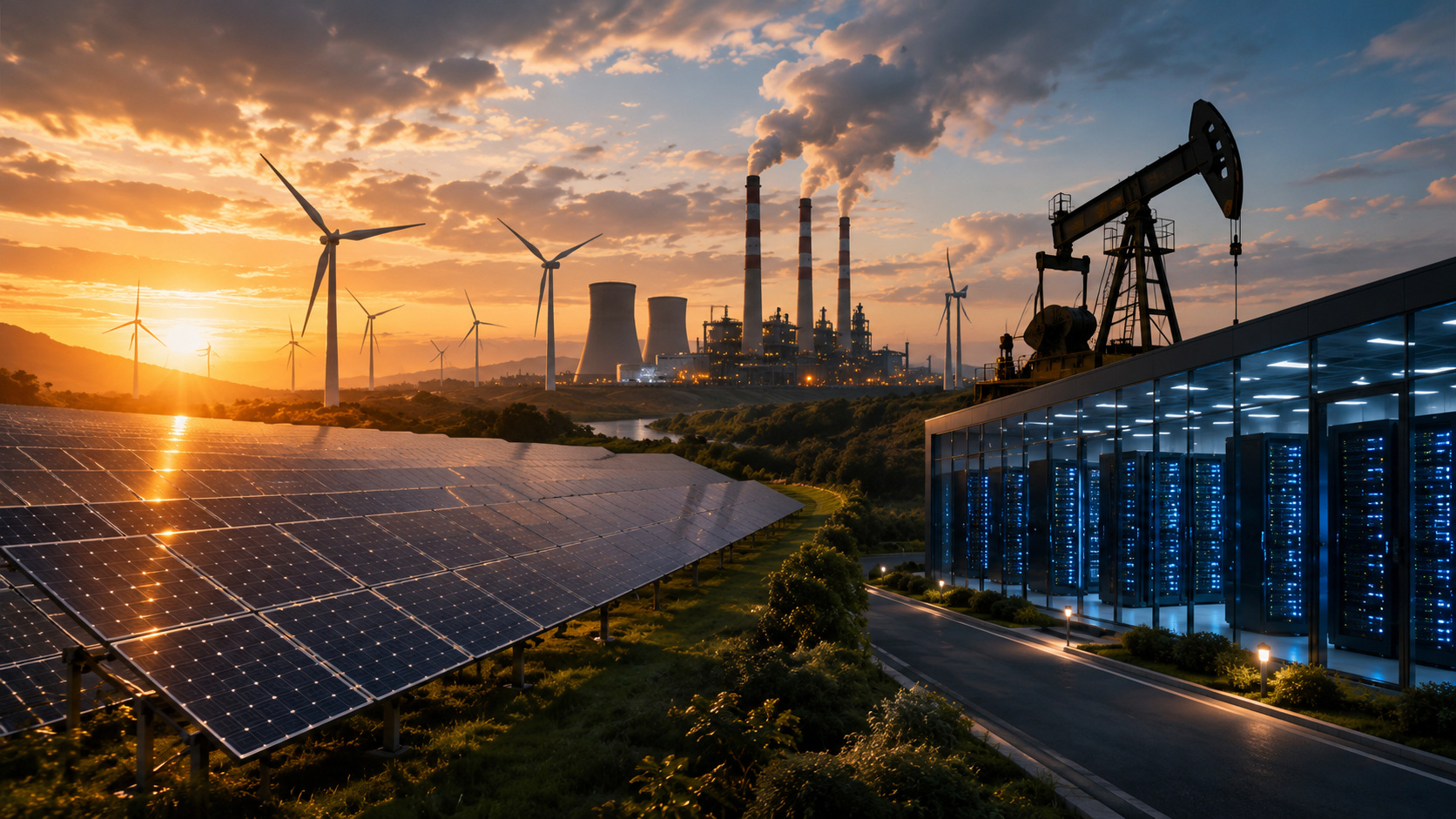
Solar energy is on track to become the largest source of electricity on the planet by 2035. However, a new BloombergNEF report points out that the explosive advancement of artificial intelligence and data centers may prolong the life of fossil fuels for much longer than many experts imagined.
Furthermore, the accelerated growth in demand for electricity is creating an unprecedented scenario: while solar panels are gaining ground at a record pace, natural gas and even coal-powered plants are still seen as essential to keep gigantic digital structures running 24 hours a day.
Solar energy is expected to take global leadership by 2035
According to projections, solar energy will surpass coal, oil, and natural gas as the world’s main source of electricity within the next decade.
Moreover, experts state that the change will occur mainly for economic reasons. The costs of solar panels continue to fall rapidly, making this technology increasingly competitive compared to traditional sources.
-
Solar energy can increase property value by up to 10% and become a selling point.

-
Solar and wind energy surpass natural gas for the first time in the world and accelerate energy revolution

-
Africa has about 500,000 cell towers and most still burn diesel to operate, while companies rush to cover antennas with solar energy and avoid signal blackouts.
-
Farmers swapped diesel for solar panels in Pakistan, powered irrigation pumps almost cost-free, expanded rice fields, and now groundwater has become a red alert in the countryside.




Solar panels are getting cheaper every year
The advancement of photovoltaic energy is directly linked to the reduction of production costs.
Furthermore, projections indicate that solar panel prices may fall by an additional 30% by 2035, further expanding their economic advantage.
A large part of this reduction happens thanks to large-scale production and industrial incentives implemented by China.
Artificial intelligence completely changes the energy scenario
While solar energy grows, another phenomenon is also transforming the global market: the explosion of artificial intelligence.
Additionally, AI systems rely on enormous data centers that consume gigantic amounts of electricity to process information, store data, and train advanced models.
This growth is putting pressure on power grids in various regions of the planet.
Data centers become major energy consumers
Data processing centers have become one of the fastest-growing energy areas in the world.
Furthermore, projections indicate that the electrical demand associated with data centers could grow rapidly in the coming decades.
The expansion of cloud computing, generative artificial intelligence, and digital services explains much of this progress.
AI may keep fossil fuels alive until 2050
Despite the rise of renewable sources, fossil fuels continue to offer an important advantage.
Moreover, natural gas and coal-fired plants can operate continuously, without relying on weather conditions.
For this reason, BloombergNEF estimates that these sources could account for about 51% of the additional generation needed to power data centers by 2050.
Market projects massive expansion of solar energy
Forecasts show impressive numbers.
Additionally, data centers are expected to drive the installation of approximately:
- 1 terawatt of additional large-scale solar energy;
- 400 gigawatts of distributed solar energy;
- 370 gigawatts of natural gas;
- 110 gigawatts of coal.
These numbers demonstrate how the energy transition could occur in a hybrid manner over the coming decades.

Technology companies gain power over the energy sector
With the advancement of artificial intelligence, technology giants are beginning to directly influence the future of the global energy matrix.
Moreover, companies responsible for building data centers will play a decisive role in choosing the energy sources used on a large scale.
Experts believe that these decisions can determine which technologies will remain economically viable until the middle of the century.
Google and other giants are already seeking new solutions
The big tech companies are also looking for alternatives to reduce their dependence on fossil fuels.
Moreover, projects involving long-lasting batteries, geothermal energy, and even nuclear energy have been receiving billion-dollar investments.
The goal is to ensure a continuous supply of electricity without increasing carbon emissions.
Batteries enter the energy dispute
The energy storage appears as one of the most important bets to accelerate the transition.
Additionally, battery systems allow storing the surplus produced during the day and using it at night or during periods of low solar generation.
This technology can reduce the need for fossil plants in various regions.
Excess solar energy already creates new challenges
In some countries, the expansion of solar energy is starting to create curious situations.
Additionally, regions in Spain and Italy have recorded a drop in electricity prices during the day due to excess photovoltaic generation.
As a result, companies have started investing in hybrid projects that combine solar panels and battery storage.
Brazil can gain space in this new race
Brazil appears in a strategic position within this scenario.
Additionally, the country has one of the cleanest electrical matrices on the planet, with a strong participation of renewable sources such as hydroelectric, solar, wind, and biomass energy.
This characteristic can attract new investments in digital infrastructure and data centers.
Global demand for energy continues to soar
The growth does not involve only artificial intelligence.
Additionally, electric vehicles, digitalization of the economy, cooling systems, and industrial electrification also increase the global energy consumption.
Therefore, experts believe that the world will need to rapidly expand its electric generation capacity.
What the report predicts for the coming decades
Among the main points highlighted are:
- Solar energy leading global generation by 2035;
- Continuous drop in the price of solar panels;
- Explosive growth of AI data centers;
- Increase in global electricity demand;
- Continued use of natural gas and coal;
- Expansion of batteries, geothermal, and nuclear energy.
Furthermore, the study shows that the energy transition should occur gradually, combining different technologies.
The future of energy will be defined by artificial intelligence
The race for artificial intelligence is already transforming much more than computers and software.
Moreover, the growth of data centers could completely redefine global energy planning in the coming decades. While solar energy advances towards global leadership, fossil fuels continue to find space precisely because of the need to supply the digital revolution around the clock.
Therefore, experts believe that the future of energy will not be decided solely by solar panels, but also by the algorithms that drive the new era of artificial intelligence.




Be the first to react!