Portuguese


On September 18, 2024, the California Department of Water Resources celebrated the opening of a levee at Lookout Slough in Solano County, a project that returned tidal waters to 3,400 acres, excavated about 42 km of channels, and expanded flood storage in the California Delta.
California opened a levee in Solano County and allowed the tide to reclaim 3,400 acres of restored areas for the first time in about a century. The action marked the completion of Lookout Slough, considered by the state to be the largest coastal wetland restoration project ever undertaken in the Delta.
The announcement was made on September 18, 2024, by the state government and the California Department of Water Resources. In addition to recovering habitat and creating tidal channels, the project was presented as a nature-based solution to reduce flood risks in the Central Valley and protect neighboring communities during extreme events.
Tide returned to occupy an area closed for decades
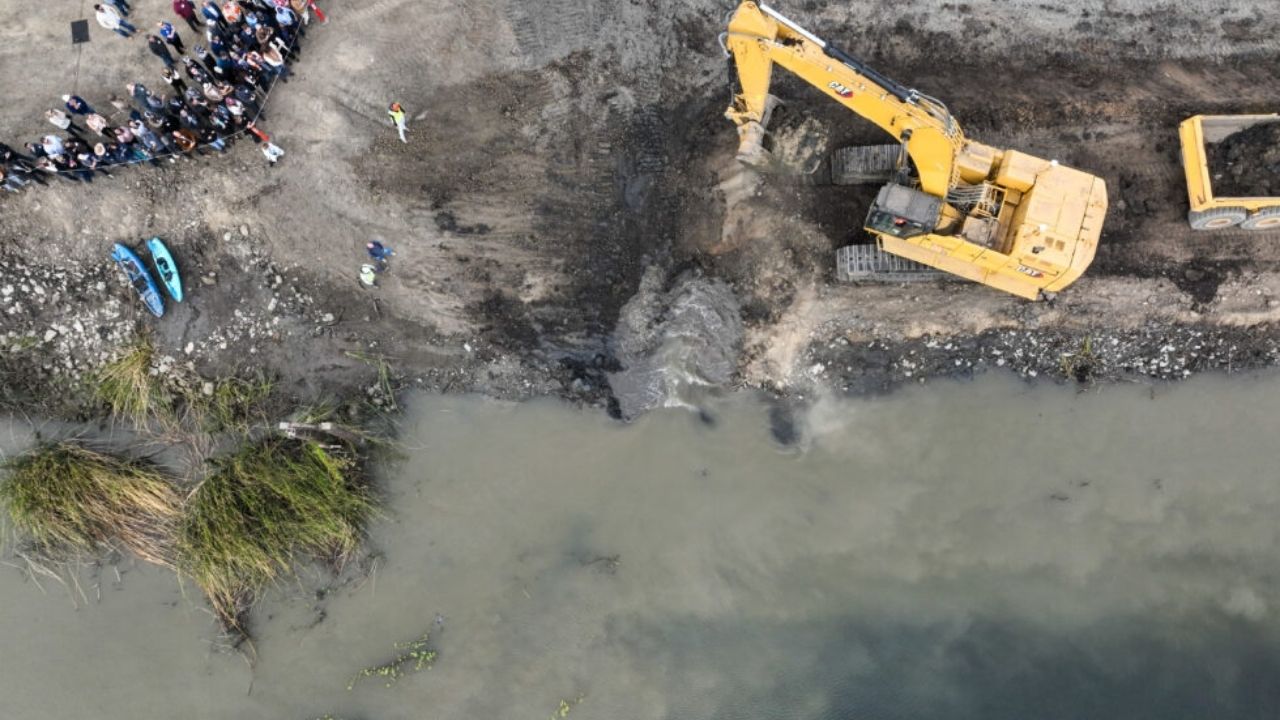
The most symbolic point of the project was the opening of the levee at the eastern end of Lookout Slough. With the intervention, tidal waters began to circulate again through an area of 3,400 acres of restored habitat, something that had not occurred for approximately one hundred years, according to the California government.
-
US Mayor Goes Undercover as Homeless for a Week to Understand Rising Homelessness, Sparking Debate in His City

-
Teen from Brazil Turns School Snack Sales into Million-Dollar Confectionery Business Projected to Earn Nearly $1.9 Million in 2024

-
Why Do Electrical Outlets and Switches Turn Yellow? Understanding the Impact of Light, Temperature, and Materials on Color Change
-
Former Brazilian laborer and ice cream vendor turns struggling company into $16.5 billion giant with 90,000 employees.


The scene seems the opposite of what is expected in a flood protection project: instead of preventing water entry at all costs, the project allowed it to return in a controlled manner. The logic was to make the tide part of the solution, not just a threat.
Lookout Slough is located in the Sacramento-San Joaquin Delta, a strategic region for water, agriculture, infrastructure, and ecosystems in California. The area also connects to the Yolo Bypass, important for water storage and passage during floods.
The opening of the levee was celebrated as the final stage of a project with multiple benefits. In practice, the restoration seeks to combine flood protection, wetland restoration, creation of tidal channels, and support for water management in a region vulnerable to climate extremes.
Project created channels and expanded space for floods
The construction of Lookout Slough began in June 2022. According to the California Department of Water Resources, the works included the construction of more than three miles of a set-back levee, about 25 feet high, equivalent to approximately 7.6 meters.
This new levee was designed to offer protection against centennial floods, already considering a margin for future sea level rises. In other words, the intervention was not only environmental; it also had a direct function in infrastructure and climate adaptation.
Another central point was the excavation of 26 miles of open tidal channels, equivalent to about 42 kilometers. These channels help distribute water throughout the restored area and recreate the natural dynamics of wetlands, allowing tidal flow to circulate through the terrain again.
Additionally, the site now offers more than 40,000 acre-feet of additional water storage capacity in case of flooding within the Yolo Bypass. This extra space acts as a kind of “breathing area” for future floods, reducing pressure on nearby communities and infrastructure.
Water once contained became a tool for protection
For a long time, containment works were designed to keep water away from occupied areas. At Lookout Slough, the strategy was more complex: maintaining protection through a new set-back levee while returning to the tide an area capable of absorbing water during extreme events.
This approach is known as a nature-based solution. Instead of relying solely on rigid barriers, the project uses the environment’s own functioning to reduce risks. The restored wetland can receive water, slow down flows, and create space for floods to spread in a less destructive way.
Governor Gavin Newsom stated, in the announcement, that California seeks solutions that work in harmony with nature to protect communities, ecosystems, and local economies in the face of floods and droughts related to climate change. The statement reinforces the framing of the project as part of the state’s climate agenda.
The case draws attention because it reverses the traditional image of water as an enemy. Instead of simply blocking the tide, the work reorganizes the territory so that water can circulate where it can help reduce impacts.
Lookout Slough combines heavy construction and environmental restoration
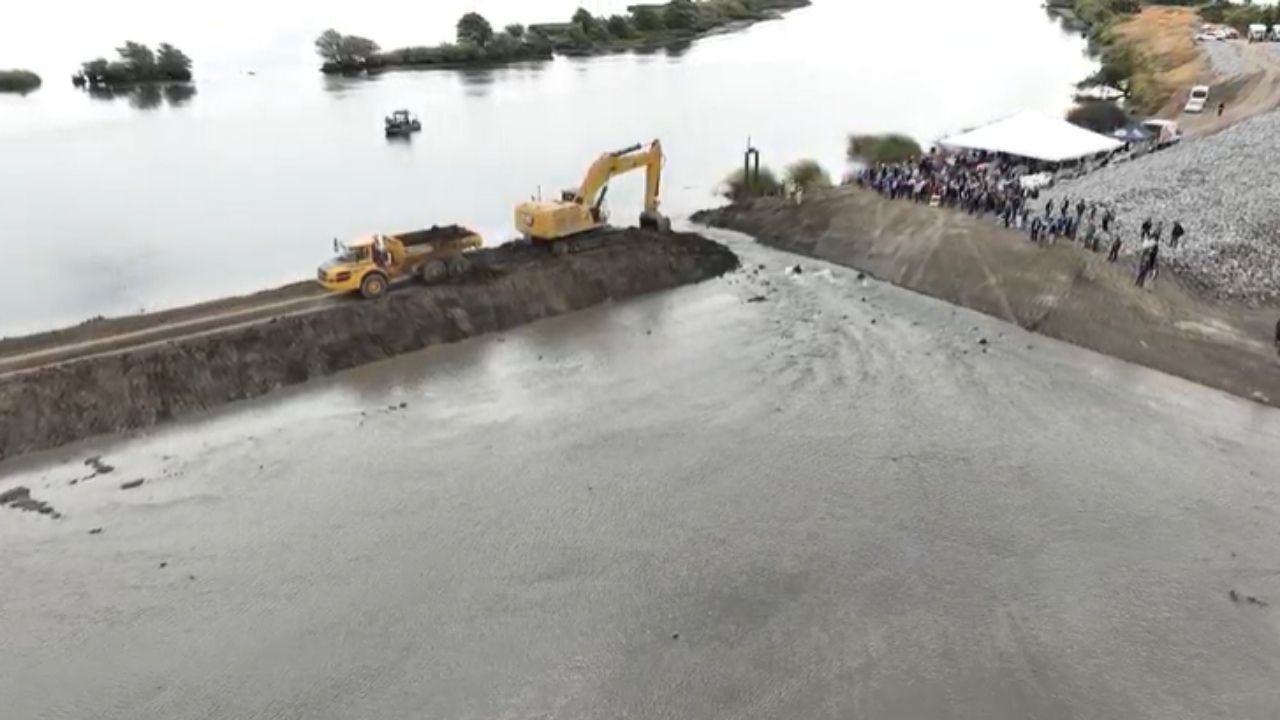
Although the final result seems natural, the project required heavy engineering. The opening of the dike was just one of the steps in an intervention that involved construction, excavation, revegetation, and hydraulic reorganization of a large area of the Delta.
According to the state government, the restoration also included native habitat through natural revegetation and other strategies. The intention is for the area to function as a tidal wetland, with channels, vegetation, and space for sensitive Delta species.
The project is also expected to create recreational opportunities, such as wildlife watching and fishing. Still, the main focus of the news is not on tourism or wildlife, but on the combination of water infrastructure and flood protection.
This combination explains why Lookout Slough was presented as a multi-benefit project. It does not solve just one problem: it attempts to simultaneously address flood risk, wetland loss, water management, and climate adaptation.
Public and private partnership accelerated delivery
Lookout Slough involved participation from the California Department of Water Resources and Ecosystem Investment Partners. The dike opening ceremony brought together state and local authorities and project partners, marking the completion of the restoration on site.
In the DWR statement, Director Karla Nemeth highlighted that protecting people from floods does not need to be in conflict with the environment. The statement summarizes the central argument of the project: infrastructure and restoration can work together when the territory is planned to safely receive water.
California’s Secretary of Natural Resources, Wade Crowfoot, also linked the project to the state’s goals for large-scale restoration in the Delta. The government reported that there are more than a hundred projects underway, led or supported by the DWR, focused on habitat, special species, and water management.
California treats Lookout Slough as part of a larger strategy to build critical infrastructure and expand nature-based solutions. The controlled breach of the dike, therefore, was not an isolated gesture, but a piece within a climate adaptation policy.
A century later, the tide returned with a new function
The return of the tide to Lookout Slough is symbolic because it restores a dynamic interrupted for about a hundred years. The water that was once kept out now returns with a planned function: to feed channels, occupy wetlands, and enhance flood response capacity.
This type of project shows that flood protection does not only depend on higher walls. In some cases, making room for water can be more efficient than trying to completely confine it. The difference lies in control, planning, and choosing where this water can circulate.
By creating about 42 kilometers of channels and restoring 3,400 acres, the Lookout Slough transforms an area of the Delta into living infrastructure. It is not an invisible work: it is landscape, habitat, temporary reservoir, and indirect flood barrier at the same time.
For communities in the Central Valley and surrounding areas, the main expected impact is the reduction of risk in future events. The work does not eliminate floods, but adds storage capacity and reorganizes the water flow in a sensitive region.
When opening a levee becomes a strategy against floods
The case of California shows an important shift in the way of dealing with water in times of climate extremes. The levee was not opened due to neglect, abandonment, or emergency, but as part of a project designed to let the tide return with ecological and preventive function.
The completion of Lookout Slough also raises a relevant discussion for other countries: in vulnerable areas, is it better to try to block the water at any cost or to rebuild natural spaces capable of absorbing part of the impact? The answer depends on each territory, but the Californian example shows that engineering and nature can work together.
With 3,400 acres restored, about 42 kilometers of tidal channels, and more than 40,000 acre-feet of additional storage, the work became a case of landscape-based climate infrastructure. The water once feared is now treated as an ally, as long as it is guided by technical planning.
Do you think projects of this type, which make room for water instead of just trying to block it, could inspire flood solutions in other regions? Leave your opinion in the comments.