






 Portuguese
  Spanish


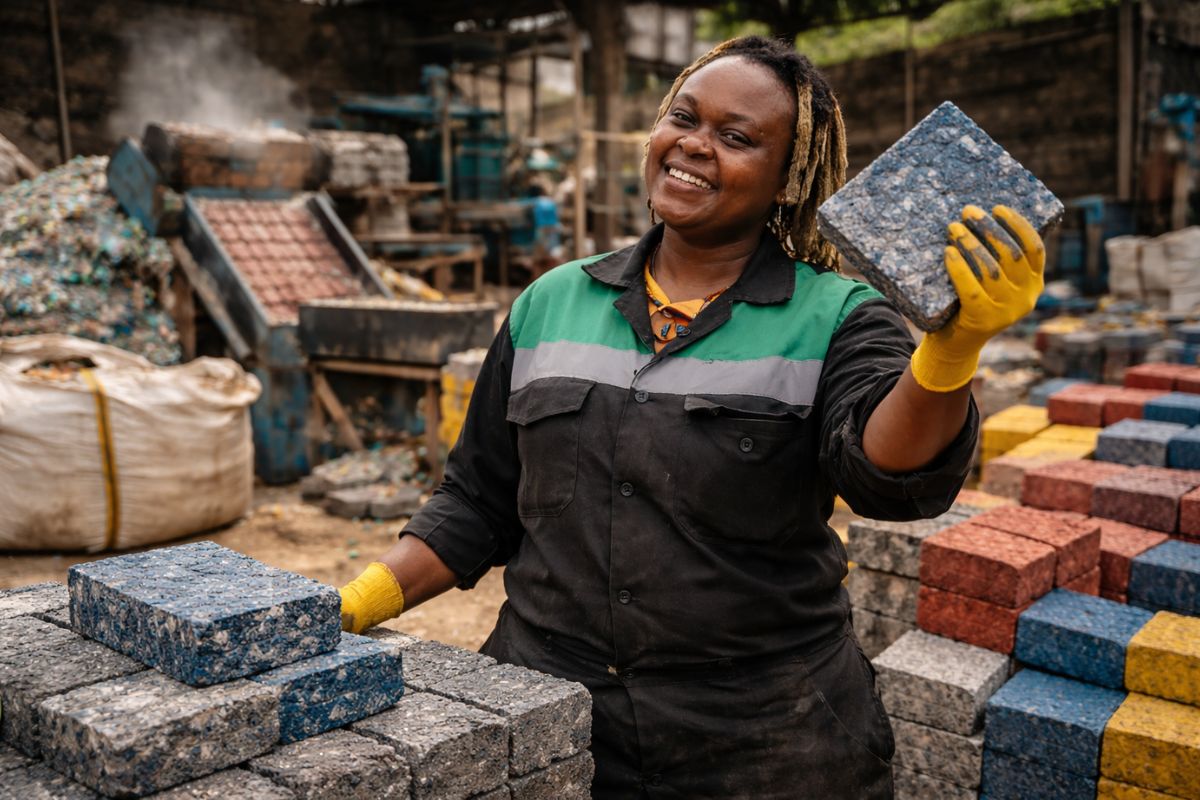


Engineer Nzambi Matee Set Up a Workshop That Looks Chaotic, Created Gjenge Makers and Produces 1,500 Plates Per Day with Plastic and Sand; The Pavements Have Certification from the Standards Office of Kenya, Melt Only Above 350°C and Today Also Reach Directly to Schools and Homes in Nairobi
Engineer Nzambi Matee works in a small workshop in Nairobi, Kenya, surrounded by metal tubes and gears, where discarded plastic stops being trash and becomes pavement. What looks like improvisation is, in practice, engineering applied to the most visible problem on the streets.
The 29-year-old engineer created Gjenge Makers to transform plastic bottles and containers into paving slabs made from a mixture of plastic and sand, with a daily production of 1,500 units. The result is not an “eco-friendly craft”, but a certified product designed to withstand real use and compete with concrete in strength and durability.
The Workshop That Looks Chaotic and the Process That Needs to Be Reproducible

Those looking from the outside see disorder: parts, metal, noisy machines, tests. For the engineer, it’s a prototyping environment.
-
Giant Robots Build Entire Neighborhood of 100 3D-Printed Homes in the U.S., Showcasing Technology’s Impact on Construction Industry

-
Helsinki Residents Receive Water That Travels 120 Kilometers Through a Hidden Rock Tunnel from a Lake Before Treatment

-
Brazil’s Sertão Region Nears Completion of Latin America’s Longest Artificial River, Transforming Water Access in Drought-Prone Ceará
-
Pre-mixed stabilized mortar set to revolutionize construction in 2026: extends usability to 36 or 72 hours, boosts productivity, and minimizes waste in building projects.



It was in this space that she developed a machine capable of transforming discarded plastic into “stones” for paving, sustaining the operation of Gjenge Makers.
The difference between an idea and a product lies in repetition. The engineer herself summarizes the leap: it’s not enough to learn how to make one brick, you need to learn how to make 1,000.
Producing 1,500 plates per day requires consistent mixing, machine stability, and standardization, because pavement cannot vary like a laboratory experiment.
Plastic, Sand and Why Some Wastes Behave Better Than Others

The interlocking pavement described comes from the combination of plastic and sand.
The engineer arrived at the proportions through trial and error, until she understood that some plastics “stick together” better than others when heated and combined with aggregates, which affects final strength and finish.
This detail explains why the development took time: it’s not just about melting plastic.
It’s about controlling the mixture, testing the material’s behavior, and adjusting the process so that the plate can withstand impact, weight, and usage variation.
The engineer also evolved the machines to manufacture the blocks at scale because the real challenge begins when demand moves from prototype to routine.
Certification, Melting Point Above 350°C and the Direct Comparison with Concrete
Gjenge pavements have complete certification from the Standards Office of Kenya, which brings the product into the real world of purchase, construction, and specification.
The basis provides two numbers that turn into technical arguments: melting point above 350°C and strength superior to concrete equivalents.
This combination shifts the type of conversation with clients. Instead of a generic promise, it brings criteria: standards, testing, batch, reproducibility.
For schools and owners, the appeal is not just “recycle,” it’s to receive a durable and affordable floor, with performance described as surpassing concrete and thermal behavior with a high margin.
From Job to Backyard: 2017, Noise, Year-Long Deadline and the Practical Turn
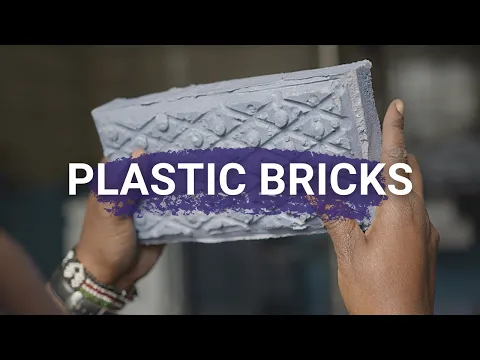

The engineer graduated in materials science, worked as an engineer in the oil industry in Kenya and, in 2017, quit her job as a data analyst to set up a small laboratory in her mother’s backyard.
The inspiration came from what she frequently saw: plastic bags and waste scattered on the streets of Nairobi.
The beginning was hard and not very “romantic.” The machine was loud, neighbors complained, and she requested a year to achieve the right proportions.
The engineer describes a period of total focus, with a social life set aside and savings invested in the process. This is the point where the story stops being a good idea and becomes a calculated personal risk.
Test Outside the Country, Materials Laboratory and the Fine-Tuning That Binds the Project
The project gained momentum when the engineer received a scholarship for a social entrepreneurship training program in the United States.
She brought paving samples and used the materials laboratories at the University of Colorado in Boulder to test and refine the proportions of sand and plastic.
This part matters because it shows the method: measure, adjust, repeat. The engineer did not rely solely on workshop intuition; she took the material to a testing environment and returned with better parameters.
It’s the difference between “it works in my backyard” and “it works with standards and scale.”
Why the Plastic Problem Becomes Urgent and Not Just an Environmental Agenda
The backdrop is a volume that does not stop. Globally, 1 million plastic beverage bottles are purchased every minute, and up to 5 trillion disposable plastic bags are used each year.
In this scenario, the engineer refers to plastic as a poorly used and misunderstood material: huge potential, disastrous final destination.
When this plastic is not absorbed by formal systems, it ends up in the most predictable path: landfill, street, drainage, urban landscape.
Nairobi, like many large cities, pays the price in the form of blockages, visible dirt, and everyday degradation, and it’s at this point that local solutions become relevant, as they attack the problem where it appears.
The School in Mukuru, the Floor in the Patio and the Social Effect That Goes Beyond the Material
One of the schools cited as a user is the Mukuru Professional Training Center, located in the slum of Mukuru Kyaba, in Nairobi.
The patio and paths between the classrooms have been covered with interlocking pavements, replacing dirt trails with firm and usable areas on a daily basis.
The program coordinator, Anne Muthoni, states that they plan to pave the entire area around the school and calls the solution cheaper, with direct thanks to the engineer.
She also ties in the social point: young people need to be motivated to care for the environment while making money. Here, the pavement becomes infrastructure and a narrative of income at the same time, without relying on a generic discourse.
UNEP, Young Champion of the Earth and the Industrial Reading of What Is Happening
For her work, the engineer was named Young Champion of the Earth by the United Nations Environment Program, an award that offers seed funding and mentorship to promising environmentalists. The foundation also brings a technical reading from UNEP, by expert Soraya Smaoun, on the need to rethink manufacturing and the end of life of industrial products.
The interpretation is straightforward: the engineer’s innovation in civil construction highlights economic and environmental opportunities when shifting from a linear economy, which discards after use, to a circular economy, which keeps materials in the system for as long as possible. In practice, this means taking waste from the end of the line and turning it into construction input, with market, standards, and scale.
Engineer Nzambi Matee built, in Nairobi, a concrete response to the excess of plastic: machine, mixture of plastic and sand, certified pavement, 1,500 plates per day, melting point above 350°C, and strength described as superior to concrete.
The journey went through 2017, backyard laboratory, noise complaints, time needed to adjust proportions, tests in materials laboratories, and the creation of a company that connects street, landfill, and civil construction.
Now I want specific answers: in your city, what waste do you see most accumulating on the ground, bag, bottle, or packaging, and where would a pavement made by an engineer have the most immediate impact, on sidewalks, schools, patios, or neighborhood internal roads? And would you trust such a floor more for being certified, or would you only believe it after seeing years of actual use?









Claro!! Plásticos? Os hacéis una idea de lo contaminante que puede ser eso emitiendo vapores? Os acordáis de los suelos mullidos de los parques? Desprenden un montón de químicos con el calor. Tantos que deberían de prohibirlos.
Mis felicitaciones, para ella!! Qué gran aporte!!
Vejo mais embalagens pelas ruas, confiaria neste piso sim, deveria ser utilizado pra ontem!!