Portuguese
  Spanish


One Of The Largest Submarine Disposals Of The Nuclear Era Is Back In The Spotlight
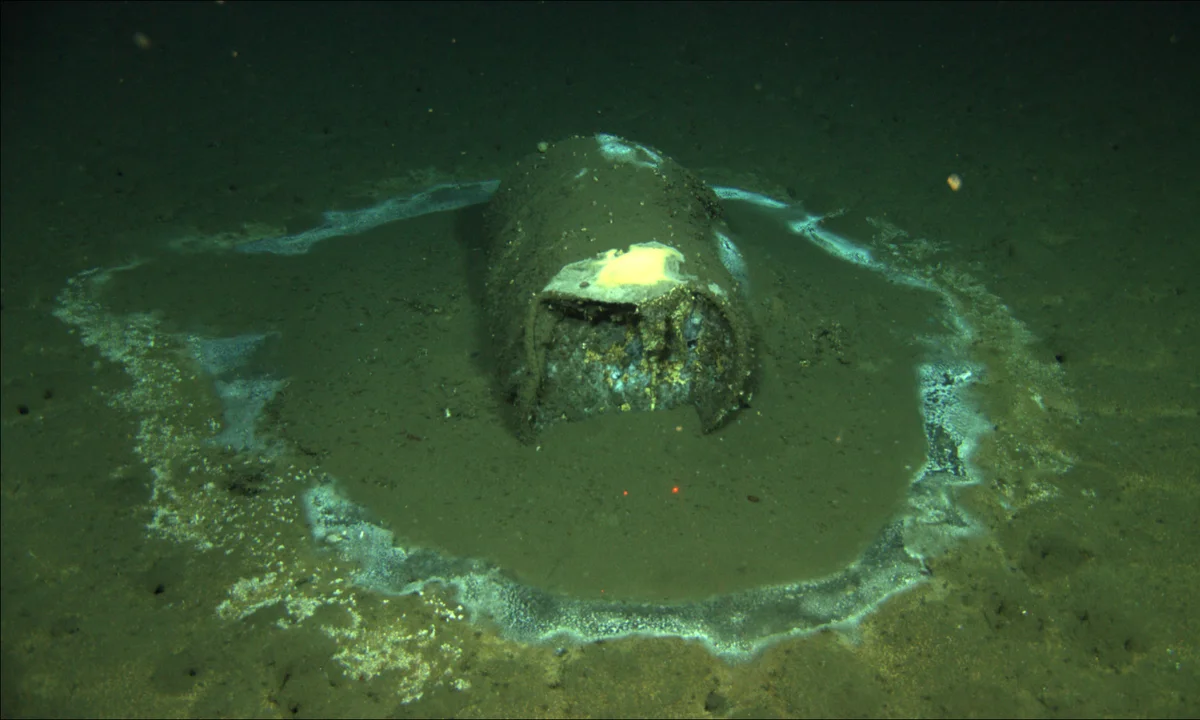
One of the largest toxic legacies of the 20th century is about to emerge — or at least be confronted. Starting on June 15, France will initiate a groundbreaking mission to map and study over 200,000 barrels of radioactive waste discarded by European countries in the depths of the Atlantic Ocean between 1946 and 1990.
These containers, now forgotten at over 4,000 meters deep, were thrown into the sea when the practice was legal and seen as a safe solution for low-activity materials, such as gloves, lab scraps, and samples with unstable isotopes. Decades later, with a new environmental awareness and advancements in science, the country is trying to understand the real impact of this submerged past — and whether it can be reversed.
A Historical Error Hidden At The Bottom Of The Sea
For nearly 50 years, nuclear waste dumping at sea was a common practice among European powers. Over 200,000 radioactive barrels were thrown into the so-called abyssal plains of the northeastern Atlantic, an area of up to 6,000 meters deep. This type of disposal was only banned in 1993, with the London Convention, which globally prohibited the dumping of waste into the ocean.
-
Oceanographer Turns Abandoned Fishing Nets from Brazilian Waters into Bags, Creating Jobs and Earning Over $7,000 Monthly

-
Volcanic Soils from Destructive Eruptions Turn into Million-Dollar Crops: Ashes Nourish Grapes in Lanzarote, Bananas in the Canary Islands, Blood Oranges on Mount Etna, and Cacti in Mexico, Showcasing How Lava-Formed Lands Sustain Rare Harvests in Seemingly Barren Regions
-
In the Caucasus Mountains, a Community Preserves a Language So Rare Few Outsiders Can Understand It

-
Slovakia’s Ice Cave Holds Over 110,000 m³ of Frozen Wonders, Boasts Walls Up to 27 Meters Thick, and Was Among the First Electrified Caves Globally



Much of the radiation is believed to have dissipated, according to experts, mainly due to the short half-life of elements like cesium-134 and iron-55. Nevertheless, there has never been a large-scale investigation to verify the state of the barrels or the long-term effects on marine ecosystems.
The response to this silence has now come, with the NODSSUM Mission, led by the National Center for Scientific Research (CNRS) of France. The initial focus is not to remove the barrels — a monumental operation — but to understand exactly where they are, what condition they are in, and whether they pose a continuous risk to marine life and the planet.
Submarine Mission: Technology To Examine The Invisible
The first phase of the operation, scheduled between June 15 and July 11, will be led by the UlyX, a remotely operated underwater vehicle from the French Oceanographic Fleet. Capable of diving up to 6,000 meters, the UlyX will meticulously map the dumping area using high-resolution sonar, flying about 70 meters above the seafloor.
After that, the robot will approach the barrels — without touching them — to capture images and collect samples of water, sediments, and fauna. The goal is to see how the radionuclides behave and interact with the marine environment. Fish and crustaceans will also be captured with special nets, called traps, for laboratory analysis.
The second phase, scheduled for 2026, will be even more delicate: a robot with mechanical arms, such as the Victor or Nautile, will approach the barrels directly to collect samples around them and assess whether it is possible to initiate a selective recovery operation — or if, paradoxically, the best option is to leave everything where it is.
The entire process follows strict radiation protection protocols, supervised by the French Nuclear Safety Authority.
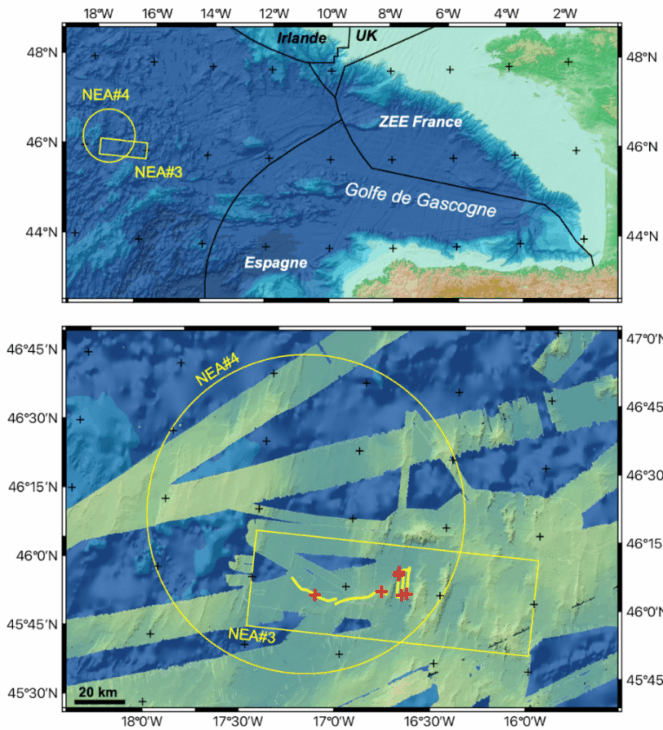
The Planet Faces Its Ghosts
In addition to trying to correct historical errors, the French mission will be crucial for understanding the long-term effects of the practice of dumping nuclear waste into the sea. Studying the barrels in the Atlantic may offer valuable clues about the resilience of the oceans, the limits of marine life, and the real risks of underwater nuclear waste storage.
Although Brazil did not participate in these historical dumps, it can also benefit from the results. The Brazilian coast has sensitive areas of marine biodiversity and is discussing, for example, where to store radioactive waste from plants such as Angra 1, 2, and the future Angra 3. Understanding the impacts of past practices can help avoid catastrophes in the future.