Portuguese
  Spanish


The civil construction of Espírito Santo showcased this week solutions that address three sensitive points of any construction: deadline, cost, and environmental impact.
The 3rd edition of ES Construção 2026 began on July 8 and runs until July 10, at the Carapina Pavilion, in Serra, with free entry and parking, from 2 PM to 9 PM, according to the event’s official page.
The highlight that draws the most attention is a duplex house that can be ready in five days, made with EPS panels, the expanded polystyrene, a material popularly known as Styrofoam.
-
Dubai will invest US$ 22 billion in sewage tunnels up to 90 meters deep, replacing pumps with gravity and replacing more than 100 old stations, in an attempt to save a city of skyscrapers, artificial islands, and rapid growth from an underground problem that has already overflowed into the streets.

-
The history of the Hercílio Luz Bridge involves controversies, love, and renewal: From its iconic construction to its reopening, it is a symbol of Santa Catarina.
-
On the world’s highest navigable lake, the Uros people have hand-built around 100 floating straw islands, living on them for 3,000 years without concrete or foundations.

-
Newly Completed Brazilian Highway in the Serra da Rocinha Becomes a 16.5 km Cycling Challenge and Boost for Local Tourism


The difference lies in its structural use: the panels are coated with galvanized steel meshes on both sides and receive appropriate finishing to form resistant walls.
The fair brings together 150 exhibitors and was set up to present products, construction systems, technical lectures, and business rounds. As reported by A Gazeta on July 8, 2026, the organizers expect to generate more than R$ 600 million in business, in a sector that employs more than 130,000 people in Espírito Santo.
The EPS duplex that eliminates part of the traditional heavy construction
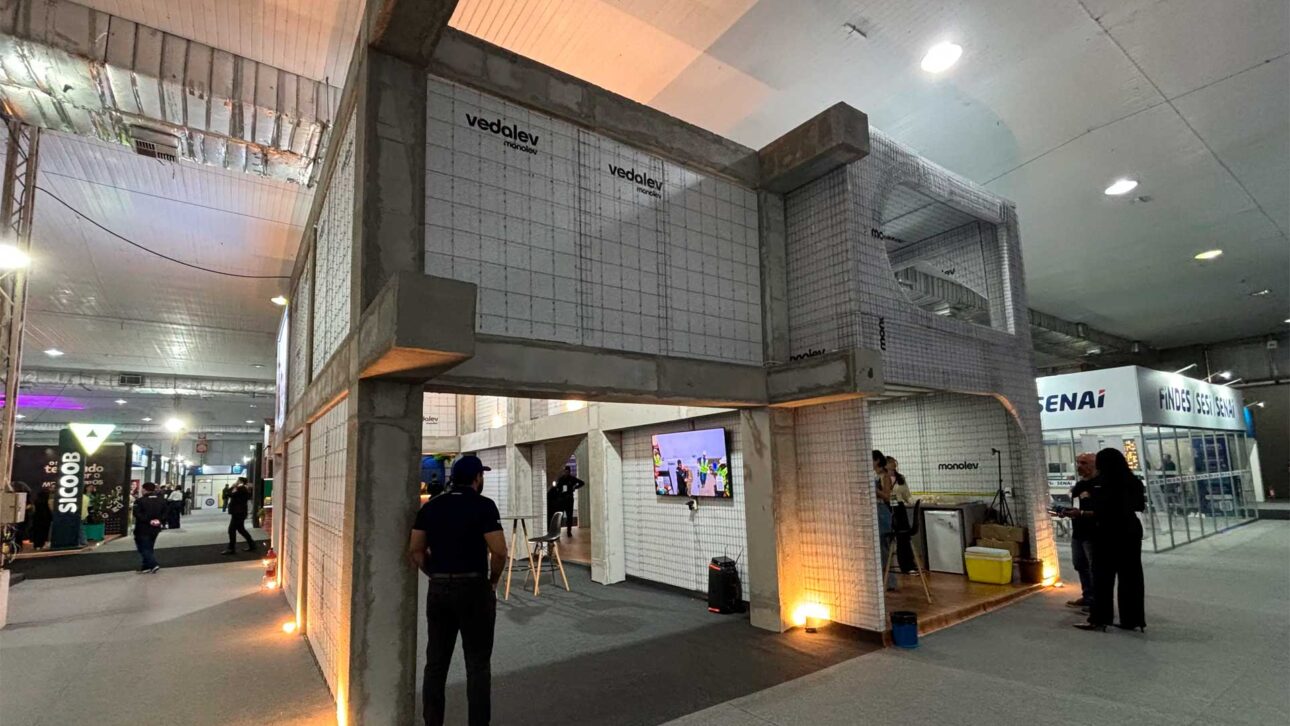
The two-story model displayed at the fair uses EPS panels coated with galvanized steel. In practice, the proposal replaces part of the conventional logic of blocks, tiles, pillars, and visible beams with an industrialized system, lighter and with quick assembly.
The EPS does not enter the structure alone. It functions within a set, combined with metal mesh, coatings, and technical design. Therefore, the promised speed does not eliminate stages such as foundation, electrical and plumbing installations, city hall approval, and technical responsibility of an engineer or architect.
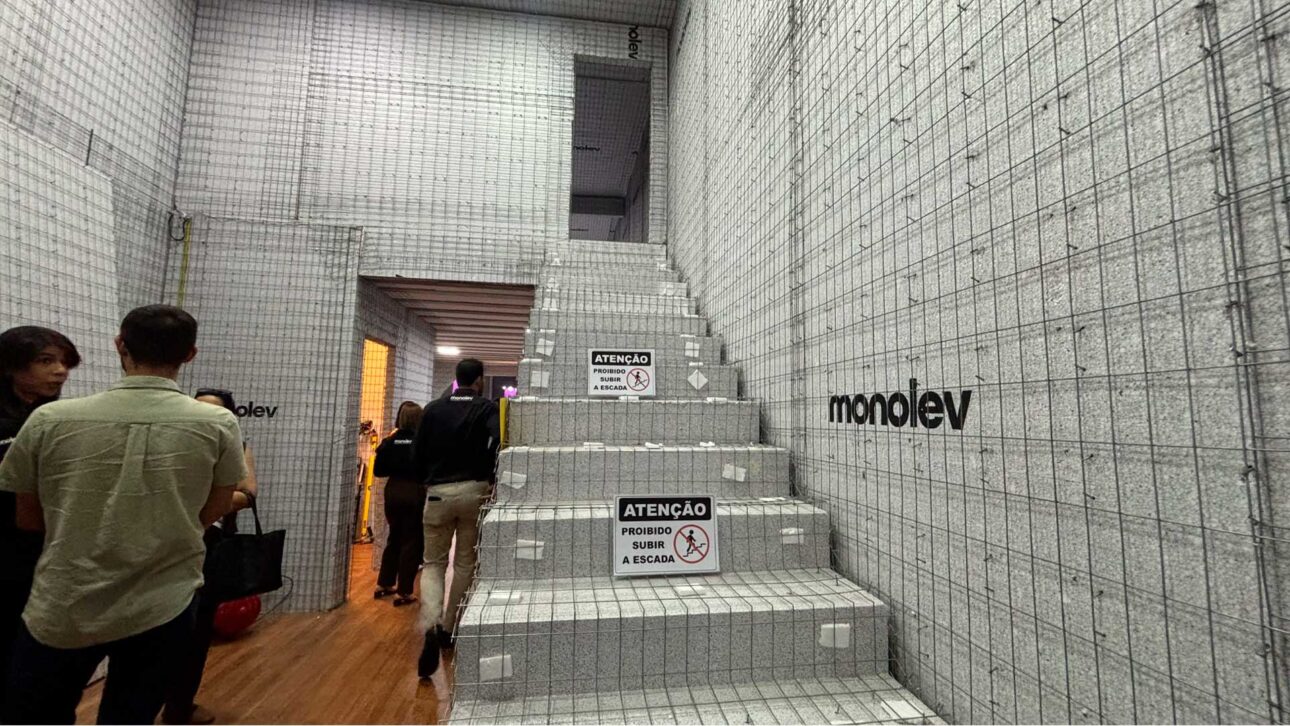
The promise of five days draws attention because it tackles one of the biggest bottlenecks in Brazilian civil construction: the downtime between masonry, curing, rework, material transport, and labor on site. In industrialized systems, part of the pieces arrives ready or semi-ready, reducing improvisation at the construction site.
Even so, this type of construction should not be treated as an “instant house.” The structure assembly time does not necessarily include documentation, land preparation, public connections, personalized finishing, and possible adaptations to climate, soil, and local legislation.
The 250 m² modular house shows another way to live faster
Another product displayed is a modular house of 250 m², assembled in up to 15 days. The model combines a metal structure and lightweight concrete panels, with bedrooms, living room, bathrooms, kitchen, pool, deck, and barbecue area.
The attraction of this type of housing lies in predictability. Instead of building each wall from scratch on the land, modular construction brings pre-fabricated parts to the site, with measurements, fittings, and finishes defined before assembly.
The presented house also includes automation for equipment such as air conditioning and television. This detail indicates that the discussion has already moved beyond the simple exchange of brick for panel and entered another phase, where the construction is thought of as an industrial product, with thermal, acoustic performance, and electrical integration from the project.
For the end consumer, the promise is a shorter construction with less waste. For builders, the gain may be in standardization, reduction of rework, and the possibility of scaling projects with less dependence on artisanal processes.
Sustainable sand enters construction as an alternative to material extracted from nature
Sustainable sand also gained space at ES Construction 2026. The product presented by Ecotech is obtained from the beneficiation of sandy material generated in the processing of iron ore, with applications in concrete, mortars, cement artifacts, and other areas of civil construction, according to the company.
The relevance of this input becomes apparent when looking at the natural sand supply chain. Construction of houses, buildings, roads, drainage, and sanitation consume large volumes of the material. When extraction is not well controlled, rivers, banks, and mining areas suffer environmental pressure.
At the fair, Ecotech showcased the use of sustainable sand in projects related to Arena MRV, the Atlético Mineiro stadium in Belo Horizonte. The case helps to show that the product is not restricted to laboratory tests or small applications.
The company is also preparing to add grit to its portfolio starting in 2027. The announced goal is to market 300,000 tons of sand and 150,000 tons of grit, totaling 450,000 tons of inputs for construction and infrastructure.
What changes on the site when construction becomes assembly
The presence of modular houses, EPS panels, lightweight concrete, and mining sand points to a change in method. The site ceases to be just the place where everything is manually produced and starts to function as an area for assembly, control, and installation.
This movement does not eliminate workers. It changes the type of qualification required. Assemblers, designers, engineers, installation technicians, machine operators, performance specialists, and finishing professionals start to share space with traditional construction roles.
In Brazil, construction remains heated. The CBIC reported, based on the Novo Caged, that the sector created 154,448 formal jobs in the first five months of 2026 and reached 3.1 million workers with formal contracts in the country.
This data helps explain why fairs like ES Construction focus on productivity. If there is demand for housing, infrastructure, and private projects, the sector needs to deliver more without relying solely on long sites, material waste, and schedules vulnerable to rain, lack of input, and rework.
The future of construction depends less on promise and more on scale
The solutions showcased in Espírito Santo show a possible path, but still depend on scale, financing, and technical confidence. An EPS house ready in five days draws attention, but it needs to meet standards, withstand daily use, and undergo a total cost evaluation, not just speed.
The same applies to sustainable sand. The replacement of natural sand only gains momentum when there is regularity in supply, quality control, acceptance by construction companies, and proof of performance in concrete, mortar, and precast materials. Vale reported that its sustainable sand operation reached 1 million tons sold since 2023, indicating that the topic has already entered the strategy of large mining companies.
In the end, the fair at the Carapina Pavilion shows that the construction industry is testing a practical response to an old problem. The sector wants to build faster, use less material, reduce waste, and deliver properties with better performance. The question now is to what extent these technologies will move from the stands to the actual budgets of families, construction companies, and governments.
Would you build a two-story house made with EPS panels or would you still trust traditional masonry more? Leave your opinion in the comments and tell us if the speed of construction would weigh more than the method used in the building.