






 Portuguese
  Spanish


Even With International Expansion and High Demand for Handcrafted Products, Traditional Companies in the Footwear Sector Face a Silent Crisis: the Growing Disinterest of New Generations in Filling Production Line and Factory Floor Positions.
The lack of skilled workers has become a growing challenge in one of the most traditional sectors of the Brazilian industry: footwear.
According to Sergio Bocayuva, president of Usaflex, in an interview with the UOL portal, the labor shortage affects not only the footwear branch but the retail sector as a whole, reflecting a clear trend among new generations, who reject manual labor on the factory floor.
According to him, people today prefer positions in automated environments or in other areas, leaving a hard-to-fill gap in production lines that still depend on artisanal expertise.
-
Self-Taught Brazilian Innovator Brings Solar Power to Shantytowns Using Scrap, Solar Panels, and Phone Batteries

-
Brazil Pioneers Innovative Project to Transform Used Baby Diapers into Sustainable Solutions for Schools and Cities
-
Cargo Ship Completes Historic Nighttime Voyage to Porto Alegre, Revolutionizing Large-Scale Navigation in Brazil After 42 Years
-
Say Goodbye to Round Drains: Linear Models Improve Water Drainage, Simplify Cleaning, and Offer Sleeker Finishes for Bathrooms and Balconies



Sergio Bocayuva recently participated in the videocast “UOL Leaders” from UOL Economia, where he explained the complexity involved in producing leather shoes, a characteristic of Usaflex.
Although some processes, such as sewing, have been automated, most of the manufacturing remains handcrafted, requiring intense qualification and training of employees.
According to him, the company maintains an internal school dedicated to training new professionals, facing the daily challenge of retaining this specialized workforce.
For the production of a single shoe, about 150 people are involved, with 80 on the production line and another 70 in the back office, responsible for development and support.
This structure reveals the degree of complexity and interdependence of each step to ensure the final quality of the product.
Founded in 1998 in the city of Igrejinha, in Rio Grande do Sul, Usaflex has already expanded its operations beyond Brazilian borders, with more than 300 franchises spread across the country and a presence in 60 countries.
This international expansion, however, does not alleviate the problem of recruiting and retaining workers for the production lines.
Challenges for the Brazilian Industry with Skilled Labor
The phenomenon of labor shortage in the Brazilian industry is not isolated.
Sectors such as footwear, textiles, and metallurgy face similar difficulties, exacerbated by changes in the labor market and generational shifts in professional expectations.
Recent research indicates that young people aged 18 to 35 increasingly seek professions that offer greater flexibility, a technological environment, and the possibility for growth, avoiding positions considered repetitive or requiring intense physical effort.
Human resources specialists explain that the scenario is also influenced by social, economic, and educational factors.
The lack of adequate technical qualification in schools and the disinterest in working in traditional industries hinder the filling of vacancies.
Companies, in turn, need to invest in training and valuing employees to overcome this gap.
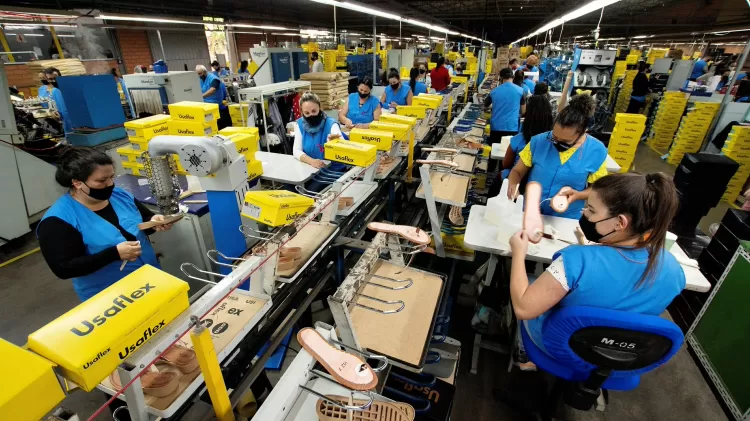
In the footwear sector, the challenge is even greater due to the need to maintain artisanal processes that ensure the quality and design of the products, characteristics valued by the market.
Complete substitution by automation, although desired, is not feasible in the short term, as many steps require delicacy and manual knowledge.
Usaflex, according to Sergio Bocayuva, stands out by investing in internal training, creating an environment where young people can learn and grow within the company.
Nevertheless, the executive warns that the interest of the new generation in working in these roles is limited.
“We perceive a very significant difficulty. The new generations do not want to work on the factory floor, unless it involves fully automated equipment,” he stated.
Impacts of Scarcity and Paths for the Future
The phenomenon of labor shortages can have significant impacts on the national industry, compromising deadlines, quality, and competitiveness.
Additionally, the difficulty in finding skilled professionals may lead to stagnation in the sector and a loss of market share globally.
On the other hand, the scenario also drives companies to innovate and rethink their production processes, with increased investment in technology, automation, and professional qualification.
These actions can, in the medium and long term, reverse the trend, creating more attractive jobs aligned with the profile of new generations.
Keywords such as labor shortage, Brazilian footwear industry, artisanal production, automation in industry, and professional qualification are essential to understand the current context and the challenges faced by the sector.
It is also crucial to keep track of market trends and the digital transformation that can shape the future of the industry in the country.
In light of this scenario, the question remains: how can Brazilian companies balance the need for artisanal processes with the growing demand for automation and, at the same time, attract and retain young talent to ensure the future of the national industry?


