Portuguese
  Spanish


Data on annual working hours, inequality, and the 6×1 scale PEC place Brazil in a prominent position in the debate on work, income, and productivity in South America.
Brazil is among the South American countries with the longest working hours and, at the same time, appears among the most unequal in the region.
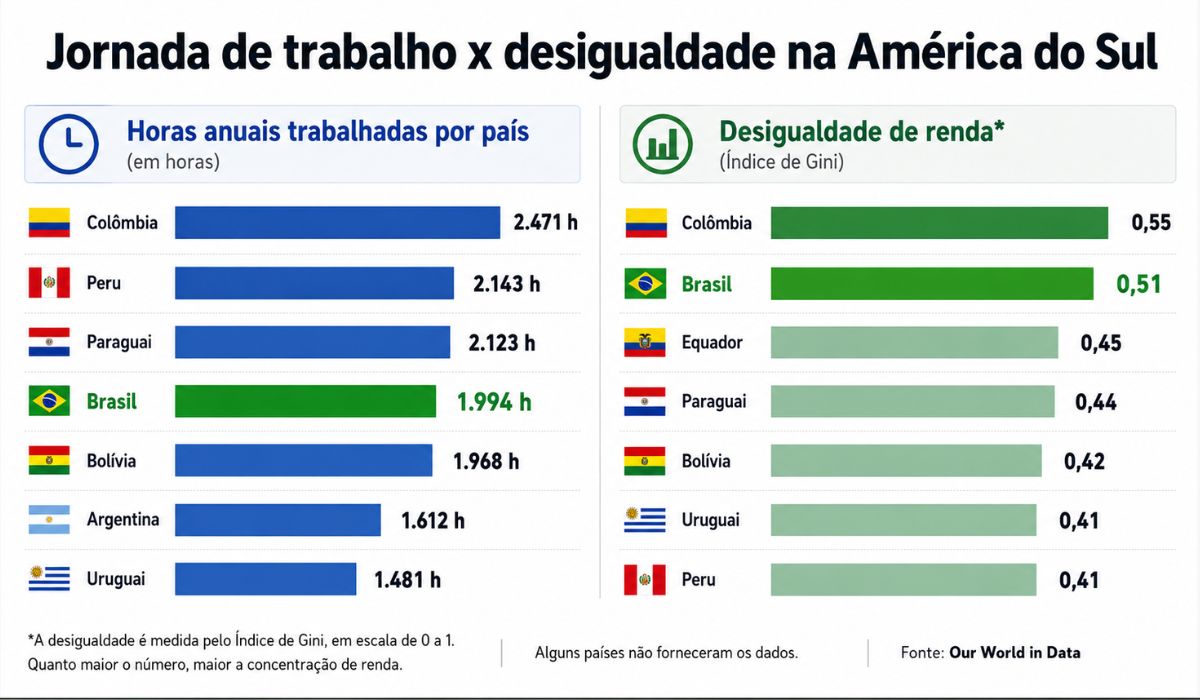
Data from the platform Our World in Data indicate that Brazilians worked, on average, 1,993.72 hours in 2023, equivalent to almost 2,000 hours per year.
In the South American comparison available in the database, the country ranks behind Colombia, Peru, and Paraguay.
-
Major Appliance Manufacturer Closes Factory in Argentina, Shifts Production to Brazil, and Restructures in Latin America with Mexico Closure, Investing Up to $165 Million

-
China to Revive $3.6 Billion Mega-Dam Project in Myanmar, Stalled Since 2011, Promising 6 GW Capacity and Completion in Eight Years

-
Foreign Company Wins Auction for Brazil’s First Immersed Tunnel, a $1.3 Billion Project with $14 Million Contract Under Federal Investigation

-
China’s Century Megaproject Wows the World: Massive Water Transfer Network Moves Water from Wet South to Arid North, with Ambitious Plans in the Tibetan Plateau Involving Giant Tunnels at Altitudes up to 4,000 Meters




The data gained relevance amid the debate on the 6×1 scale, a model where the worker works six days and has one day off.
The discussion advanced in the National Congress.
On May 27, 2026, the Chamber of Deputies approved, in two rounds, a PEC that limits the workweek to 40 hours and provides for two days of rest per week.
After the vote in the Chamber, the text proceeded to the Senate for analysis.
The relationship between working more and better income distribution, however, does not automatically appear in the indicators.
Brazil maintains a high annual workload and also records one of the highest levels of income concentration in South America, according to data from Our World in Data and the World Bank’s Poverty and Inequality Platform.
The Gini Index, used to measure inequality, ranges from 0 to 1.
The closer to 1, the greater the income concentration.
In the regional reading cited in the survey, Brazil records a Gini of around 0.50, second only to Colombia, with about 0.54.
According to labor economics experts, the numbers indicate that long working hours do not necessarily mean an improvement in income distribution.
The comparison between countries depends on factors such as productivity, informality, labor market composition, labor legislation, and the level of qualification of occupations.
Brazil has the 4th largest annual workload in South America
The Brazilian average of almost 2,000 annual hours is below that recorded in Colombia, which appears with 2,471 hours per worker per year.
Peru, with 2,143 hours, and Paraguay, with 2,123 hours, also surpass Brazil in the comparison cited by Our World in Data.
These numbers consider the annual average of hours worked per employed person.
The platform reports that the series combines historical data from Huberman and Minns with information from the Penn World Table.
From 1950 onwards, the database includes employees and self-employed workers in the economy.
The Brazilian position draws attention due to the intersection of two indicators: long working hours and high income inequality.
This scenario helps explain why the reduction of working hours has gained space in public debate, especially in sectors that adopt schedules with only one weekly day off.
Material produced by the Chamber of Deputies states that seven out of ten Brazilian workers work 44 hours a week, often in schedules that leave only one day of rest.
The same content points out that the workload tends to be greater among people with lower education and lower salaries.
Inequality in Brazil weighs more within the country, experts say
Experts consulted by R7 differ on the meaning of the data.
For some economists, there is no consolidated evidence that countries with longer working hours are automatically more unequal.
This assessment considers that international comparison involves different realities.
Productive structure, informality, average productivity, labor legislation, and job distribution can alter how working hours and income relate in each country.
Economist Rafael Richter, an associate of Livres, states that inequality may weigh more within each country than in comparison between countries.
According to him, lower-income workers tend to extend their working hours or seek other occupations to complete their budget.
“In this sense, inequality may weigh more within each country than in the comparison between countries. Lower-income workers tend to work more hours to supplement their income and maintain basic living conditions,” he stated.
In Richter’s assessment, inequality becomes more relevant when it limits the development of people’s potential.
He claims that, in Brazil, low social mobility affects the ability to increase productivity in the long term and makes it difficult to generate income at higher levels.
“Data has been indicating that richer and more productive countries tend to work fewer hours. This happens because productivity gains allow for more wealth to be generated in less working time. In part, this is also the difference between Brazil and some Latin American neighbors, which in recent decades have achieved more consistent productivity advances than those observed in the Brazilian economy,” he said.
Productivity enters the debate on working hours
Another interpretation presented by specialists relates inequality, working hours, and productivity.
In this view, more egalitarian countries tend to have more qualified jobs, better salaries, and more efficient working hours.
In economies with a large number of low remuneration positions, part of the population needs to increase their workload or seek additional income.
This dynamic, according to economists, helps explain why working many hours does not necessarily translate into higher individual income or lower inequality.
Economist Natale Papa argues that the two aspects are related.
For him, more unequal countries tend to concentrate workers in low-productivity occupations, where salaries are lower and the need to supplement income becomes more frequent.
“In more unequal countries, like Brazil, many people need to work more hours or have multiple sources of income to supplement their budget. At the same time, low-productivity jobs usually pay lower salaries. This creates a cycle where a large part of the population works a lot, but with low value generation and little social mobility,” he stated.
The analysis differentiates two points of the debate.
One of them deals with the number of hours worked.
The other involves the value produced in that period and how the income generated is distributed among workers.
In the Brazilian case, specialists point out that the discussion about working hours involves impacts on income, organization of companies, productivity, and quality of life.
The processing of the PEC in the Senate should keep these topics at the center of negotiations between workers, employers, and parliamentarians.
PEC to end the 6×1 schedule continues in the Senate
The PEC approved by the Chamber amends the Constitution to reduce the normal working hours from 44 to 40 hours per week, without salary reduction.
The text also establishes two days of paid weekly rest, with one preferably on Sundays.
The approved report provides for a transition.
According to the proposal, the workweek would initially decrease from 44 to 42 hours after 60 days of enactment.
After 12 months, it would drop to 40 hours per week, with a limit of eight hours per day.
The text analyzed by the Chamber gathered discussions from previous proposals.
One of them was PEC 221/2019, presented by Deputy Reginaldo Lopes, which proposed a gradual reduction to 36 hours per week over ten years.
Another was PEC 8/2025, by Deputy Erika Hilton, which advocated for a 4×3 schedule, with four days of work and three days of rest.
In the approved opinion, the workweek was set at 40 hours.
The proposal, however, still depends on the Senate’s analysis to advance.
Until the conclusion of the process, the effects of the change on sectors that operate with continuous service, on-site schedules, and a large number of low-income workers remain under discussion.
The debate takes place in a country where the annual average of work approaches 2,000 hours and income inequality remains among the highest in the region.
For experts, the combination of these indicators shows that the number of hours worked does not solely explain the distribution of income.
Following the Senate’s analysis, the proposal should undergo a new round of discussion on costs, business adaptation, remuneration, and working conditions.