Portuguese
  Spanish



Reflect Orbital Project Seeks to Reflect Sunlight Back to Earth
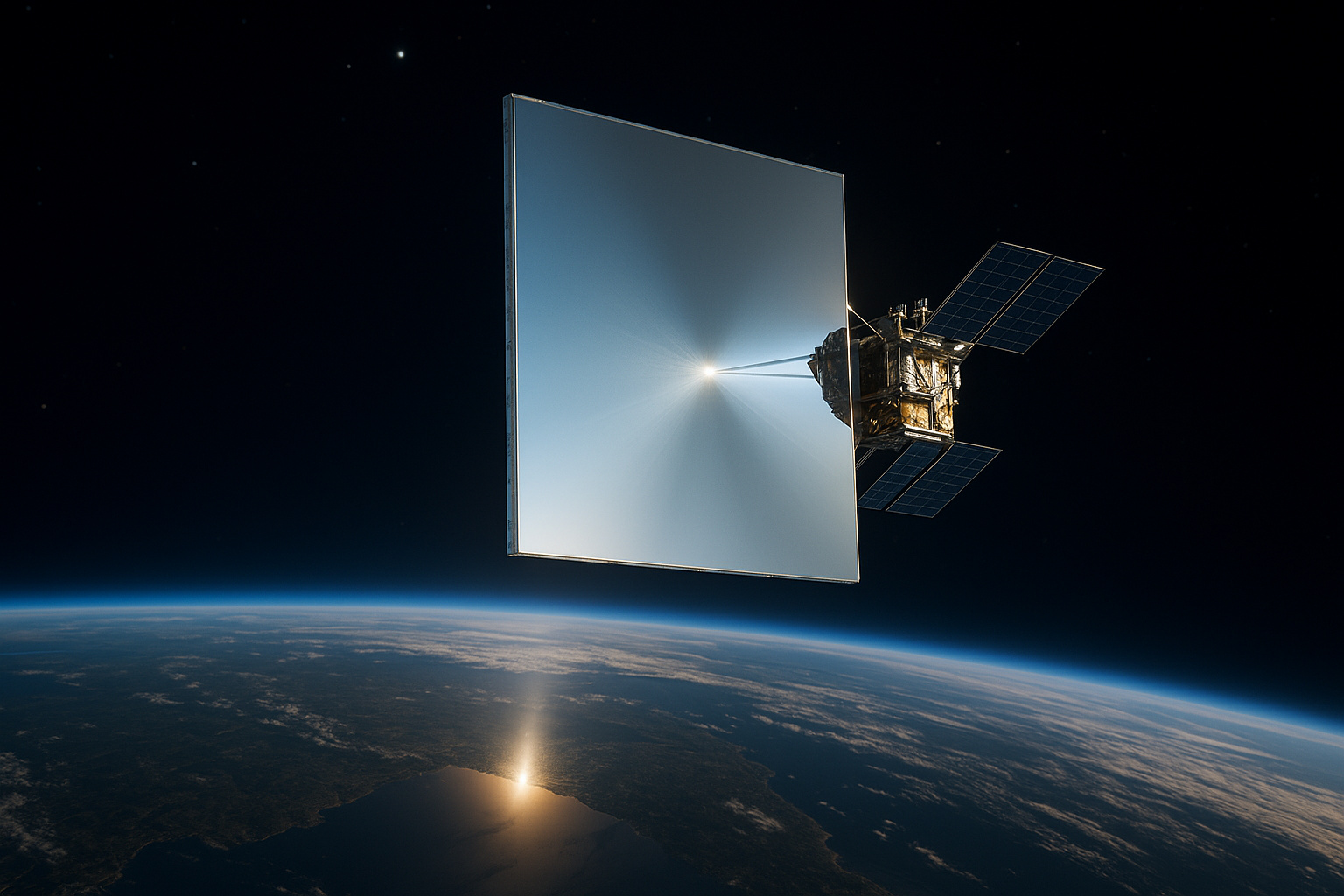
The Californian startup Reflect Orbital requested permission from the United States government in October 2025 to launch the first space mirror measuring 18 meters by 18 meters into orbit. The launch is scheduled for April 2026 and marks the beginning of a constellation with over 4,000 reflector satellites. These devices are expected to redirect sunlight to Earth during twilight, extending solar energy generation even after sunset.
The request, sent to the Federal Communications Commission (FCC), explains that the mirror will reflect light onto specific points on the planet. Additionally, the project has support from the U.S. Air Force, amounting to US$ 1.25 million (R$ 6.7 million).
Thus, Reflect Orbital seeks to test an unprecedented method of continuous energy generation and reduce dependence on conventional sources.
Scientists Warn About Astronomical and Environmental Impacts
However, astronomers and environmentalists have expressed strong concerns about the proposal. Astronomer John Barentine from the Silverado Hills Observatory in Arizona explained that the mirrors could emit beams up to four times brighter than a full moon.
He emphasized that excess light could interfere with astronomical observations and affect nocturnal species sensitive to light. Furthermore, the deputy director of the Royal Astronomical Society, Robert Massey, classified the project as “catastrophic from an astronomical standpoint”. According to him, the goal of extending the day and illuminating the sky could compromise scientific observations and hinder astronomical research.
On the other hand, Massey compared the case to the Starlink project from SpaceX, which already faces criticism for creating light trails in astronomical images. However, unlike Starlink, Reflect Orbital plans to intentionally reflect sunlight, making intense brightness a central element of the mission. As such, the light impact would shift from being accidental to becoming a programmed effect.
ARTICLE CONTINUES BELOWSee also
World’s Largest Engie Solar Plant in Brazil Highlights Billion-Dollar Energy Waste Issue: Company Considers Batteries and Bitcoin Mining to Avoid Wasting Production

Over 60 Tractors Take to the Streets in Lopera as Solar Parks Compete with Olive Groves, Affecting 13,000 to 100,000 Trees According to Conflicting Reports

Brazil’s Vitória Airport to Launch Solar Plant Covering Area of 10 Soccer Fields, Boosting Clean Energy and Cutting Costs
Switzerland Converts Train Tracks into Solar Power Plants with Removable Panels to Generate Energy Without Using Additional Land



Company Promises Control and Limited Duration of Reflections
In response to the criticisms, Reflect Orbital stated that the system was designed to limit the time and area of reflections, avoiding intense light pollution. According to a statement sent to the magazine Space, each illuminated point will have a diameter of about 5 km and a maximum duration of a few minutes.
After that, the mirror will change position, preventing the light from remaining concentrated over the same location.
Additionally, a company spokesperson stated that “our service will be localized and of short duration.” During the test scheduled for 2026, observers will see a moving bright spot, and the brightness on the ground will be similar to that of the moon. Thus, the company believes that the visual impact will be minimal and controlled.
Reflect Orbital also assured that it will conduct comprehensive environmental studies before launching the constellation. To this end, it will work in partnership with ecology and astronomy experts, aiming to reduce ecological and light effects.
Risks to Nocturnal Life and Biological Balance
Experts point out that the risks go beyond astronomy. Light pollution can directly interfere with the natural cycles of animals and humans, altering biological rhythms and nocturnal behaviors.
The environmentalist David Smith from the British organization BugLife highlighted that “light pollution disrupts the balance between day and night that has guided life on Earth for billions of years.”
Additionally, a report from the Royal Society released in 2024 revealed that global artificial brightness increases by about 10% per year. As a consequence, the number of stars visible to the naked eye has decreased from 250 to approximately 100.
In light of this scenario, astronomers and biologists fear that the impact on nocturnal human and animal life could become irreversible if the project advances.