Portuguese
  Spanish


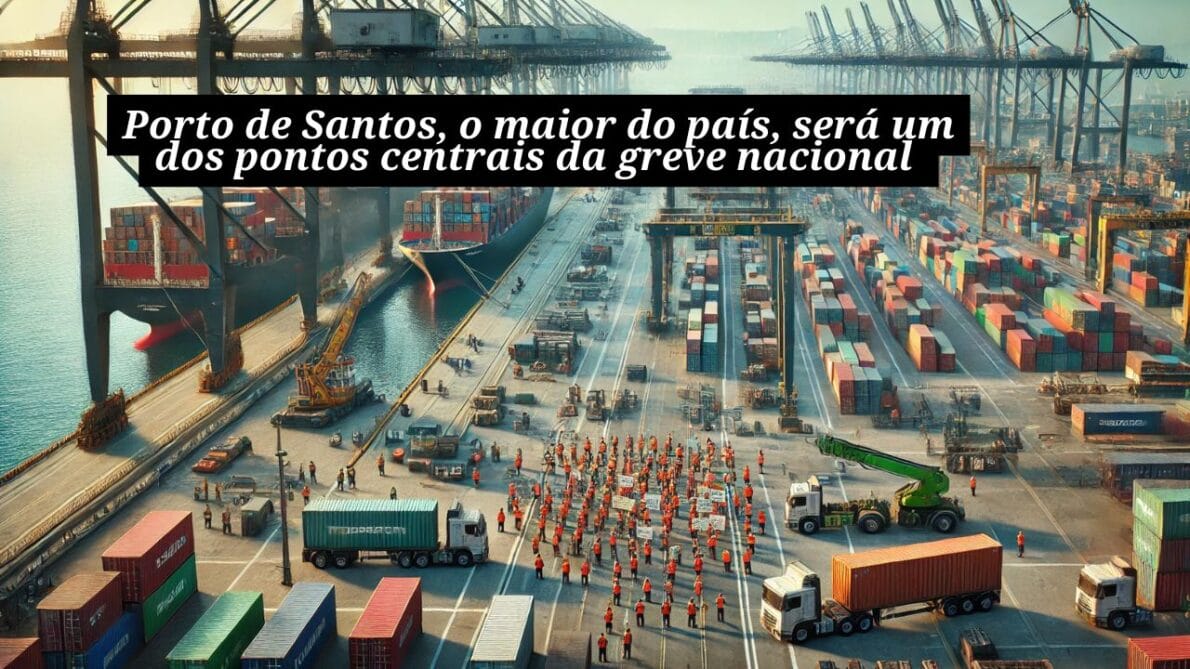

New Regulation May Directly Affect The Rights Of Port Workers, Driving The National Strike In Brazilian Ports. The Demonstration Will Take Place In All Ports Of The Country, Aiming To Prevent The Precarization Of Working Conditions.
National strike in Brazilian ports is already scheduled for next Tuesday (22), and the tension is palpable among port workers across the country. In a large-scale action, unions from all regions decided to halt activities in response to proposed changes in the regulatory framework of the sector, which will be presented the next day (23) to the President of the Chamber, Arthur Lyra.
On Tuesday, the country will see significant mobilization in the ports. From 7 AM to 1 PM and from 1 PM to 7 PM, port workers will be on strike, protesting against a document that, according to them, jeopardizes their rights and union stability. What’s at stake is the survival of entire categories in the port sector, with the possible elimination of exclusivities in essential services and the authorization for the use of cooperatives by companies, which, in practice, may reduce jobs and worsen working conditions.
What Is Behind The National Strike In Brazilian Ports?
The mobilization of port workers is not an isolated act. The new regulatory framework for ports, which will be presented by a group of 15 jurists next Wednesday (23), has been seen as an attempt to weaken labor rights in the sector, favoring business interests without consulting union representatives.
-
Three Chinese companies manufacture more than 96% of the world’s dry cargo containers and 100% of refrigerated ones, in a dominance built over 40 years that has made it almost impossible for the West to compete in this market.

-
The Panama Canal stores water in Gatún and Alhajuela lakes to maintain 38 daily crossings and prevent a drought linked to El Niño from once again stalling ships, raising freight rates, and putting pressure on global supply chains as occurred in 2023 and 2024.

-
While the US Navy still relied for decades on the subsonic Harpoon and Tomahawk missiles for naval combat, the US Air Force reactivated the AGM-183A ARRW program on May 12, 2026, in an anti-ship version capable of making a Nimitz-class aircraft carrier disappear in minutes.

-
While commercial hydrogen fuel cells do not exceed 80 degrees Celsius due to the requirement of liquid water in the membranes, researchers at Monash University on May 18 made an ultrathin graphene and boron nitride-based membrane operate at 250 degrees Celsius without needing water.



Miro Machado, president of Sintraport – Union of Port Workers, was clear in stating that “the workers were not heard” in the negotiations. During a meeting at the Santos City Hall last Thursday, he warned about the consequences of the proposed changes and emphasized that the workers are being forced into a defensive position.
The International Transport Workers’ Federation (ITF) has also entered the discussion, sending a letter to the President of the Chamber. In it, they highlight that the changes in the document may “precarize and take away workers’ rights and end the union organization of Brazilian port workers.”
Local Impact: The Situation In Santos
The Port of Santos, the largest in the country, will be one of the central points of the national strike in Brazilian ports. In addition to concerns about the regulatory framework, local port workers are facing a new controversy: the auction of the area of 601,000 m² in STS-10, recently announced by the Ministry of Ports and Airports.
Miro Machado was emphatic in commenting on the impact of this decision: “This will end the public wharf, affecting thousands of workers.” The possible closure of Ecoporto, where currently 500 fixed employees and another 2,000 on a rotating basis work, is another factor increasing the tension.
The mayor of Santos, Rogério Santos, has also expressed his opposition to the auction, stating that he will not allow the end of the public wharf. In his statement, he emphasized that this issue has been brought to the Federal Court of Accounts during a hearing in Brasília.
With all these tensions at play, the question remains: will the national strike in Brazilian ports be able to pressure the government to reconsider the new regulatory framework? Or will business interests prevail, permanently changing the port landscape in the country? Leave your opinion in the comments!