






 Portuguese
  Spanish


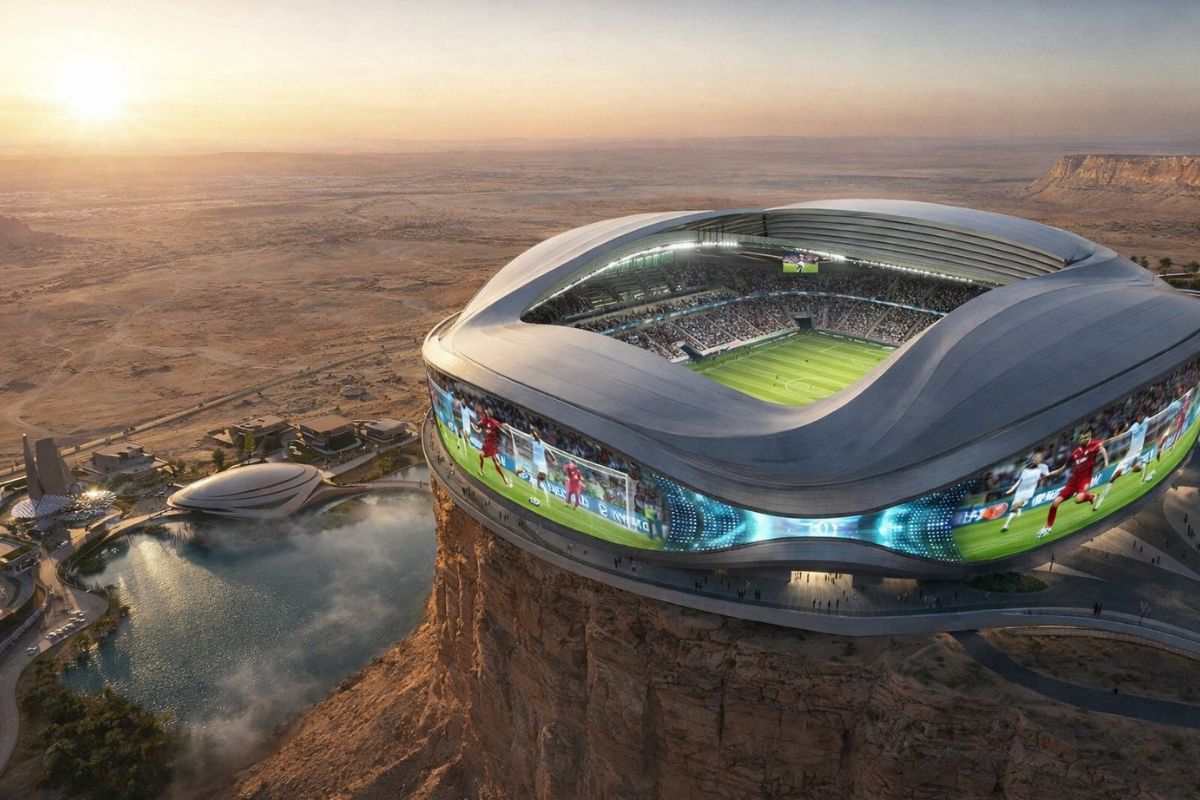


With Design By Populous, The Mohammed Bin Salman Stadium Combines Extreme Altitude, Display Technology, And Environmental Solutions To Operate In The Desert. Between Turf Mobility, Integration With Hospitality, And Microclimate Generated By An Artificial Lake, The Arena Concentrates Saudi Strategy For Tourism, Business, And Ongoing Global Sports Spectacle.
The Mohammed Bin Salman Stadium was conceived to be the most iconic sports hub for the 2034 World Cup in Qiddiya, Saudi Arabia. Positioned atop a 200-meter cliff, the project combines high-impact architecture, multifunctional operation, and climate solutions geared towards the desert environment.
In the overall design, the arena connects sports, entertainment, and services within a single structure: retractable turf for alternate uses, a giant LED wall for immersive experience, and a cooling system using an artificial lake. The proposal shifts the debate from “where to play” to “how the stadium redefines the complete journey of the audience”.
Why The Stadium Was Positioned On A 200-Meter Cliff
The choice of the cliff is not just aesthetic. In Qiddiya, the elevated terrain allows the stadium to transform into a continuous visual landmark, visible as a territorial and tourist symbol. Located about 40 minutes from Riyadh, the site combines relatively close access to the capital with the scenic effect of a deployment that engages with the surrounding desert.
-
AI Radar Built with Old Camera and $20 Gains Attention After Alleged $317,000 Sale to Chinese Government, But Lack of Documentation and Official Confirmation Raises Questions

-
Amateur Detectorist Discovers 3,400-Year-Old Bronze Age Gold Treasure with 121 Pieces in Transylvania, Including a Unique Ring

-
Italian Designer Develops Solar-Powered Terracotta Water Purifier Producing Up to 5 Liters of Drinking Water Daily Without Electricity

-
New Hydrogel Made from Algae and Shrimp Shells Absorbs 60 Times Its Weight in Water to Combat Drought in Spanish Agriculture


This decision also follows a strategic logic: the stadium ceases to be an isolated facility and becomes part of international positioning. Instead of competing solely by audience capacity, the arena competes for attention through architectural uniqueness, urban narrative, and potential visitor attraction outside match days.
At the same time, building in this topographical condition imposes specific technical requirements. Stability of the rocky base, circulation routes, evacuation, and logistical operation need to function with a high standard of safety and predictability. Practically speaking, the visual spectacle depends on engineering that is as robust as it is discreet.
How The Stadium Combines Retractable Turf And Giant LED Wall
At the sports core, the retractable turf is one of the most relevant features because it enhances operational versatility. With this system, the stadium can alternate between soccer matches and other formats, such as entertainment events and e-sports competitions, without compromising the main floor during intense usage cycles.
This model alters the traditional logic of an arena focused solely on a sports calendar. The stadium operates as a multi-use platform, with potential for revenue spread throughout the year, rather than concentrated in specific rounds and tournaments. The direct consequence is greater commercial elasticity and increased capacity for space occupancy.
The giant LED wall reinforces the same principle. Instead of conventional screens with secondary functions, the visual display takes a central role in the event’s ambiance, with immersive language and dynamic high-definition content possibilities. For fans onsite and remote audiences, this changes the perception of scale, rhythm, and spectacle.
In comparison with more standardized arenas, the combination of “mobile turf + immersive visuals + service integration” shifts the focus from basic infrastructure to total experience. It’s not just a stadium to watch the game; it’s architecture designed to produce permanence, consumption, and real-time audio-visual narrative.
The Role Of The Artificial Lake In Cooling The Stadium In The Desert
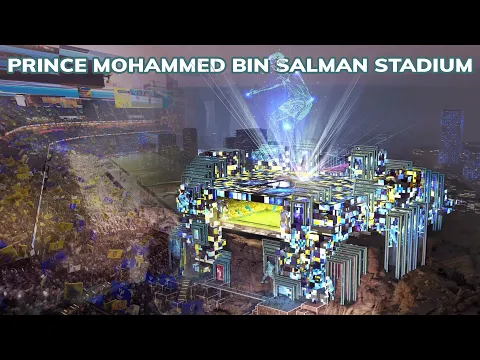

In an environment of extreme heat, cooling through an artificial lake emerges as a technical and environmental response simultaneously. The proposal includes a reservoir beneath the structure, utilizing rainwater capture and recycling in a circular system. In a region of low precipitation, this design requires rigorous water management and continuous operation.
The physical principle combines evaporation and thermal exchange to reduce internal temperature, decreasing dependence on heavy air conditioning based solely on high electrical demand. Practically, the stadium tries to transform a climatic limit into an active engineering component, creating a more comfortable microclimate for fans and operation.
The key point here is not only the existence of the lake but the quality of system management: maintenance, water quality, actual cooling efficiency, and integration with the other layers of the project. Without consistent technical governance, an innovative solution may lose performance over time.
On the other hand, when well executed, this model strengthens the discourse of sustainability applied to sports infrastructure. Instead of treating the desert as an insurmountable obstacle, the project attempts to adapt the stadium’s operation to the local context, focusing on efficiency and long-term operational permanence.
Qiddiya And The Integration Of The Stadium With Tourism, Services, And Daily Use
The stadium was planned as the heart of a 50,000-square-meter entertainment district, with high-end shops, restaurants, and hospitality connected to the complex. This integration expands the economic utility of the arena and reduces dependence on “game days” to justify investment and flow of people.
This arrangement also influences the profile of visitors. Part of the audience arrives for soccer; another part through the leisure, business, and hospitality ecosystem. When the stadium integrates with the destination, it changes function: from a sports stage to an urban anchor for consumption and tourism.
Within the sports operation, the expectation is that the arena acts as home to Al-Hilal and Al-Nassr, two clubs with significant audience reach. This link tends to strengthen the calendar, usage regularity, and international visibility of the facility, especially during a phase of expanding the global image of Saudi football.
The direct connection with Riyadh’s road infrastructure completes this logic of access and scale. The more predictable the mobility in and out, the greater the capacity for the stadium to support multiple events with quality experience, safety, and competitive travel times.
What The Stadium Represents For The 2034 World Cup And For The Saudi Strategy
In the context of the 2034 World Cup, the Mohammed Bin Salman Stadium appears as a showcase of innovation and a central piece of national narrative. The arena brings together architectural impact criteria, multifunctionality, and sustainability in a single asset, aligned with the economic repositioning proposal associated with tourism and entertainment.
The strategic reading is clear: using football as an accelerator of infrastructure and international image. The stadium, in this context, functions as a symbol of transition, connecting sports ambition, experience technology, and development of new revenue hubs outside the traditional economic matrix.
There is, however, a critical dimension that cannot be ignored: projects of this scale require consistency in execution, operational transparency, and high-level maintenance post-event. Success does not depend solely on the inauguration or the initial visual impact but on the ability to deliver ongoing performance for many years.
If this continuity is confirmed, the arena could influence the standard of future projects in extreme climate regions, showing how sports architecture, water management, and immersive entertainment can coexist within the same model.
If it fails, it will serve as a warning about the limits of complexity when technology and spectacle advance faster than daily operations.
The project places the stadium at the center of a larger change: from playing infrastructure to experience, city, and economy infrastructure.
In Qiddiya, the combination of cliff, retractable turf, immersive LED, and cooling through the lake forms a rare proposal in global football, with the potential to redefine what is expected from a World Cup arena.
Although designed for the 2034 World Cup, the stadium is estimated to be completed by the end of 2026 or early 2027, in time to host matches of the 2027 Asian Cup.
Some reports indicate that the complete complex may take until 2029 to be 100% operational.
Now I Want Your Personal View: If You Were A Fan In This Context, What Would Matter More In Your Evaluation, The Technological Innovation Inside The Stadium Or The Guarantee Of Comfort And Sustainability In The Desert? And, Thinking About The Future, Do You Believe This Model Should Inspire Stadiums In Other Countries?


