Portuguese
  Spanish


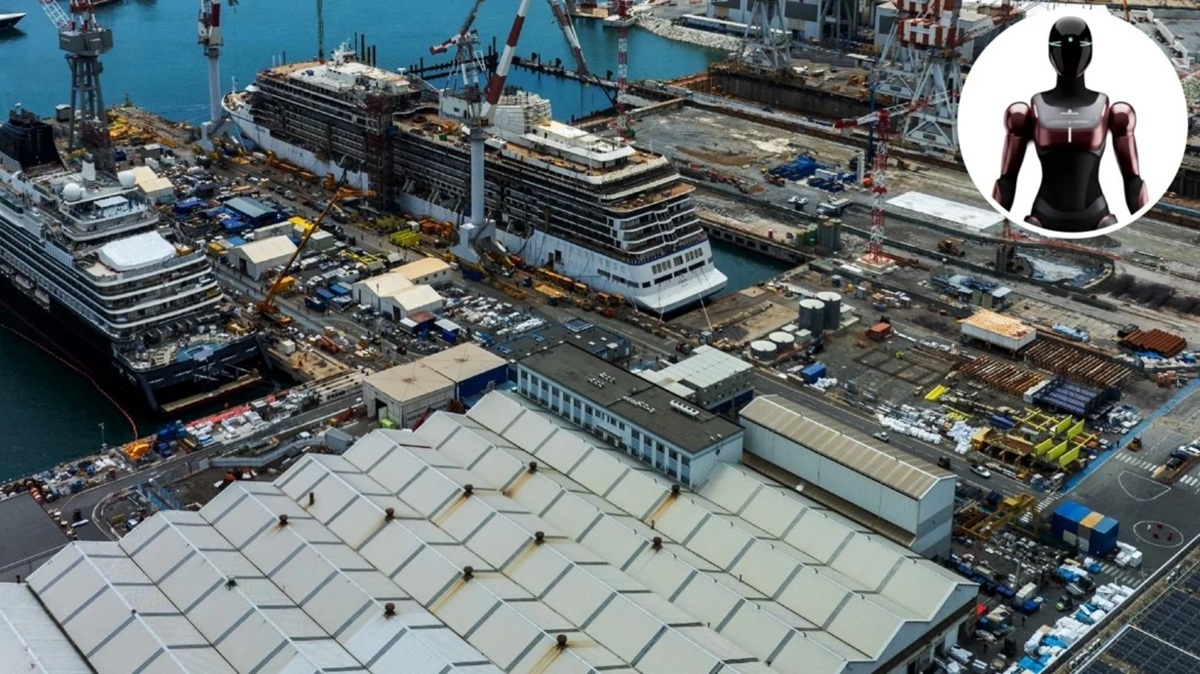


Italian Shipyard Fincantieri Transforms Sestri Ponente Unit Into Industrial Laboratory to Test Humanoid Robot Gene.01 in Naval Structural Welding, Focusing on Long Seams, Digital Traceability, and Possible Application in Superyachts Above 130 Meters
Fincantieri, the Italian industrial giant operating the Sestri Ponente shipyard, is developing the humanoid robot Gene.01 in partnership with Generative Bionics to work in naval welding, focusing on structural seams and potential impact on superyachts over 130 meters.
Sestri Ponente Shipyard Becomes Testbed for Gene.01
The initiative was presented in partnership with the Italian robotics company Generative Bionics. The project focuses on a humanoid platform designed to operate within an active shipyard, not limited to laboratory environments.
The Sestri Ponente shipyard will serve as an industrial testbed. The unit will be transformed into a validation environment for humanoid automation applied to shipbuilding, integrating the robot into real production routines.
-
NASA Plans Telescope That Can Be Repaired by Robots 1.5 Million Kilometers from Earth

-
China Launches First Oceanic Medical Rescue Ship with Advanced Facilities to Serve Remote Regions

-
Midea Unveils Portable PortaSplit Air Conditioner: 12,000 BTUs, Quiet Mode, Heating, Dehumidification, App Control, and AI Efficiency Without Professional Installation
-
Singapore Turns Incinerated Waste Ash into Construction “Sand” in Ambitious Project to Revolutionize Megacity Waste Management


In the first phase, the humanoid Gene.01 will support specific naval welding activities. The focus will be on long and repetitive seams in hull blocks, stiffeners, double bottoms, and structural bulkheads.
Structural Welding With Real-Time Monitoring in the Shipyard
These seams are not aesthetic elements, but central structural components of the vessel. The robot will monitor the welds in real-time with cameras and artificial intelligence, tracking bead position, travel speed, and arc stability.
The system will also signal defects such as undercut and porosity. Initially, Gene.01 is expected to assist, not replace, qualified welders by holding torches or devices, recording process data, and performing repetitive passes under supervision.
Mobility is a central element of the proposal. Traditional robotic arms work well in fixed and predictable cells but require customized devices and isolated areas, facing limitations in confined spaces.
Humanoid Platform for Complex Shipyard Environments
The humanoid has been designed to accompany workers in narrow spaces within partially assembled blocks. It will be able to navigate sloping surfaces and metal staircases, where wheeled systems face challenges.
The design philosophy, described as Physical AI, distributes intelligence across joints and limbs. The system uses comprehensive body sensors to maintain balance while operating close to heavy structures in the shipyard.
The robot was envisioned as a cobot, ready to share space with human teams and adhere to safety rules without remaining isolated by protective barriers.
Strategic Impact on Shipbuilding and Superyachts Above 130 Meters
Welding in shipyards exposes workers to fumes, heat, vibration, noise, and prolonged postures, often at heights over water. Reducing time in more severe positions is seen as a measure linked to the sustainability of the workforce.
Pierroberto Folgiero, CEO of Fincantieri, stated that advanced robotics and artificial intelligence applied to industrial processes represent a strategic lever for the evolution of shipbuilding.
For superyachts over 130 meters, the impact could be measurable. More consistent long seams may reduce distortions in hull plates, allow for a more uniform finish, and decrease subsequent corrections.
The complete digital traceability of each weld can integrate the sales narrative for owners who demand rigorous classification standards.
History of the Shipyard and Transition to a New Technological Phase
The shipyard that delivered the superyacht Serene, valued at US$ 400 million and equipped with two helipads and a hangar for submarines, belongs to Saudi Crown Prince Mohammed bin Salman.
This same unit also produced a new class of ultra-luxury megayachts for Four Seasons. Now, the site is set to experience a new form of industrial prestige with the introduction of the humanoid Gene.01.
If the project succeeds, the next superyacht may incorporate refinements associated with a robot that learned to weld between steel hulls in Genoa, consolidating a new phase in the history of the shipyard and shipbuilding.