Portuguese
  Spanish



Discovery Reveals Unprecedented Details About the Formation of a Giant Star, with Up to 20 Times the Mass of the Sun, in a Distant Region of Interstellar Space.
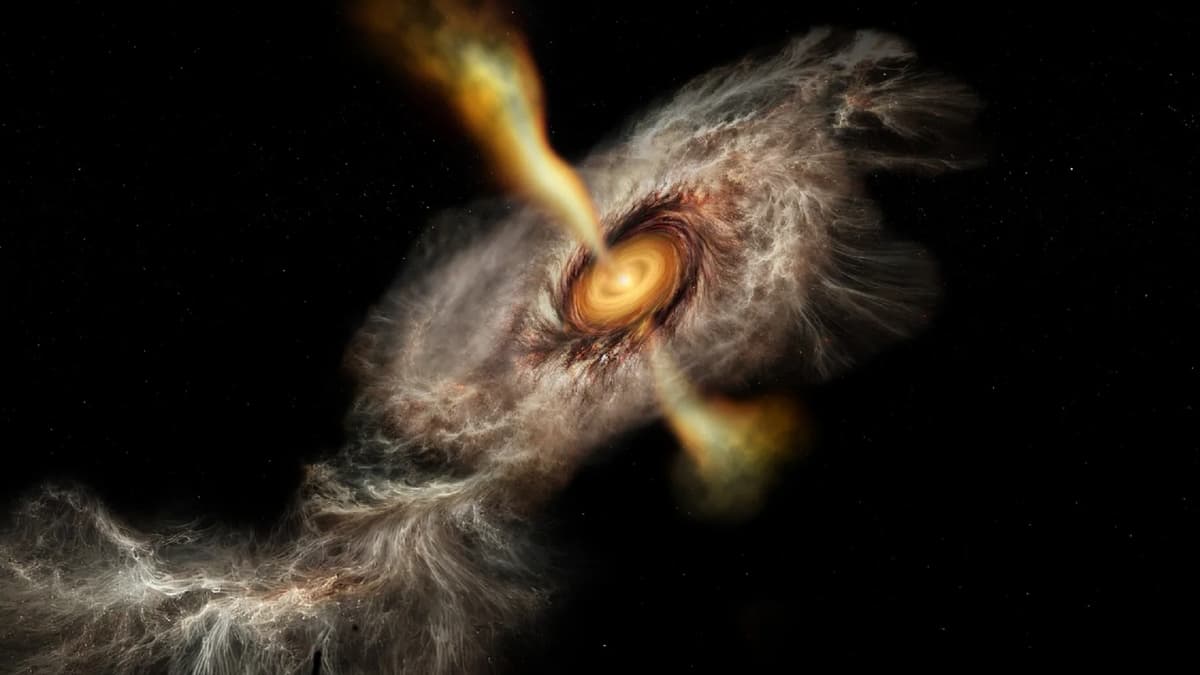
Astronomers captured the clearest image ever seen of a star in formation feeding on gas at incredibly high speeds. This is a rare moment captured of the birth of a giant star, with up to 20 times the mass of the Sun.
A Star in Formation
The star, named HW2, is located about 2,300 light-years from Earth, in the region known as Cepheus A.
This region is a stellar nursery, where new stars emerge from clouds of gas and dust. HW2 is a massive protostar, meaning it is at an early stage of development. Even so, it already has a mass between 10 and 20 times that of our Sun.
-
Bioengineer Develops Microscope That Magnifies Objects Up to 2,000 Times Using Just a Folded Sheet of Paper, a Tiny Lens, and Less Than $1, Bringing Lab Science Anywhere for Less Than the Cost of a Candy

-
Dog Walker in English Forest Uncovers 3,400-Year-Old Bronze Age Axe
-
Texas Blackout Inspires Student to Develop Bionic Leaf Catalyst for Converting Sunlight, Water, and Bacteria into Fuel

-
Brazilian Students Develop Process to Turn Styrofoam Waste into Water-Purifying Charcoal





The moment is considered rare. Giant protostars are difficult to observe clearly, as they are enveloped in dense layers of dust.
However, the team achieved a groundbreaking view of the formation process of HW2, revealing important details about its growth.
Gas Mapped with Ammonia
To obtain these images, astronomers used an innovative technique. They resorted to ammonia—a common molecule found both in space and in household cleaning products—to map the rotating gas disk around the star.
This ammonia emits radio waves that penetrate the dust, allowing for clear visualization.
The observations were made in 2019, using the Very Large Array, a set of radio telescopes located in New Mexico, United States.
With this equipment, the team was able to identify that the disk surrounding HW2 is supplying gas to the star at an extremely high rate: the equivalent of two Jupiter masses per year.
Rules for Giant Stars
The study shows that even giant stars follow processes similar to those of smaller stars, like the Sun. “We are always trying to obtain general rules that can explain the greatest number of phenomena we observe,” explained Alberto Sanna, the study leader and a researcher at the National Institute of Astrophysics in Italy.
According to Sanna, the data reinforces that the laws governing star formation are the same, just on different scales. The disk feeding HW2 exhibits turbulent behavior and shows asymmetries: the eastern side has nearly double the gas of the western side.
An Invisible Cosmic Pipeline
This difference in the disk indicates that there may be an external force interfering with the system. Scientists suggest that a flow of gas and dust nearby—similar to a filament—could be channeling material to HW2. This phenomenon has been described as a “cosmic pipeline.”
Although these structures have not yet been directly observed, the models proposed in the study pave the way for future telescopes to confirm the theory. For scientists, understanding how long HW2 will continue to grow is one of the next steps.
The study will be published in the journal Astronomy & Astrophysics and is also available on the arXiv preprint server.