






 Portuguese
  Spanish


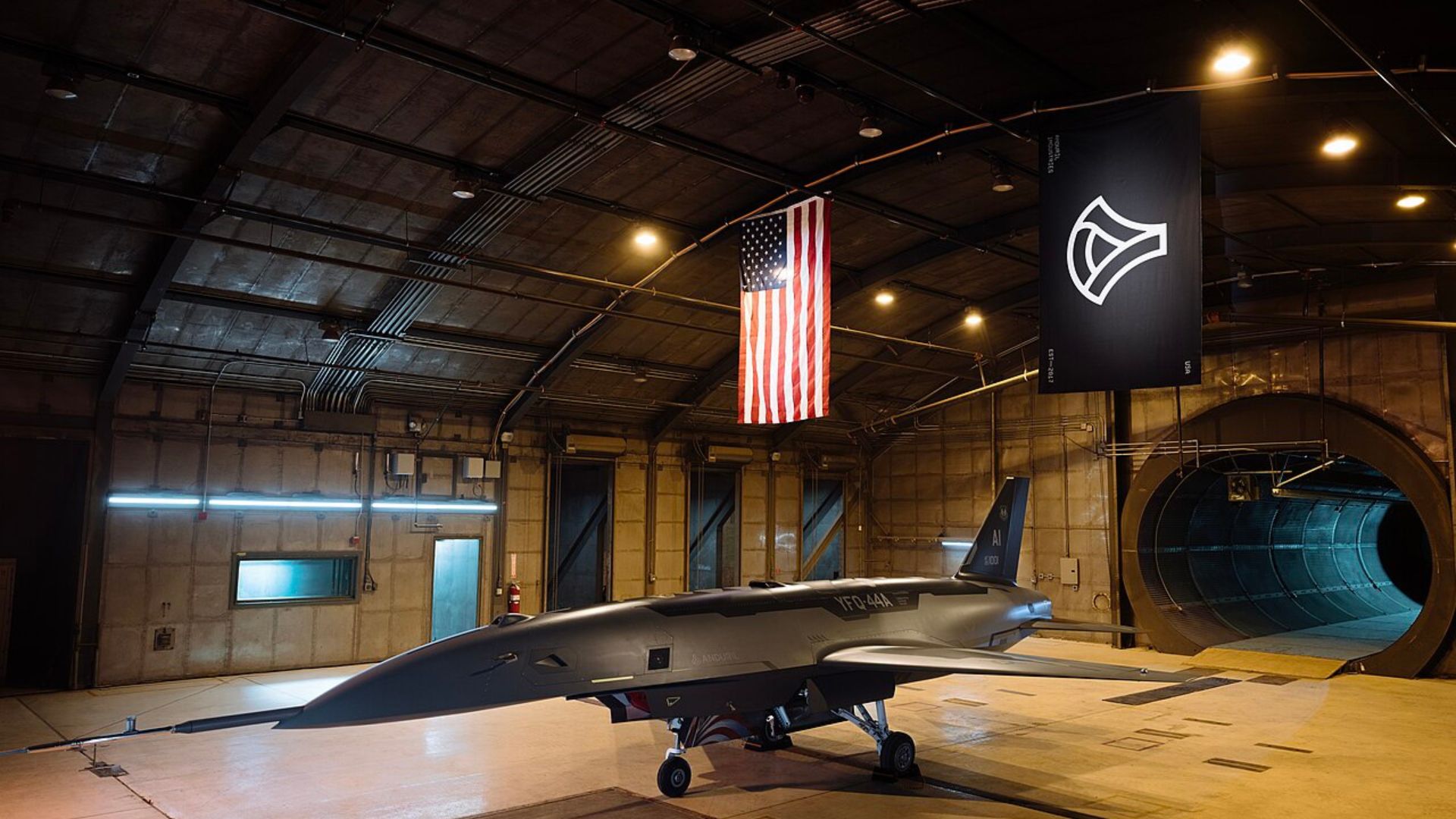


Unmanned Military Jet With Fighter Shape And Semi-Autonomous Control Enters Flight Tests And Becomes Showcase Of The New Technological Race Of The U.S. Air Force. Anduril Project Seeks To Operate Alongside Manned Aircraft, Expanding Range And Tactical Options With Scalable Production.
An unmanned jet with a fighter appearance, no windows, and capable of taking off, flying, and landing with minimal human intervention has entered the flight testing phase in the United States and has begun to symbolize a practical shift in how the U.S. Air Force intends to operate in the future.
Anduril Industries, a defense technology company based in Los Angeles, reported that its jet drone YFQ-44A conducted a demonstration flight at a testing site in California, in an announcement made jointly with the U.S. Air Force.
YFQ-44A And The “Loyal Wingman” Concept
The YFQ-44A is part of the American effort to develop unmanned jet aircraft designed to act as a “loyal wingman,” a concept used to describe autonomous or semi-autonomous platforms that can accompany manned fighters on missions, expanding range, coverage, and employment options.
-
A fossil kept for years in a small museum in Montreal concealed 450-million-year-old soft tissue, a discovery that has only happened once before in history.

-
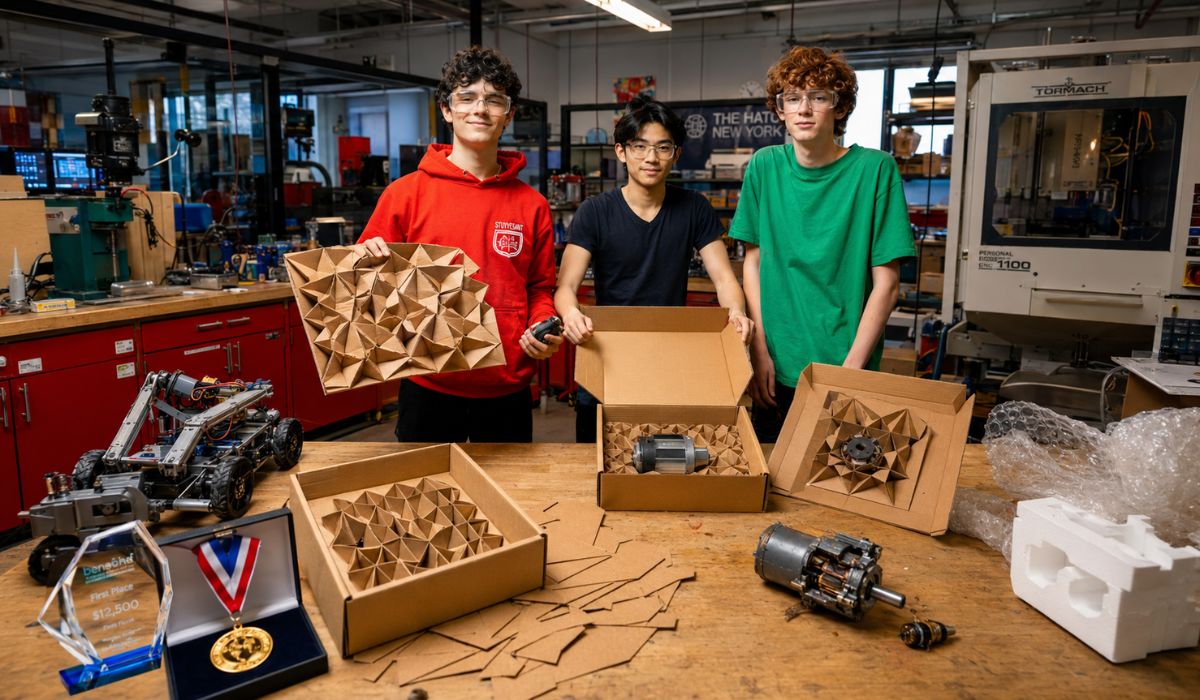
Three teenagers transform cut cardboard into Japanese origami-style packaging that promises to retire styrofoam and bubble wrap, win a $12,500 prize, and target giants like Amazon, FedEx, and Home Depot after a robot motor arrived broken.

-
The large jar blender has a rival: Oster Ultra Power bets on 1,000 W, six stainless steel blades, and two portable cups with leak-proof lids.

-
Tesla injected an additional $250 million into the German factory, doubled the battery cell target, and opened its own production line for startups.



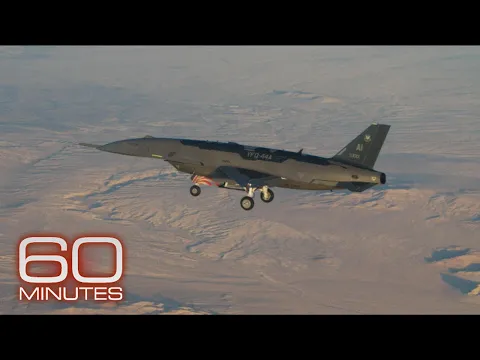
The flight presentation was treated as a milestone by demonstrating that a system of this type can operate with assisted autonomy from the earliest stages, instead of relying solely on conventional remote piloting.
According to the description released by the company and the Air Force, the flight occurred in “semi-autonomous” mode and demonstrated the drone’s ability to manage basic flight controls and power adjustments without receiving continuous human commands.

Jason Levin, an executive responsible for engineering at Anduril, stated in a statement that the aircraft can manage its own controls and also execute landing “at the push of a button,” detailing that there would not be, “behind the scenes,” a human operator piloting with a joystick and throttle.
U.S. Air Force And The Collaborative Combat Aircraft Program
The institutional reading behind the announcement also became clear in official statements.
Troy Meink, Secretary of the U.S. Air Force, stated in a note that the milestone demonstrates how competition accelerates innovation and capability delivery.
By positioning the flight as the result of a competitive process, the Air Force reinforced that the program seeks to shorten development cycles and quickly test collaborative aircraft operational employment concepts with human crews.
The YFQ-44A is part of the Collaborative Combat Aircraft (CCA) program, which the Air Force has been presenting as a way to compose a “mass” of unmanned jet aircraft alongside manned planes, especially in high-complexity scenarios.
In Reuters’ statement, the context of the CCA appears associated with the Pentagon’s preparation for a potential future dispute in the Pacific where autonomous systems would play a significant role, explaining the interest in platforms capable of operating together under the coordination of a larger force.
Industrial Competition And Rival Prototypes In Testing
Anduril’s participation in the CCA was formalized when the Air Force announced in April 2024 the selection of the company and General Atomics to develop competing prototypes within the program.
The “two-line” development dynamic was maintained as a central element.
While Anduril advances with the YFQ-44A, General Atomics also announced it has launched its own prototype, the YFQ-42A, in an earlier phase of the testing cycle and with a profile likewise geared towards semi-autonomous operation, according to information released at the time.
The proposal, according to public communication, is not limited to demonstrating that a drone can fly, but rather validating what it means to operate with assisted autonomy right from the runway.
When an aircraft completes taxi, takeoff, power adjustments, and approach procedures with low direct human interference in a single cycle, the project moves beyond being just a remote control concept and begins to test safety routines, redundancy, and response to dynamic parameters typical of the real-world environment, such as variations in speed, stability, and maneuvering envelopes.
Production, Contracts And The Jump From Prototype To Production Line

The announcement of the flight was also presented as part of a process that still involves contractual decisions and supplier selection for later stages.
Reuters reported that the Air Force is expected to announce a new contract related to a “second increment” of the CCA and is evaluating proposals from about 20 companies for the next phase of the program, while the ecosystem of companies in the sector expands its presence with competing projects.
In this context, it was noted that Shield AI reported it is developing a similar-profile aircraft called X-BAT, which reinforces the competitive environment surrounding this type of system.
On the industrial side, Anduril stated that it plans to expand its production capacity related to its CCA drone.
According to Reuters’ report, the company plans to begin manufacturing the prototype at a facility in Ohio, with an expectation to start the year following the announcement, a move that suggests a transition from a demonstration phase to a stage of production line preparation, tools, and assembly cadence compatible with broader testing and project evolution.
The combination of “first flight” with a promise of production in another location serves a role similar to that of large strategic programs: signaling that the initiative is not limited to an isolated prototype and seeks to create an industrial base capable of sustaining development, maintenance, and continuous improvement.
In the case of the CCA, the very terminology adopted by the Air Force — “collaborative aircraft” — indicates that the program’s goal is to build a system that integrates with operations involving manned aircraft, rather than functioning as a “lonely” drone with disconnected missions.
Why A “Mini Fighter” Without Windows Attracts Attention Worldwide
Even with attention focused on assisted autonomy technology, the public presentation of the YFQ-44A also relies on a straightforward element for the reader: the “mini fighter” shape without a cockpit, which attracts attention by removing the human component from the aircraft.
Reuters’ report described the drone as resembling a “windowless” mini fighter, which makes the visual impact almost immediate and explains why the program tends to generate curiosity beyond the specialized audience, as the change is noticeable even to those who do not follow defense routines.
The news of the inaugural flight was recorded on October 31, 2025, and marked, according to Anduril and the U.S. Air Force, the passage of the aircraft from a stage announced in statements and presentations to the phase where in-air behavior can be measured, compared, and adjusted in test cycles.
As it is a prototype, the flight stage tends to occur under controlled profiles and with defined objectives, which makes relevant what was publicly highlighted: the emphasis on the semi-autonomous character and the absence of a hidden pilot controlling the aircraft as if it were a remotely piloted model.
The advancement of the YFQ-44A is part of a practical debate on how air forces intend to balance technology, cost, risk, and combat capability in contested environments, and the presentation of the program suggests that the Air Force wants to learn from real prototypes before final fleet requirements and employment doctrine are established.
As jet drones approach the performance, speed, and system integration universe historically associated with manned fighters, what operational and ethical limits should guide the autonomy of military aircraft without a pilot on board?


