






 Portuguese
  Spanish
  5 min of reading
  5 comments


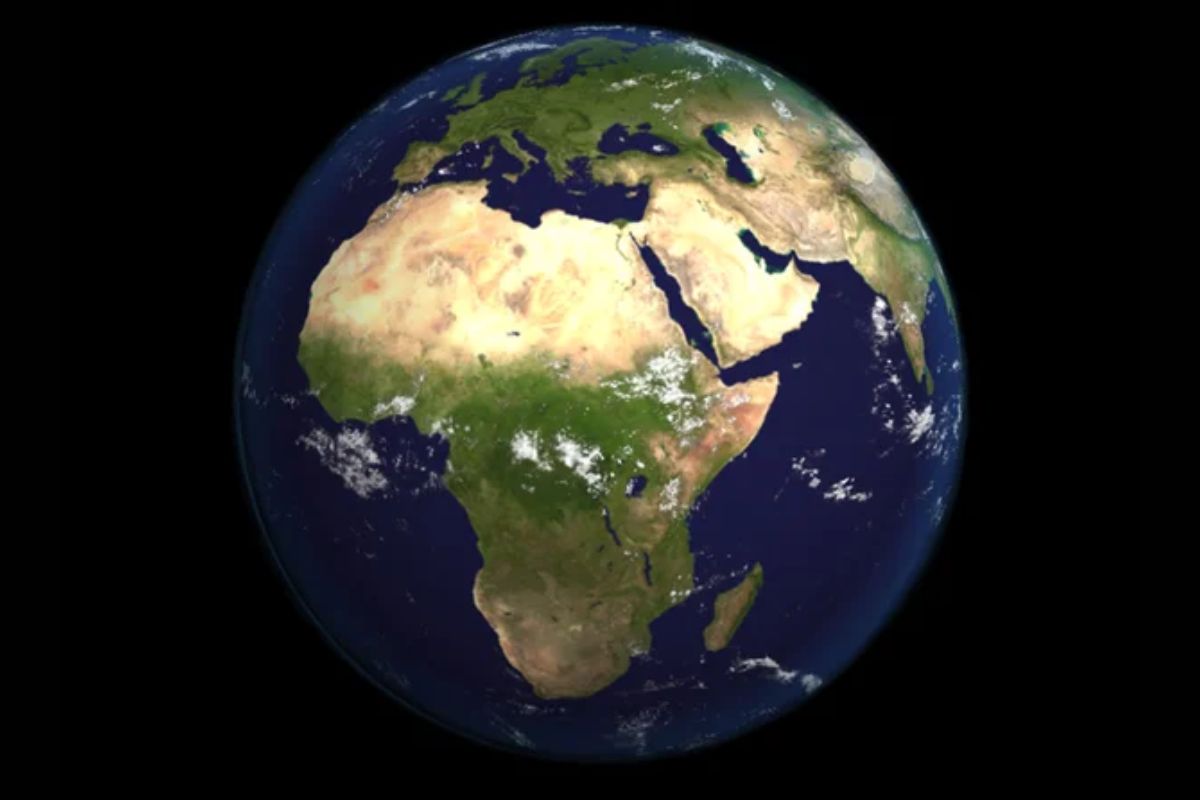


The Formation Of A Future Supercontinent Known As Eurafrica Predicts The Collision Between Africa And Europe, The Definitive Closure Of The Mediterranean Sea, And The Birth Of A Giant Continental Mountain Range, In A Gradual Tectonic Process That Already Leaves Measurable Signs In The Seismicity And Volcanism Of The Region
The supercontinent of the future begins to be drawn at the meeting point between Africa and Europe. The slow and continuous convergence of the tectonic plates that shape the Mediterranean indicates a clear outcome: the Strait of Gibraltar is likely to close, the sea evaporates, and gives way to a new mountain range, welding the two shores into a single continental mass called Eurafrica.
The timescale is profound and the mechanism is physical. The plates move a few centimeters per year, but accumulate enough energy to fold rocks, uplift terrain, and turn seas into salt deserts. The Mediterranean acts as a living laboratory, where subduction, faults, and microplates record the silent march toward the next global rearrangement.
From Pangea To The Next Supercontinent
The history of the Earth is marked by cycles of continental aggregation and fragmentation. From the ancient Pangea to the current mosaic, plate tectonics explains how continents come together, collide, and separate. When continental masses collide, the crust does not easily sink, and the energy dissipates into intense deformation, giving rise to mountain ranges.
-
A 10-year-old girl in Manaus created a styrofoam buoy with a sensor to detect trash in streams, became the sole representative from Latin America in an international challenge in London, and turned the pollution she saw near her home into a sustainable invention.

-
It was neither a crash nor abandonment; this retired plane left the airport in parts, crossed Costa Rica on trucks, and ended up becoming a suite in the heights with daily rates exceeding R$ 2,000.

-
She panicked when she saw her daughter fall from the crib; years later, she turned the experience into a factory generating R$ 9 million per year.

-
At 75 years old, João José de Carvalho, known as Mr. Janjão, was accepted for the second time by Sisu after overcoming distance, physical limitations, and years away from school, to fulfill his dream of studying Biological Sciences at UFPI.


This process is predictable based on simple physical principles. Convection currents in the mantle drag the lithosphere like a slow conveyor belt, guiding continents to inevitable encounters. The collision between Africa and Eurasia that we see today in the Mediterranean is a stage of a larger cycle that tends toward the formation of another supercontinent.
The Mediterranean is a complex frontier. As studies show, the African plate is advancing northward, while microplates like Anatolia are laterally shifting, compressing and fracturing the region. Sections with active subduction feed volcanoes and tremors, while other segments already show continental deformation.
This heterogeneity creates a zipper pattern that closes from east to west. Zagros and Caucasus indicate advanced collision in the eastern sector, while Italy, Greece, and the Hellenic arc reveal the persistence of oceanic subduction. In the extreme west, Gibraltar emerges as the likely endpoint of this tectonic stitching.
How The Mediterranean Closes
The definitive closure requires sealing off Gibraltar. When the connection to the Atlantic is interrupted, the Mediterranean loses its replenishment and enters a state of desiccation, a scenario already recorded during the Messinian Salinity Crisis millions of years ago. The result is the deposition of thick layers of salt and an extremely subsided relief.
In the future, the continental collision keeps the barrier closed. Evaporation surpasses the influx of freshwater, and the basin becomes a permanent salt desert, while tectonic compression continues to shorten and thicken the crust. The ancient seabed becomes part of the collision zone that will give rise to the mountain range.
After desiccation, the African and European continental crust collides directly. The rocks of the Mediterranean seabed, rich in evaporites, act as slip layers that facilitate folds and large-scale stacking, favoring the growth of an extensive mountain range in the Himalayan alpine style.
The comparison with the Alps and Himalayas offers clues. Stacked nappes, ophiolites trapped in the suture, and high-grade metamorphism are expected features. The Eurafrican Mountain Range could reach significant altitudes and extend for thousands of kilometers, welding margins that are currently separated by deep waters.
What Changes In The Climate When A Supercontinent Emerges
Geography controls the climate on a large scale. A supercontinent enhances continentality, creates arid interiors, and seasonal thermal extremes. Without oceanic moderation, vast inland areas may exceed known habitable limits for many species.
The closure of the Mediterranean alters regional circulation and the eventual closure of larger oceans remodels the global distribution of heat. The likely result combines reorganized ocean currents, displaced wind belts, and new orographic barriers influencing rainfall and temperatures in both hemispheres.
What drives this scenario is the physical system of the Earth, not human decisions. How long it will take depends on millimeter-scale annual rates accumulated over tens of millions of years, an order of magnitude compatible with the evolution of major mountain belts.
Where the main suture occurs tends to be the Mediterranean strip, from the more mature eastern sector to the closure at Gibraltar. Why this happens stems from the balance between the creation and destruction of crust and from the mantle convection that drives the plates toward collision.
What Can Already Be Observed
Signs are present today. Recurring seismicity along the southern edge of Eurasia and active volcanism like that of Etna indicate the persistence of subduction and compression. Each major tremor is a small step in regional shortening.
In the Alps and neighboring arcs, uplift and structural complexity provide a mirror of what will emerge when the Mediterranean disappears. What we see at the surface is the expression of processes that operate continuously at depth.
The supercontinent that will unite Africa and Europe is a natural conclusion of a dynamic planet, capable of draining an entire sea and raising mountains in its place. The Mediterranean is already recording this march, and Eurafrica projects the next chapter of a story that began with Pangea.
Do you agree with this long-term geological scenario? Do you believe that the closure of the Mediterranean and the formation of a supercontinent would change life in currently coastal regions? Leave your opinion in the comments — we want to hear from those who live this in practice, especially professionals in geology, geography, and urban planning.






Realmente isso um processo longo mas tudo pode acontecer….
Com certeza haverá muita mudança e a pergunta que faço é; em que direção se deslocará este super continente após sua unificação??
Nao estaremos mais aqui quando talvez ocorra tudo isso…parece q é para já…mas nao tem nada a ver.