






 Portuguese
  Spanish



This change redefines combat strategies and repositions the importance of technology in the contemporary battlefield. The introduction of materials like the HT4 alters the balance between detection and concealment.
In your view, is this technology sufficient to reduce the dominance of drones, or does it represent just another step in the evolution of technological warfare?
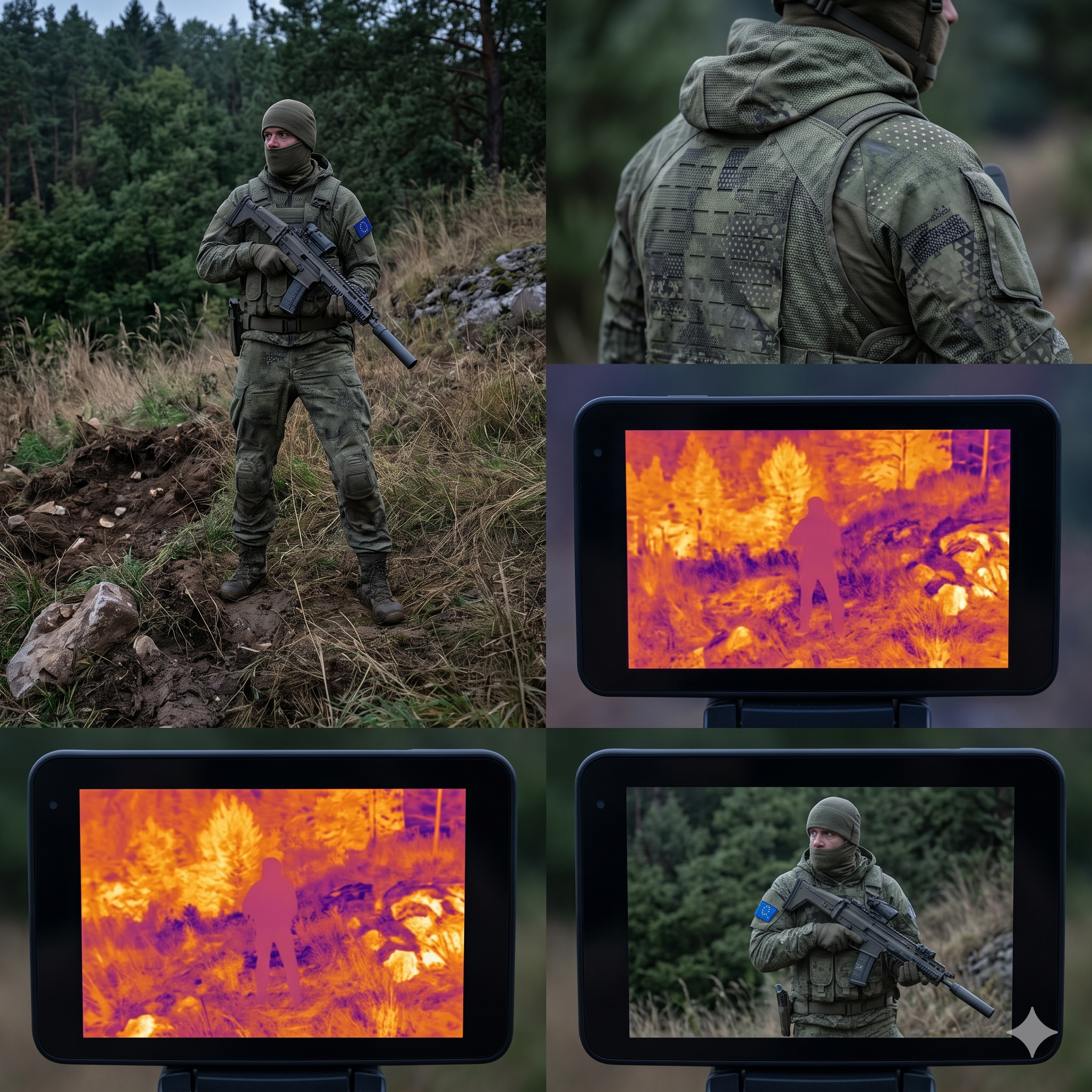
HT4 technology deceives thermal cameras, conceals human heat, and can transform military strategies in the face of drone warfare.
According to Army Recognition, HT4, developed by the French company Kastinger and commercialized by PGM Précision with the support of France’s Defense Innovation Agency, received the Prix de l’Audace in 2024, the country’s main military innovation award, granted to technologies with the potential to transform the war landscape.
-
U.S. Air Force Launches Air-to-Air Missile Project with Range of Up to 1,850 km for Indo-Pacific Operations

-
Australia to Deploy Up to 8 Nuclear-Powered Submarines in Indo-Pacific, Establishes Billion-Dollar Naval Chain Through AUKUS, Joining Elite Group Capable of Extended Underwater Missions

-
Indonesia Begins Construction of 2,000-Ton Scorpène Stealth Submarines with Advanced Weaponry and French Steel

-
Brazil’s Largest Navy Ship, NAM Atlântico, Transforms into Field Hospital During National Crises





In 2025, tests conducted with European military forces confirmed the material’s functionality in real conditions. The technology solves a problem that became central after the War in Ukraine: the fact that the human body emits constant heat and can be easily detected by thermal cameras installed on accessible drones.
War in Ukraine completely redefined the concept of camouflage by making human heat visible in any environment
For decades, military camouflage was designed to deceive human vision and optical sensors. Color patterns, textures, and materials were developed to break the soldier’s silhouette in the environment. Camouflage nets and radar signature reduction technologies also evolved.


This model presupposed an enemy observing by visual means. The War in Ukraine altered this paradigm. Since 2022, commercial drones equipped with thermal cameras have begun to detect heat signatures with high precision, making any thermal source visible, regardless of visual camouflage.
Cheap thermal drones made any soldier detectable even when stationary, hidden, or during night operations
Accessible equipment, such as adapted commercial drones, began operating with thermal sensors capable of identifying a soldier hundreds of meters away.
The human body, with an average temperature of 37°C, emits continuous infrared radiation. This emission cannot be turned off or hidden with conventional methods.
Even stationary soldiers are detectable. Movement further increases the thermal signature due to additional heating. Vehicles remain detectable even after being turned off, due to residual heat.
HT4 does not block heat, but redistributes thermal energy to mimic the surrounding environment’s temperature
HT4’s differential is not in blocking heat, but in manipulating it. The technology uses multiple layers with specific thermal properties. The inner layer retains body heat. Intermediate layers function as insulators. The outer layer emits thermal radiation equivalent to the surrounding environment.
This creates a thermal matching effect, where the material’s outer surface presents the same temperature as the background.
Adaptive thermal camouflage allows soldiers to become invisible to infrared sensors in different scenarios
If the soldier is on cold ground, the material’s outer surface emits a temperature equivalent to the ground. If near warmer structures, it adapts to that condition.
This process is not instantaneous but occurs within a few minutes, which is sufficient for tactical applications such as ambushes and strategic positioning.

One of the most relevant characteristics of the technology is its ability to conceal heat sources much higher than body temperature.
The material was tested with sources up to 1,000°C, allowing its application in engines, generators, weapons, and equipment that typically produce intense thermal signatures.
Flexible, lightweight, and multidirectional structure allows use on soldiers, vehicles, and battlefield structures
The HT4 can be used in different formats. The wearable version, called PIKS, functions as an individual poncho. The panel version allows covering vehicles, equipment, and structures.
Protection is multidirectional, maintaining effectiveness regardless of the thermal sensor’s observation angle. Its weight of less than 2.5 kg allows for operational use without compromising mobility.
Tests in extreme environments show functionality in both cold regions and tropical climates
The material was tested in environments with extreme temperatures. In cold regions, it maintained thermal correspondence even with large differences between the body and the environment. In tropical regions, where the thermal gradient is smaller, effectiveness remains, albeit with a natural reduction.
The need for thermal concealment has led several countries to develop their own solutions. Ukraine used emergency blankets with limited effectiveness. Russia announced the development of its own systems based on thermal dispersion.
These solutions do not yet reach the level of sophistication of the HT4, but they indicate a global shift in the development of military equipment.
Thermal camouflage alters strategic balance by increasing detection cost and reducing the advantage of cheap drones
The main implication of the HT4 is strategic. Thermal drones created a cost asymmetry: cheap equipment capable of detecting targets with high precision.
With the introduction of effective thermal camouflage, this advantage is reduced. Detection now requires more advanced sensors, increasing the cost and complexity of reconnaissance.
The HT4 represents a shift in the concept of military invisibility. It is no longer about hiding the visual form, but about manipulating the thermal signature.
This change redefines combat strategies and repositions the importance of technology in the contemporary battlefield. The introduction of materials like the HT4 alters the balance between detection and concealment.
In your view, is this technology sufficient to reduce the dominance of drones, or does it represent just another step in the evolution of technological warfare?









