Portuguese
  Spanish



Chinese Military Exercises Reveal Parallel Civil Navy and Disguised Military Logistics, Increasing China–Taiwan Tension.
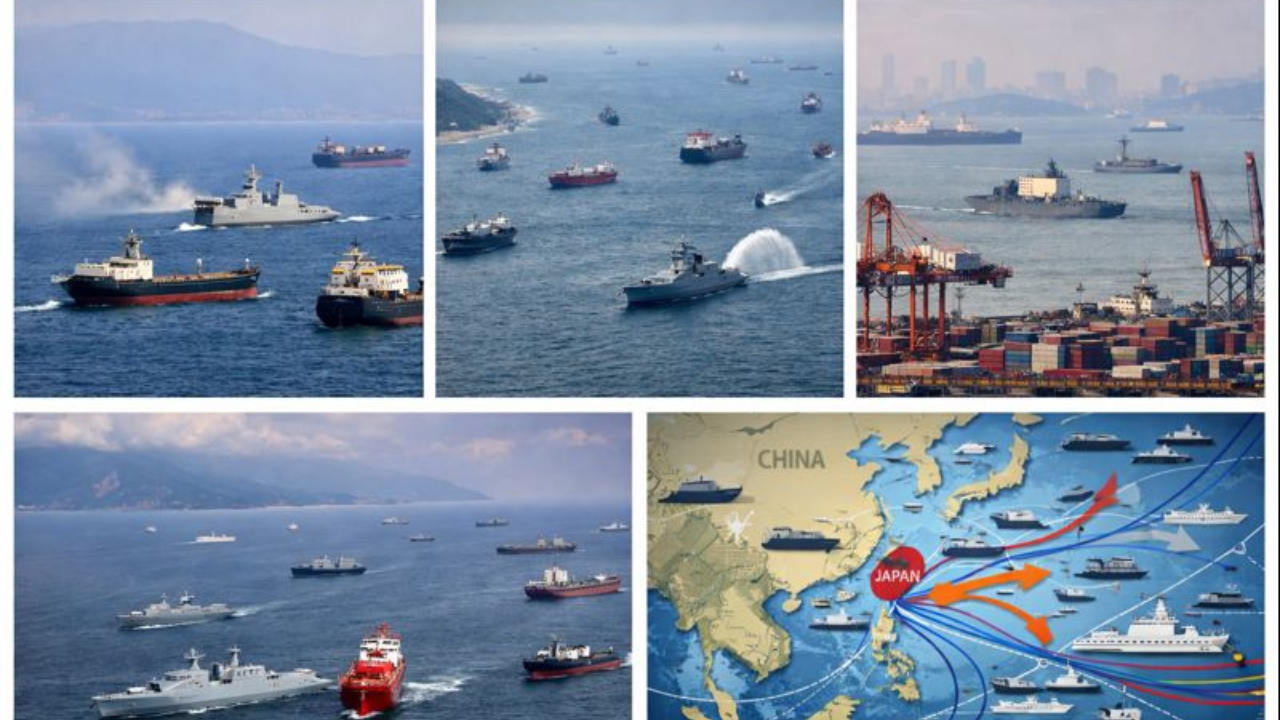
A series of Chinese military exercises, conducted around Taiwan, has brought to light indications of a parallel civil navy integrated into the maneuvers, involving commercial ships prepared to support military operations.
Conducted by China in recent days, the activities occur around the island and directly affect air and sea routes, raising alarms about disguised military logistics and its impacts on China–Taiwan tension.
The movement reinforces regional and international concerns about the balance of power in the Indo-Pacific, at a time of growing geopolitical instability.
-
U.S. Military Intervention Risk in Brazil Raises Alarm, Highlights National Sovereignty Amid Tensions Over Washington’s Terrorist Designation of PCC and Comando Vermelho

-
Brazilian Air Force’s Sole KC-30 Aircraft Completes Strategic Mission to Spain for 105mm Anti-Tank Ammunition for Leopard 1A5 Tanks

-
Brazilian Air Force Seeks to Acquire More Gripen Fighter Jets
-
U.S. Air Force Launches Air-to-Air Missile Project with Range of Up to 1,850 km for Indo-Pacific Operations



What is the So-Called Parallel Civil Navy
Unlike traditional military fleets, the so-called parallel civil navy would consist of cargo ships, oil tankers, and seemingly ordinary transport vessels.
These ships, according to recent analyses, are being prepared to operate discreetly in conflict scenarios.
Instead of displaying weaponry or military flags, these vessels blend in with everyday commercial traffic.
Thus, they could transport troops, vehicles, fuel, and supplies without triggering immediate alerts in regional surveillance systems.
Disguised Military Logistics as a Strategic Advantage
The use of civilian ships in support of armed forces rapidly expands the country’s logistical capacity.
In the event of a confrontation, this disguised military logistics would allow for constant flows of resources while the regular navy focuses on direct combat.
Additionally, this type of operation complicates the identification of strategic movements.
By confusing radars and monitoring systems, the strategy reduces the adversary’s reaction time and increases the unpredictability of actions.
Direct Impacts of Chinese Military Exercises
The Chinese military exercises are not limited to the symbolic realm.
On the contrary, they are already causing concrete effects in the daily life of the Taiwanese population, with temporary closures of air routes and changes in maritime itineraries.
These interruptions affect commercial flights, cargo transport, and regional movements.
Thus, the maneuvers demonstrate real operational capacity and practically test the repercussions of a prolonged crisis scenario.
Sixth Major Operation Since 2022
This is the sixth major military exercise conducted by China around Taiwan since August 2022.
The recurring pattern indicates a continuous process of capability accumulation and operational learning.
By repeating the maneuvers, Beijing broadens its knowledge of local geography, travel times, and potential island defense responses.
Thus, each exercise contributes to refining future operational scenarios.
The China–Taiwan Tension at a New Level
With the advancement of these strategies, the China–Taiwan tension assumes increasingly realistic contours.
Analysts point out that the integration between military forces and civil assets expands the range of options in a potential attempt to control the island.
This hybrid model also challenges traditional defense concepts, as it blurs the boundary between civil and military operations, requiring more complex responses from Taiwan and its partners.
International Reaction and Balance of Power in the Indo-Pacific
Meanwhile, strategic allies of Taiwan, such as the United States and other nations in the region, have been reinforcing statements of support for the island’s security.
At the same time, they intensify diplomatic dialogues to avoid an open military escalation.
These movements highlight that the dispute goes beyond the waters of the Taiwan Strait.
The scenario directly involves the balance of power in the Indo-Pacific, a central region for global trade and international strategic stability.
A Scenario Under Constant Observation
In summary, the recent exercises and the possible use of a parallel civil navy indicate a significant change in the way conflicts may be conducted in the future.
The combination of traditional military operations with civil assets reinforces the complexity of the scenario.
Therefore, the evolution of China–Taiwan tension remains on the radar of governments, markets, and international organizations, while the Indo-Pacific solidifies as one of the main geopolitical chessboards of the 21st century.