Portuguese
  Spanish


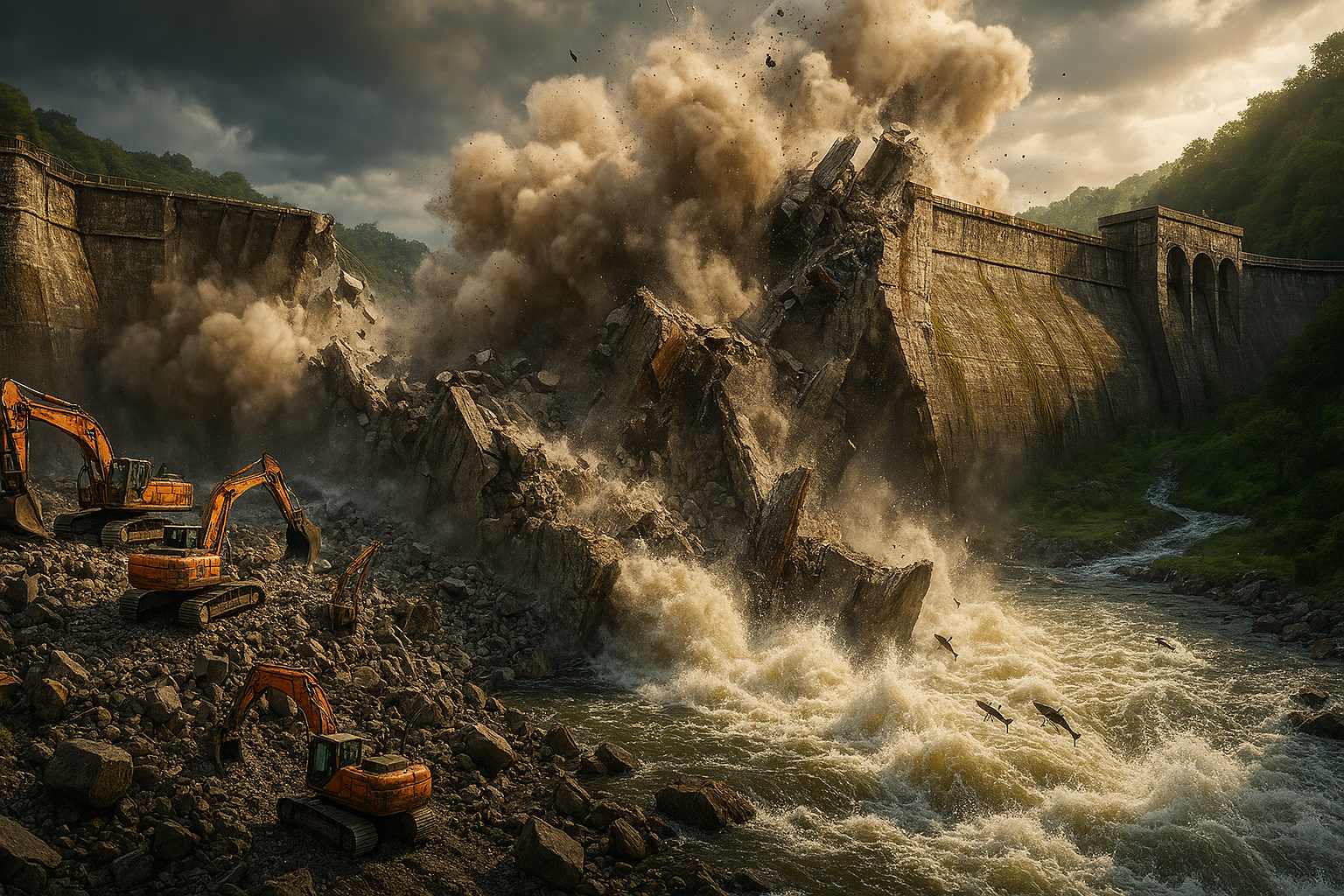


Explosives and Excavators Demolished Century-Old Dams in France to Free Rivers, Restore River Ecosystems, and Allow the Return of Migratory Fish After 100 Years.
For over a century, two concrete walls interrupted the natural flow of one of the most important rivers in Northwestern France. Built in the early 20th century for hydroelectric power generation, the dams of Vezins and La Roche-qui-Boit completely transformed the dynamics of the Sélune River, altering sediments, water temperature, biodiversity, and blocking migratory routes that had existed since the last Ice Age. What seemed like irreversible progress eventually became a symbol of silent environmental degradation. It was this very symbol that France decided to destroy, literally, with explosives, excavators, and one of the most complex river restoration operations ever executed in Europe.
The project known as Vezins & La Roche-qui-Boit Dam Removal was not just a demolition project. It represented a deep shift in mindset: for the first time, a European country consciously chose to remove large, still-functional dams to restore an entire ecosystem, even after decades of investment and energy dependence.
Vezins & La Roche-qui-Boit Dam Removal: Dams Built in the 20th Century and the Invisible Impact Over the Decades
The Vezins and La Roche-qui-Boit dams were built between 1914 and 1932 during a period when the absolute priority was to electrify rural areas and boost industrialization. At the time, the environmental impacts of large hydraulic works were little understood or simply ignored.
-
City Hall spends almost R$ 2 million on a wooden bridge only 2.5 meters wide to prevent the isolation of 5,000 people, but information about lifespan, load, and maintenance does not appear in public disclosures.

-
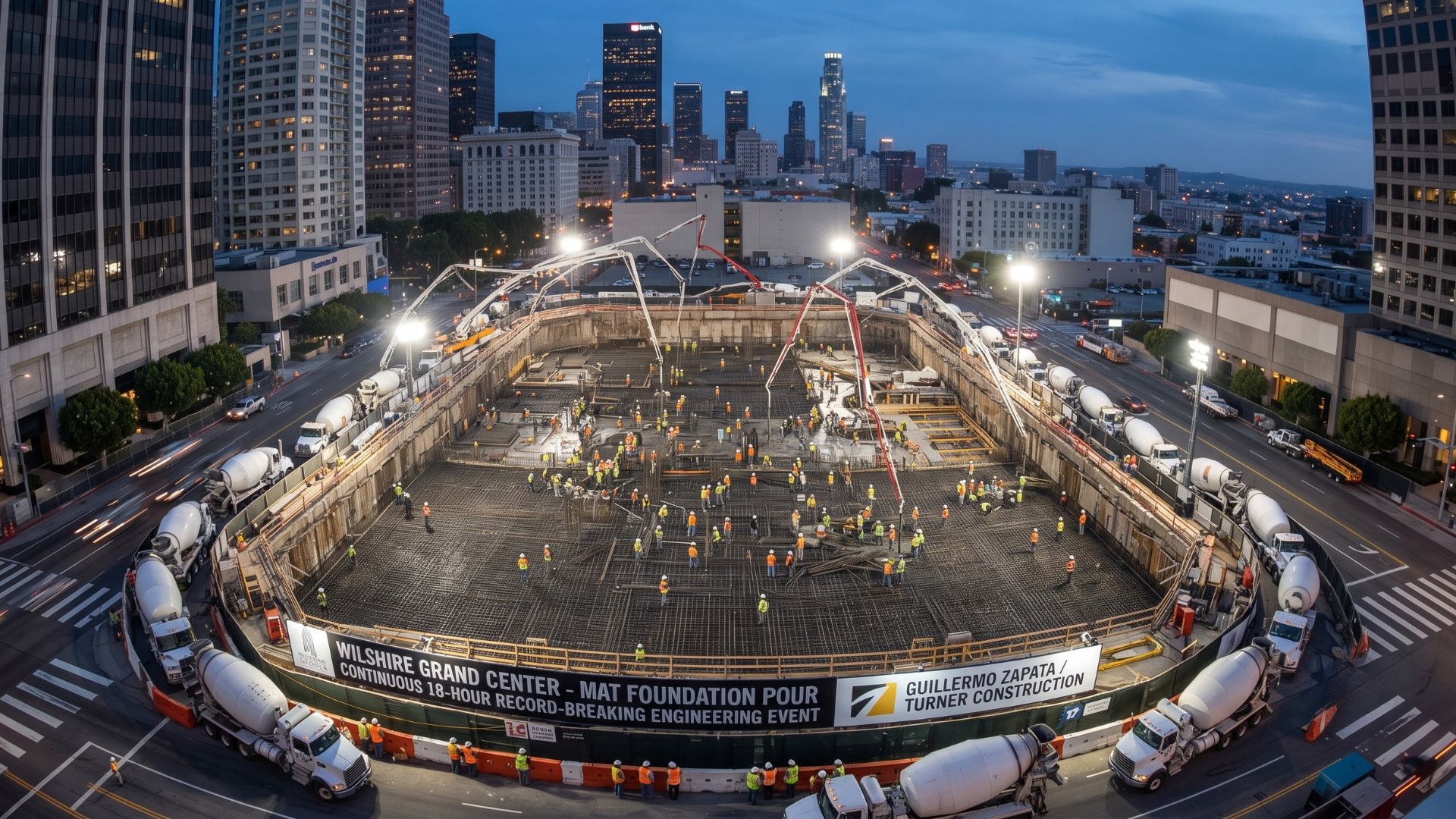
More than 2,100 trucks transported 16,200 cubic meters of concrete without interruption to create the foundation of the tallest skyscraper in the western United States and break a world record.

-
The man who started in construction with his own house founded a company in 1957, went through a banking crisis in 1987, and ended up connected to 16,500 houses in Houston.

-
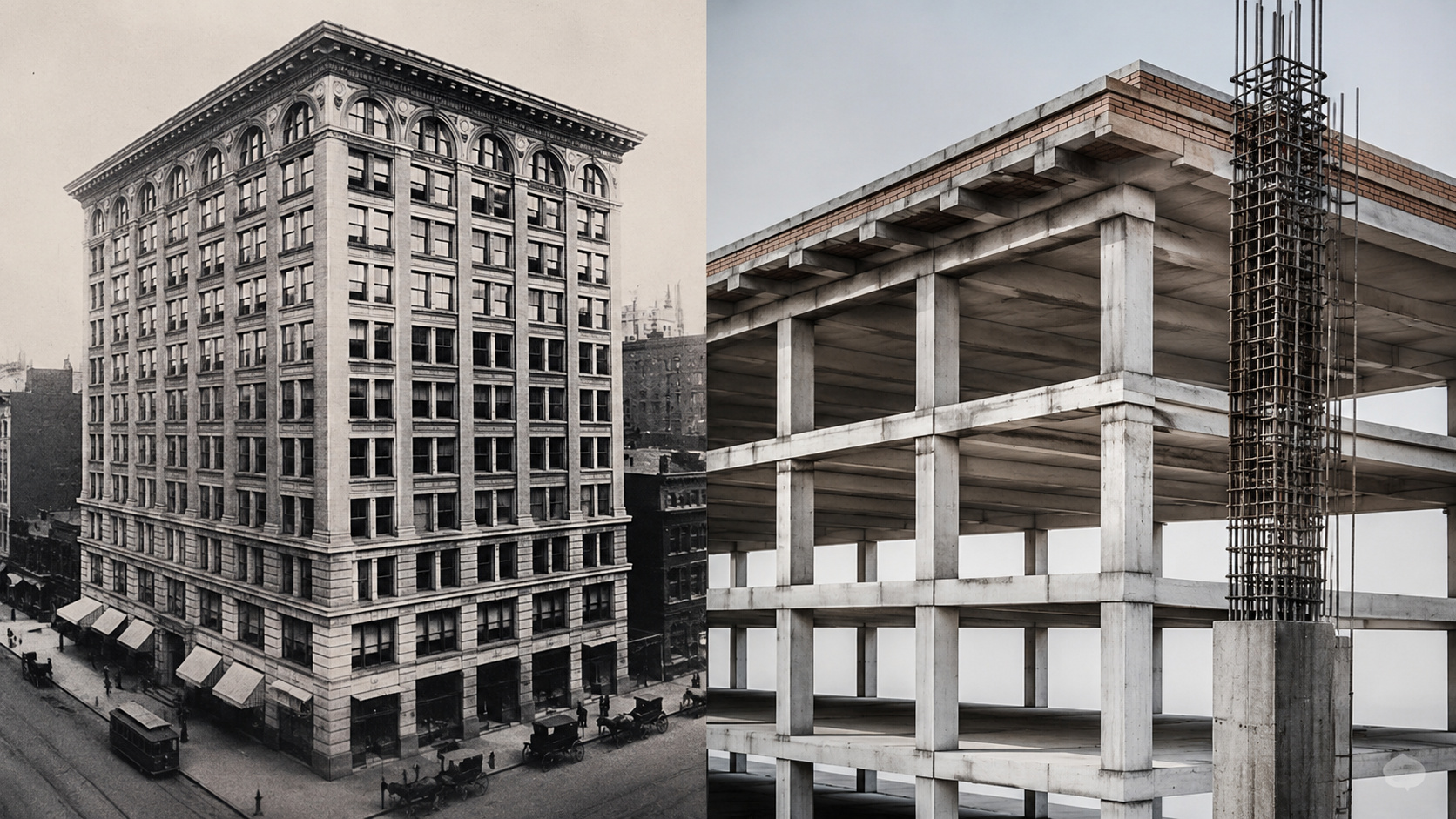
Builders challenged experts, erected a 16-story building using only reinforced concrete when the known limit was six floors, and proved that skyscrapers would never be the same again.


As the decades passed, the Sélune River ceased to be a dynamic river system and became a sequence of artificial reservoirs.

sediments that should have nourished the estuary began to accumulate behind the dams. The water lost its natural oxygenation, the temperature changed, and migratory species such as Atlantic salmon and European eel nearly disappeared completely.
The river, which had served as an ecological corridor between the interior of France and the ocean for thousands of years, became an insurmountable barrier for aquatic life.
Why Demolishing Still-Operational Dams Became a Strategic Decision
Unlike other dam removals in Europe, the case of the Sélune drew attention because the structures were still operational. The energy produced, however, no longer justified the environmental, economic, and maintenance costs.
Studies showed that the electrical production represented a minimal fraction of the regional energy matrix, while the environmental damage affected fishing, tourism, water quality, and even the river’s resilience to extreme events, such as droughts and floods.
The decision to demolish was not simple. There was political resistance, local protests, and long public debates. Still, the French government concluded that maintaining obsolete dams was more costly than removing them, both environmentally and economically.
Explosives, Excavators, and Controlled Demolition Engineering
The demolition of the dams required surgical planning. It was not simply a matter of blowing up concrete structures and letting the river flow on its own. The volume of sediment accumulated over more than 100 years posed a real risk of contamination and uncontrolled sedimentation.
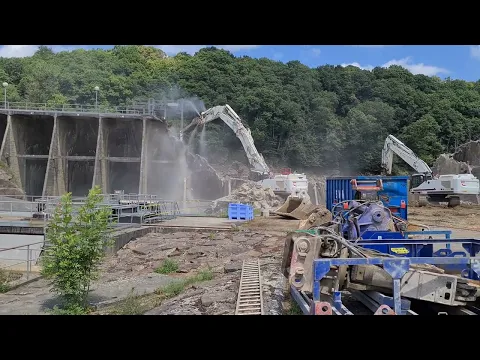

Therefore, the demolition was carried out in phases. Excavators removed parts of the structure, temporary channels were opened to control the flow of water, and explosives were used in a controlled manner to fragment critical sections of the dams.
Each phase was monitored by hydrologists, civil engineers, and biologists, ensuring that the river was “freed” gradually, without sudden collapses or irreversible damage downstream.
The Liberation of the River and the Return of the Natural Flow
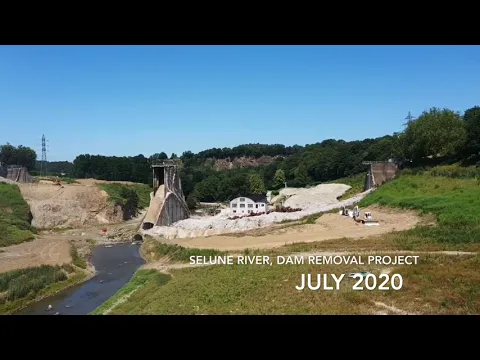
As the dams were being removed, something that hadn’t happened in over a century began to repeat: the river started to flow freely again. Sediments began to be transported once more, natural curves reappeared, and the riverbed started to reorganize itself spontaneously.
This process, known as river renaturalization, is one of the most complex in environmental engineering because it involves allowing nature itself to take control again after decades of artificial confinement.
The result was visible within a few months. Previously stagnant sections gave way to rapids, spawning zones, and diversified habitats, essential for the recovery of aquatic fauna.
The Return of Migratory Fish After More Than a Century
One of the most symbolic indicators of the success of the project was the return of migratory species that had disappeared from the Sélune. The Atlantic salmon, capable of swimming thousands of kilometers between the ocean and freshwater rivers, was once again recorded in the upper stretches of the river.
Eels, sea trout, and other species also reappeared, confirming that the simple act of removing physical barriers can restore ecological cycles that have been interrupted for generations.
This return did not depend on artificial restocking. The fish returned on their own, guided by evolutionary instincts that had been blocked only by the presence of concrete.
One of the Largest River Restoration Projects in Europe
The impact of the project exceeded the boundaries of the Sélune River. France became an international reference in dam demolition as a tool for environmental restoration, influencing public policies in other European countries.

The operation became a case study for continental river recovery programs, showing that removing old infrastructure can be more effective than attempting to adapt it indefinitely.
Today, Europe is experiencing a growing movement to remove obsolete dams, many of which were built last century and no longer serve a strategic function.
Costs, Criticisms, and the Debate About “Undoing Progress”
Naturally, the project faced criticism. Residents feared losing local identity, changes in the landscape, and immediate economic impacts. Others argued that demolishing dams was “erasing history.”
The debate revealed a modern dilemma: to what extent does preserving structures of the past outweigh restoring natural systems essential to the future? In the case of the Sélune, the data began to speak for itself.
With improved water quality, new opportunities for eco-tourism, sport fishing, and territory enhancement emerged. The river ceased to be a degraded reservoir and became an environmental and economic asset.
A Precedent That Could Redefine River Management in the 21st Century
The case of Vezins and La Roche-qui-Boit marks a turning point in the relationship between engineering and the environment. For the first time, demolition began to be seen as progress, not as regression.
In a world facing biodiversity collapse, climate change, and water scarcity, allowing rivers to flow naturally again may be one of the most efficient and least costly solutions in the long run.
France demonstrated that it is not necessary to build more to progress. Sometimes, it is necessary to remove, undo, and return to nature what has been artificially blocked.
When Destruction Becomes an Act of Environmental Reconstruction
The implosion of the Sélune dams was not a spectacle of destruction, but a gesture of historical correction. Explosives and excavators, traditionally associated with environmental degradation, were used as restoration tools.
The river began to breathe again, the fish returned to migrate, and an entire ecosystem began to recompose before the eyes of engineers and scientists. The project proved that 21st-century engineering does not just have to erect colossi — it can also know when it is time to take them down.