






 Portuguese
  Spanish


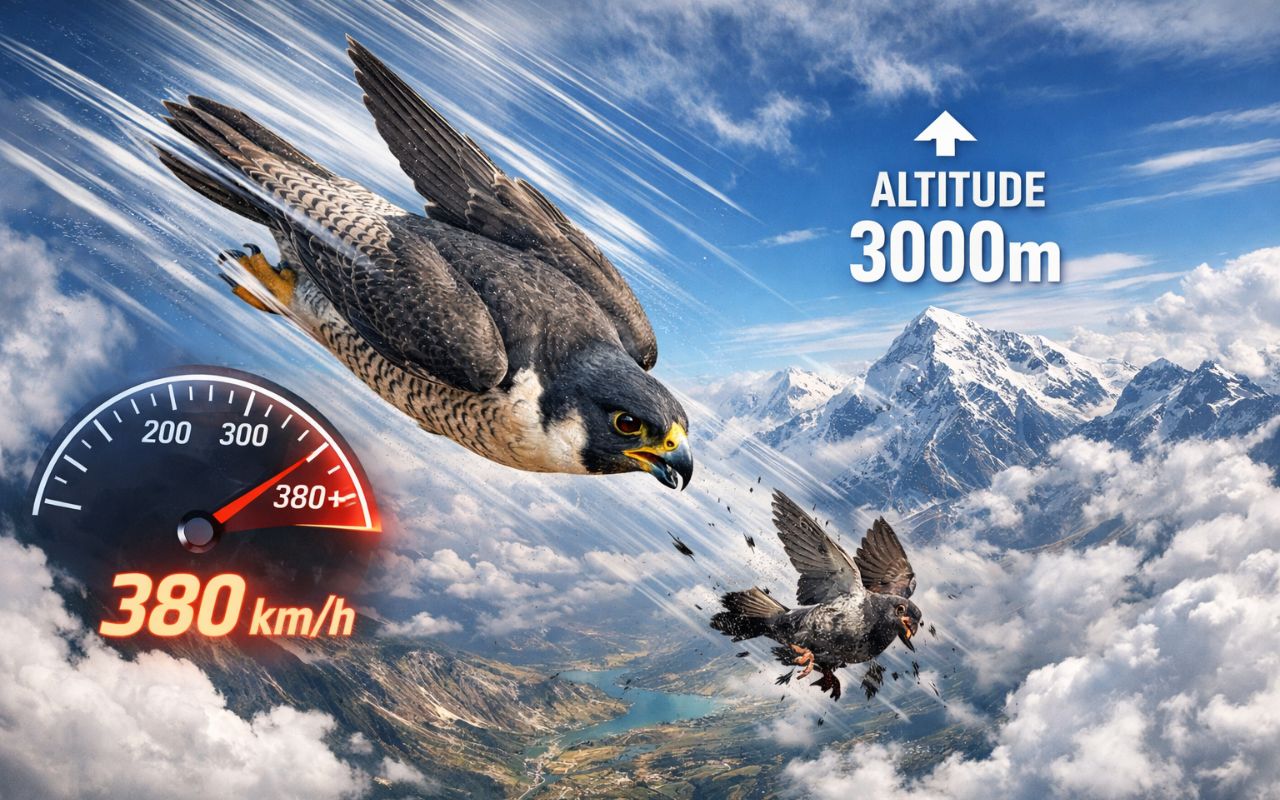


The Peregrine Falcon, Considered the Fastest Animal in the World, Reaches Over 380 Km/h in Dives and Has Hunted at Almost 3 Thousand Meters in Height.
Capable of exceeding 380 km/h in a single dive, the peregrine falcon holds the title of the fastest animal in the world, according to recent scientific records. This bird of prey performs these attacks in extremely precise vertical flights, capturing prey mid-air, often at great altitudes and in different regions of the planet.
Found on almost all continents, the falcon continues to surprise researchers with behaviors that challenge known limits of nature. This extraordinary performance occurs during the hunt.
Upon identifying prey from above, the peregrine falcon closes its wings against its body and begins an accelerated dive, using the force of gravity and its aerodynamic anatomy to achieve extreme speeds.
-
Oceanographer Turns Abandoned Fishing Nets from Brazilian Waters into Bags, Creating Jobs and Earning Over $7,000 Monthly

-
Australia deploys poisoned sausages and uses traps, shooting, and fences in a battle against invasive cats that kill over 1.5 billion native animals annually, threatening more than 200 species.

-
NASA Rover Captures “Tired Face” on Mars, Highlighting Human Brain’s Tendency to See Faces in Rock Formations

-
Ancient Stone City in the Desert, Once Home to 30,000, Puzzles Scientists with Nabateans’ Water Mastery 2,000 Years Ago





It is precisely this technique that grants the species the title of the fastest animal in the world, surpassing any other living being ever studied.
Peregrine Falcon: The Fastest Animal in the World Lives Near People
Despite the image associated with wild environments, the peregrine falcon is not limited to isolated areas.
The species is distributed across all continents, except Antarctica, demonstrating a remarkable adaptability.
Experts have already identified individuals living in large urban centers, such as New York, in the United States.
In these areas, skyscrapers and bridges replace natural cliffs and function as strategic points for observation and attack.
Thus, the fastest animal in the world shows that it can coexist even in landscapes dominated by concrete.
Extreme Speed Can Still Be Underestimated
Although reliable measurements indicate that the peregrine falcon exceeds 380 km/h, some researchers argue that the actual speed may be even higher in specific situations.
The challenge lies in the difficulty of accurately recording these moments, which last only a few seconds and often occur hundreds or thousands of meters from the ground.

Even with these limitations, the available data already consolidates the peregrine falcon as the fastest animal in the world, with no close competitors when it comes to maximum speed.
An Unexpected Hunt Led to a New Record
One of the most impressive episodes involving the peregrine falcon was discovered almost by chance.
Scientists recently identified a hunt performed at 2,881 meters in altitude, considered the highest ever recorded for the species.
The discovery occurred during a study that did not even have the falcon as its main focus.
The ecologist Michiel Boom from the University of Amsterdam was analyzing data on the gray plover (Pluvialis squatarola), a migratory bird known to fly at high altitudes between Europe and North America.
GPS Data Revealed the Attack of the Fastest Animal in the World
During the research, one of the GPS tracking devices caught the attention of scientists.
It indicated that a plover had suddenly deviated from its migratory route and descended abruptly to a quarry. That was the last recorded location of the animal.
Upon analyzing the data more carefully, researchers found that the attack happened at exactly 2,881 meters in height.
Subsequently, plover remains were found about 200 meters from a peregrine falcon nest, leading scientists to conclude that it was responsible for the capture.
Scientific Record Reinforces Extreme Ability
The case was detailed in an article published in the scientific journal Ecology, which describes both the analysis method and the study’s conclusions.
Although researchers sought to understand the reasons that lead plovers to migrate at such high altitudes, they ended up documenting one of the most impressive hunts ever attributed to the fastest animal in the world.
It is still not known precisely why these migratory birds choose to fly so high.
However, the episode revealed yet another limit being surpassed by the peregrine falcon.

Speed, Adaptation, and Precision of the Peregrine Falcon
Combining extreme speed, sharp vision, and adaptability, the peregrine falcon remains one of the planet’s most efficient predators.
Whether in natural areas or large cities, it continues to expand what science knows about the limits of animal flight.
Not surprisingly, the title of the fastest animal in the world continues to belong to this bird, which keeps breaking records — often in completely unexpected ways.






3 mtrs or kms🤔