






 Portuguese
  Spanish


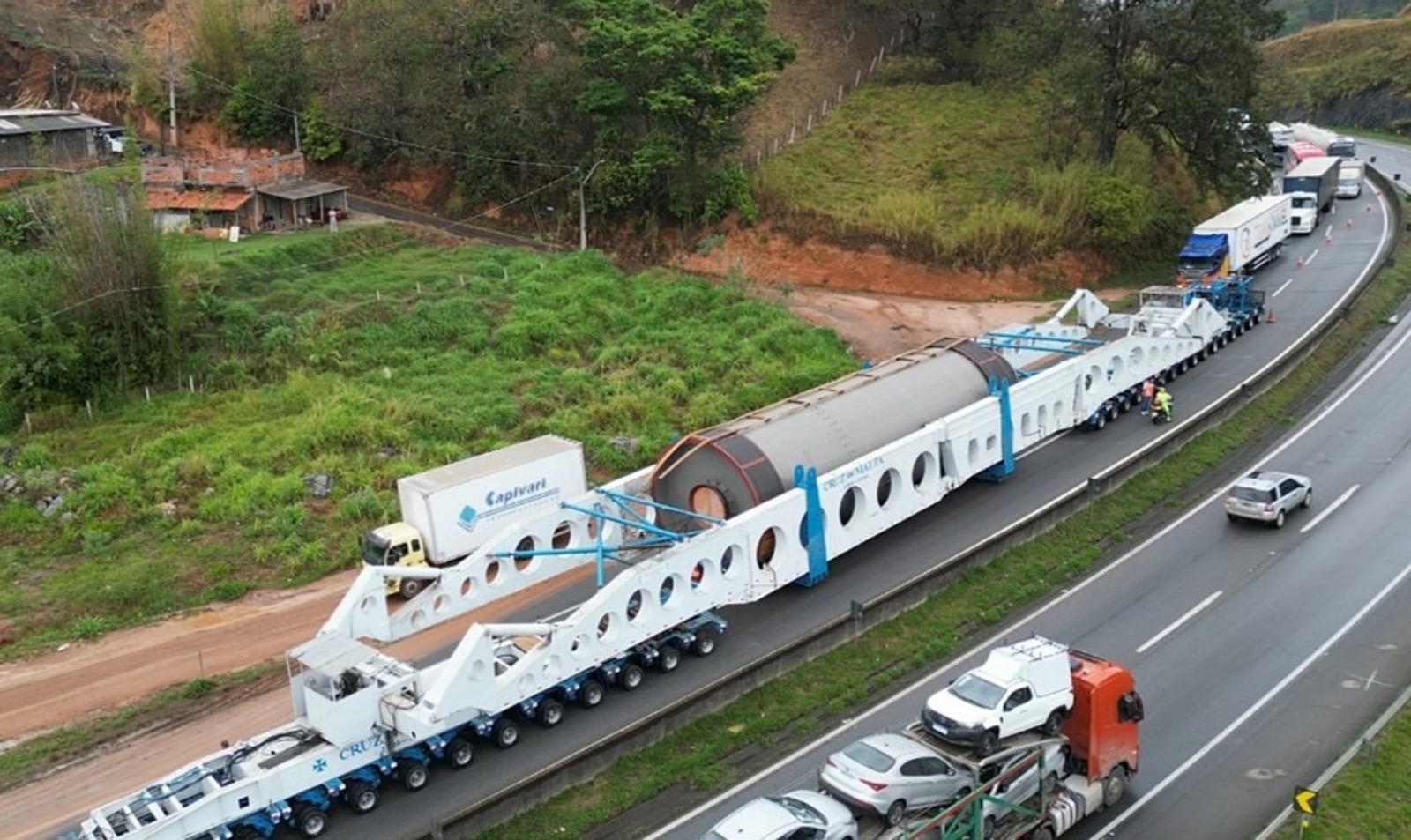


With 123 Meters in Length, 44 Axles, and 296 Tires, the Megatrailer That Left Santos Toward Edealina Slowly Advances Along BR-381, Turning the Highway into a Stage for an Unprecedented Logistics Operation
The passage of a megatrailer transporting an industrial piece of large proportions has altered traffic and sparked curiosity on Fernão Dias Highway (BR-381) for nearly three weeks. The convoy, which left Santos (SP) headed for the city of Edealina (GO), interrupted its journey on Wednesday night (29) by stopping at the Federal Highway Police yard in Perdões (MG). The stop was necessary for the cargo to be transferred to a smaller vehicle before continuing along BR-354.
A Structure the Size of a 30-Story Building
The size of the megatrailer is impressive because the assembly is 123 meters long—equivalent to a 30-story building lying down. The width reaches 7.3 meters and the height is 5.7 meters.
Including the cargo and vehicles, the total gross weight is 636.5 tons.
-
Brazilian Company Known for Brooms Grew for 95 Years to Become One of Latin America’s Largest Brush Manufacturers, with Over 300,000 Sales Points and Revenue of $150 Million

-
World’s Largest Piano Manufacturer Produces Over 100,000 Units Annually in China, Each with 12,000 Parts

-
Meet the HMS Eagle: A Colossal 34,000-Ton Aircraft Carrier of the British Royal Navy with a 247m Length, Capacity for 55 Aircraft, and 2,750 Personnel
-
“Ghost Bird” Thought Extinct for 86 Years Reappears, Disappears Again, but New Recording Sparks Global Effort to Save One of the World’s Most Sought-After Species


The convoy consists of 44 axles and 296 tires. The logistics require meticulous calculations, as each meter traveled must take into account bridges, curves, slopes, and soil conditions.
Four Trucks to Move a Single Piece
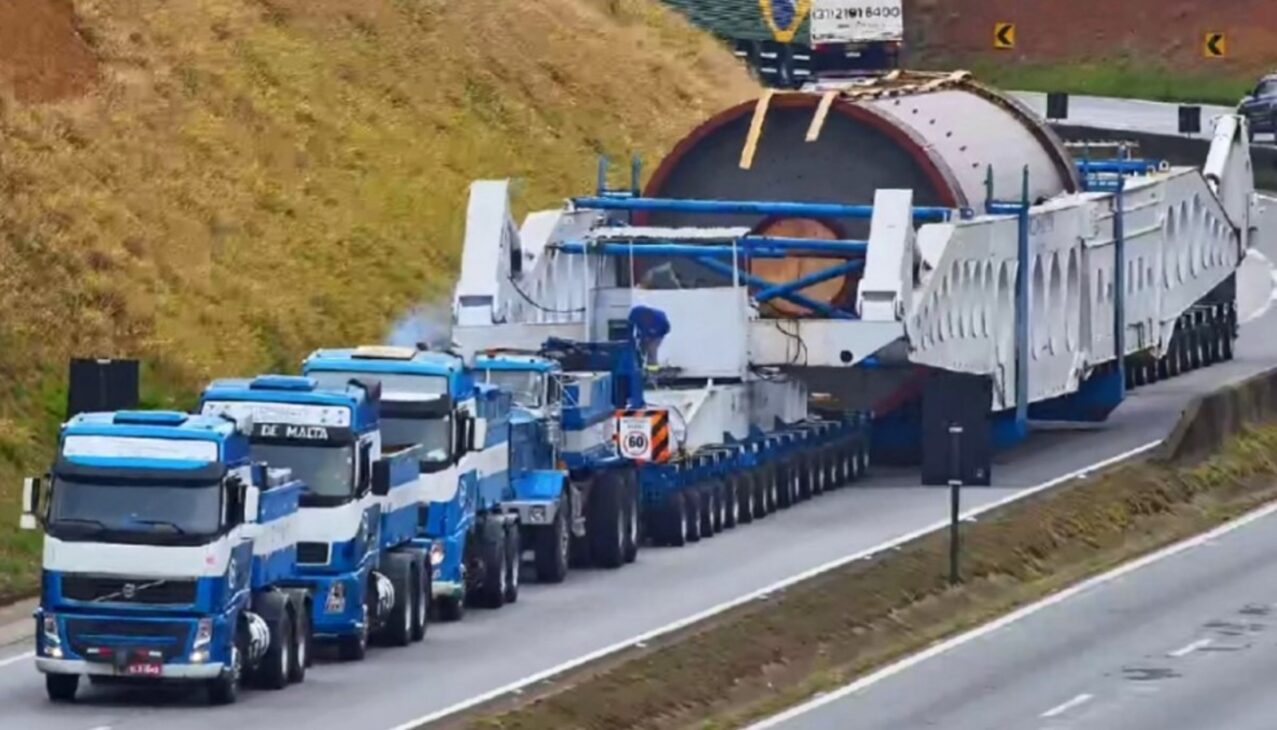
The transport is carried out by four trucks towing the trailer, each with its own driver. This configuration is chosen because the PBTC—Gross Combined Weight— is too high for a single vehicle.
The trucks used are rare in the country and have specific counterweights that help balance and distribute the force during maneuvers.
Special Cargo Heads to Cement Factory
The transported cargo is a grinding system destined for Votorantim Cimentos in Edealina. Measuring 19.5 meters long and weighing 210 tons, the piece is essential for the functioning of the industrial plant.
Due to its dimensions, it required special planning and a distinct route from the loading at the Port of Santos.
Detour of 400 Kilometers
The original route had to be altered because the height of the cargo—5.7 meters—would prevent passage under the overpasses of Anhanguera Highway.
Additionally, the width of 7.3 meters made it impossible to travel on secondary roads. A geometric feasibility study conducted by Cruz de Malta defined the new route, which added approximately 400 kilometers to the journey.
Authorizations and Additional Costs
The operation relied on authorizations from the Port Authority of the Port of Santos, DNIT, and the Departments of Highways of São Paulo, Minas Gerais, and Goiás.
Although it is a special cargo, the megatrailer pays tolls normally, calculated based on its 44 axles.
However, it does not use conventional toll booths, passing through side roads designed for large vehicles.
In addition to the standard toll, there are additional fees such as the TAP (Additional Toll Fee) and the TUV (Road Use Fee) applied on state stretches.
Slow and Controlled Movement
The convoy travels an average of 30 kilometers per day, with a maximum speed of 30 km/h. The stops are pre-programmed and monitored.
The slowness causes traffic jams in the sections where the trailer travels, although the monitoring by the Federal Highway Police has allowed for a slightly faster movement on Fernão Dias.
Megatrailer Travels Only on Dry Roads
For safety, the trailer can only circulate during the day and in favorable weather conditions. Rain prevents movement, as the weight and size make the vehicle control more difficult.
Between October 13 and 27, the convoy was halted for repairs, returning to the road on the 27th. However, new interruptions occurred due to bad weather.
Expected Arrival in January
According to Cruz de Malta, responsible for the operation, the journey began on October 9 and is expected to end in the first days of January. However, the timeline may vary depending on the conditions of the route and any unforeseen events.
Advancement of the Megatrailer: Enhanced Safety in All Sections
Strict protocols have been adopted throughout the operation. In addition to the legally required standards, the transport company added a backup tractor, a workshop vehicle with a technical team and specialized professionals, ensuring an immediate response in case of failures.
With a structure that resembles a true train on wheels, the convoy slowly advances through the country’s interior, combining engineering, logistics, and patience in one of Brazil’s largest road operations.
With information from G1.




É uma pena que ninguém inventou ainda um meio de transporte de longas distâncias, que não dependa de rodovias, e que tenham linhas dedicadas a cargas pesadas… Talvez desenvolvido sobre perfis de aço paralelos com um veículo a frente forte para puxar tudo que estiver atrás.
Pena que não existe.
Isso se chama trem kkkkkk. Mas eu entendi a ironia.