






 Portuguese
  Spanish


Discover the behind-the-scenes of the end of HMS Eagle. From a central piece in the Suez Crisis to a donor of components, uncover the history of the iconic aircraft carrier.
To ensure British sovereignty and lead the technological modernization of naval aviation in the post-war period, the Royal Navy of the United Kingdom operated the aircraft carrier HMS Eagle between October 1951 and January 1972.
Built by the Harland & Wolff shipyard in Belfast, the Audacious-class vessel was designed amidst the combats of World War II and adapted during the Cold War to accommodate heavy jet fighters through deep deck reforms.
The ship became a central piece of British global power projection in conflicts like the Suez Crisis but was decommissioned prematurely due to severe defense budget cuts, being turned into scrap in 1978.
-
“Ghost Bird” Thought Extinct for 86 Years Reappears, Disappears Again, but New Recording Sparks Global Effort to Save One of the World’s Most Sought-After Species

-
From Above, This Italian Fortress City Resembles a Giant Star: Discover Palmanova, a UNESCO World Heritage Site Renowned for Its Architecture and Perfect Symmetry

-
Teenage Boy’s Soap Business Survives Wars and Centuries, Becoming Global Giant

-
Without a Road to School, Brazilian Vendor Carves 8 km Mountain Path Alone After Watching Children Struggle



Dimensions and legacy of HMS Eagle
Operating with a total crew that reached 2,750 military personnel in the configuration with the air group, the dimensions of the HMS Eagle were impressive for the post-war reality.
The ship measured about 247.4 meters in length (811 feet and 9¾ inches), 52.1 meters in beam (171 feet), and had a draft of 11 meters (36 feet).
Its propulsion was ensured by four shafts driven by steam turbines and eight Admiralty boilers, generating a power of 152,000 shp and allowing the ship to reach a maximum speed of 29.5 knots.
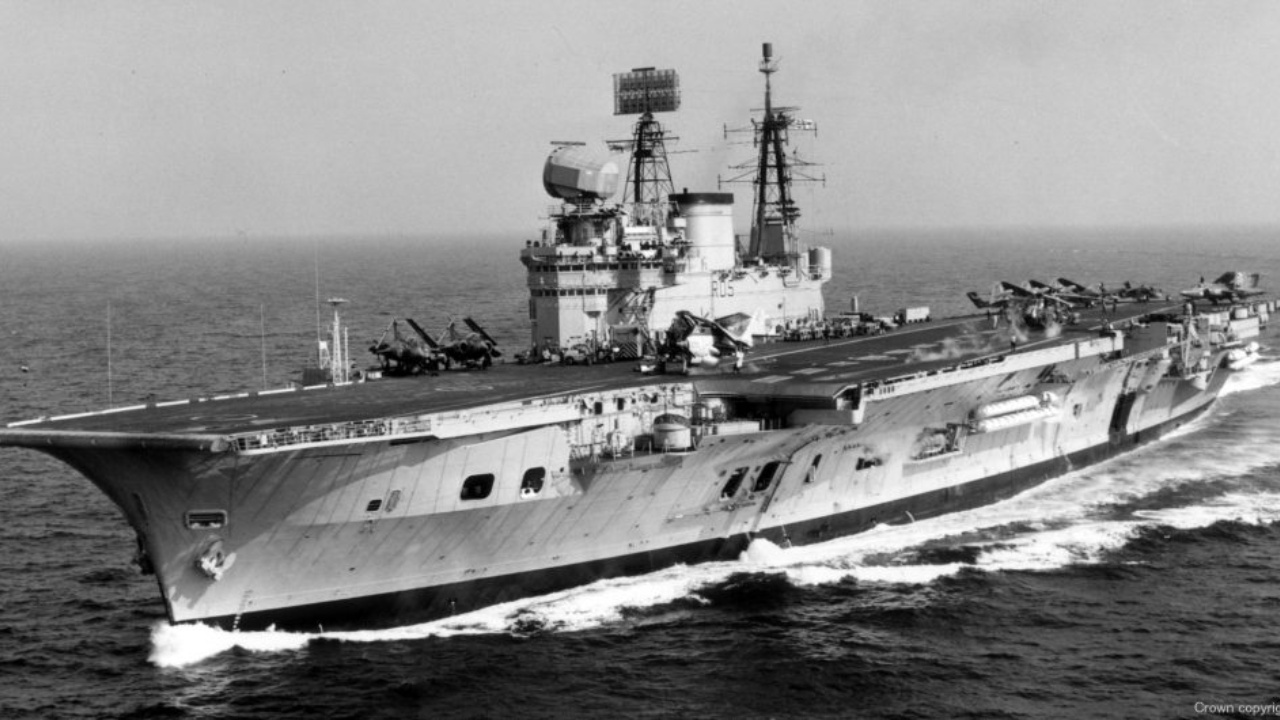
All this power and capacity to carry up to 45 aircraft and 10 helicopters transformed the ship into a historical bridge that connected the engineering learning of World War II to the era of heavy jets in the Cold War.
Only in the 21st century, with the introduction of the modern Queen Elizabeth-class ships, did the Royal Navy once again have aircraft carriers in its fleet with size and strategic capabilities superior to those of the Eagle and the Ark Royal.
Financial Crisis and Political Decisions in the United Kingdom
The retirement of the vessel was dictated by strong budgetary pressures and strategic reviews that divided opinions in London throughout the 1960s.
The British government concluded that maintaining large conventional aircraft carriers generated excessive operational costs for the country’s post-war economic reality.
This line of political thinking affected the fleet’s fate in several ways:
- Cuts to the original program: Of the four ships initially planned for the Audacious class in World War II, only two — the HMS Eagle and the HMS Ark Royal — were completed;
- Model replacement: London’s strategic defense bet shifted to nuclear submarines, land bases, and later, smaller Invincible class ships;
- Lack of investments: Although the ship maintained a high military value, its upgrade to fully operate the new generations of jets would require economic resources that the government was not willing to release;
- Future strategic impact: Ten years after its decommissioning, during the Falklands War conflict in 1982, the absence of large ships equipped with catapults and arrestor cables was intensely remembered by experts as a severe loss to British defense power.
The Baptism of Fire and Geopolitical Decline in Suez
The operational peak of the HMS Eagle occurred long before its scrapping, specifically in 1956, during the Suez Crisis.
On that occasion, in Operation Musketeer, the United Kingdom and France carried out an armed intervention in Egypt in response to President Gamal Abdel Nasser’s decision to nationalize the Suez Canal.
The ship served as the main core of the British air task force in the Mediterranean.
From its deck, notable fighters such as Hawker Sea Hawk, de Havilland Sea Venom, Westland Wyvern, and Douglas Skyraider were launched.
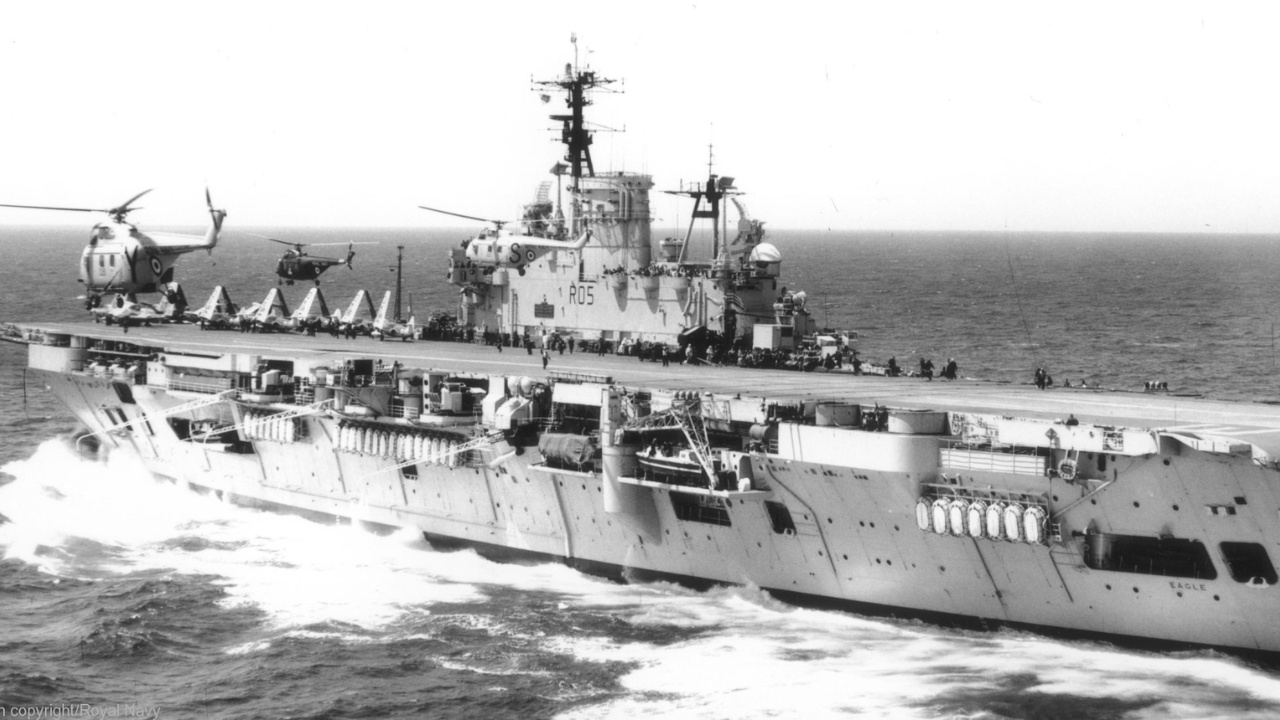
The campaign proved the military importance of projecting power far from home when there are no nearby land bases available.
However, the political outcome in Suez also brought a bitter lesson for the British: the realization that the country no longer had the economic and political margin to act as an independent imperial power on the global chessboard, accelerating a perception of relative decline and consolidating London’s strategic dependence on the United States during the Cold War.
Technical Innovations and the Air Group of HMS Eagle
Despite the political constraints, the ship built by the Harland & Wolff shipyard in Belfast — whose keel was laid on October 24, 1942, and launched by Princess Elizabeth on March 19, 1946 — was the great laboratory of the technical revolution of jet naval aviation.
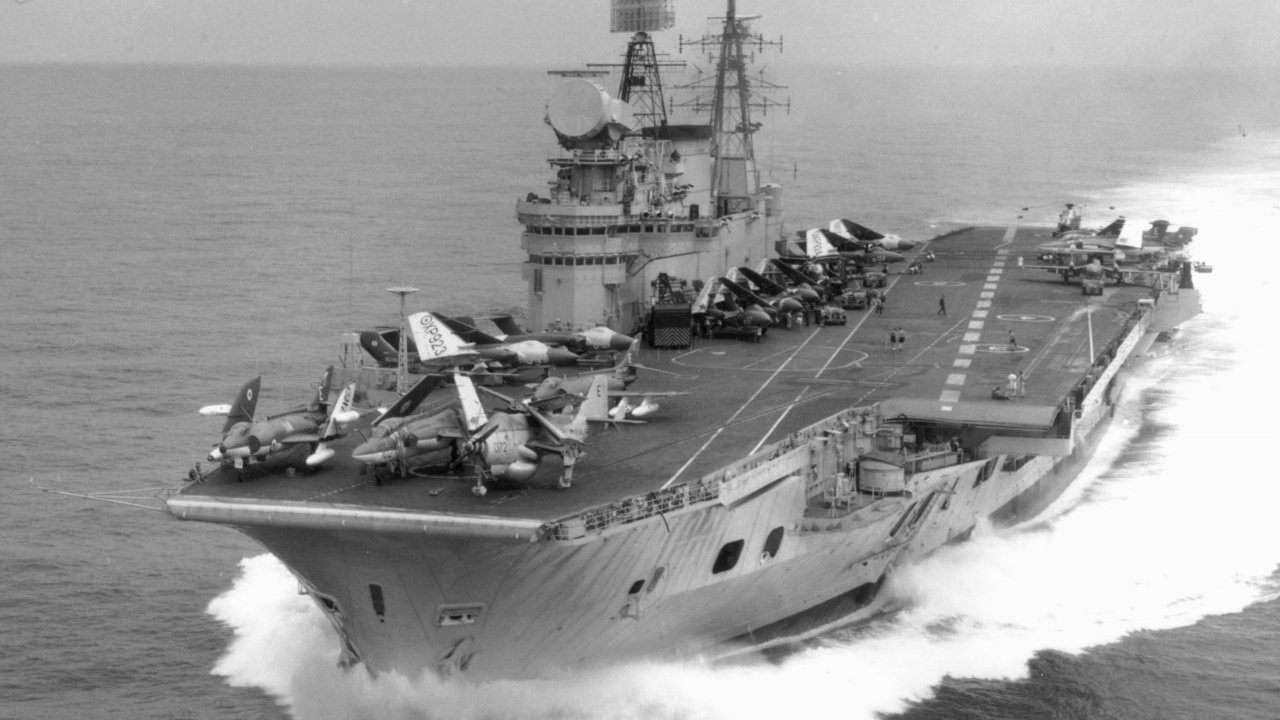
To handle faster and heavier aircraft in the 1960s and 1970s, the aircraft carrier underwent a deep reconstruction in Devonport, receiving modern resources:
- Angled deck: An 8.5-degree diagonal runway that allowed the jet to safely abort if it didn’t catch the arrestor cable, eliminating the risk of collision with aircraft parked ahead;
- Steam catapults: Powerful equipment that provided thrust for jets to take off with a full load of fuel and armament;
- Mirror landing system: Visual technology installed to provide greater accuracy and safety for pilots during landings;
- Type 984 three-dimensional radar: Cutting-edge sensor to guide shooting and monitor the movements of Soviet fleets in NATO missions.
This technological apparatus supported a balanced air group, composed of low-altitude attack aircraft Blackburn Buccaneer, air defense fighters de Havilland Sea Vixen, and the Fairey Gannet AEW, belonging to the 849 Naval Air Squadron and used for early warning. Completing the fleet were the Westland Wessex and Sea King helicopters, focused on anti-submarine warfare and search and rescue missions.
Source: Naval Power


